How to Read Oracle Cards for Beginners
You do not need a gift, a lineage, or a single memorized meaning. You need one card and a good question.
The first time I laid out a card for someone who had never touched a deck, she turned it over, looked at it, and asked, “But what does it mean?” as though there were a right answer I was keeping from her.
There was not.
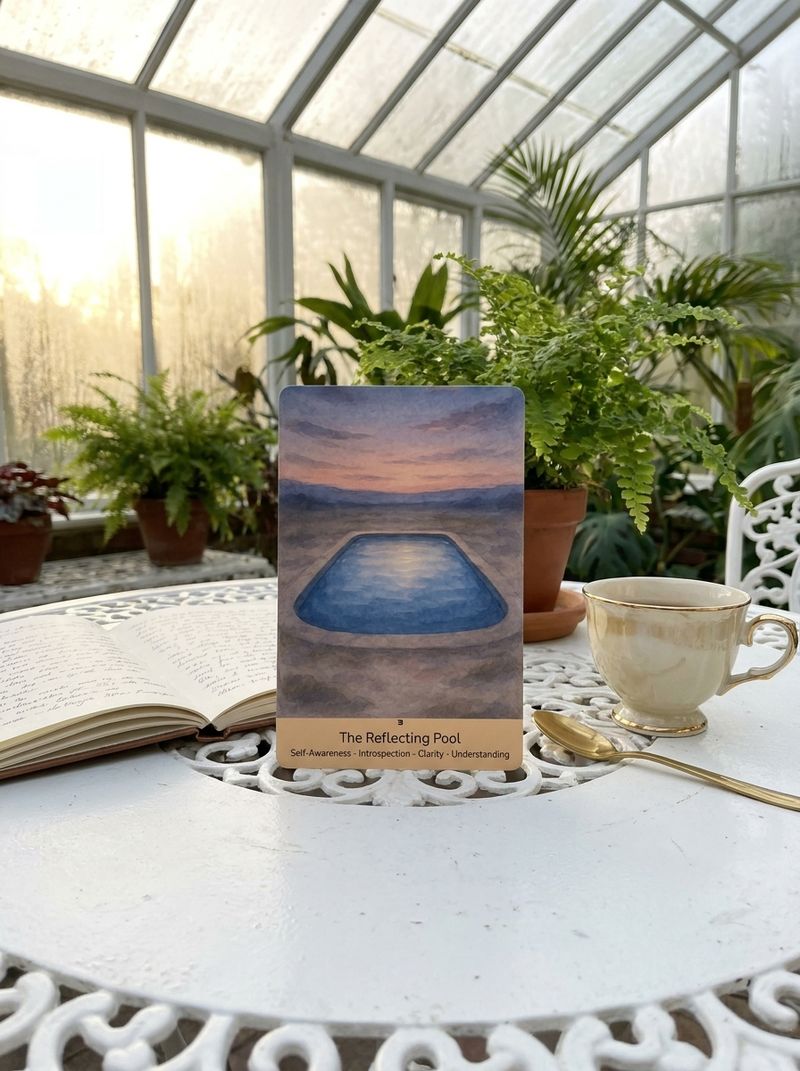
That is the thing nobody tells you at the start: an oracle card does not hand you a fact about your future. It hands you a mirror. What you are learning to read is not only the card. It is yourself, in the light the card happens to throw.
Once that clicks, the fear of “doing it wrong” mostly falls away, and you can begin.
First, what a reading actually is
An oracle deck is a set of images and words built around a theme. You draw a card, sit with it, and let it ask you something. That is the whole mechanic.
The cards I make are what I call mirror decks. Each one offers a question, a pattern, or a phrase, never a prediction. A good reading is not, “This will happen.” It is, “Here is what may be worth my attention right now, and here is a fresh angle from which to see it.”
This reframe matters because it takes the pressure off. You are not performing accuracy. You are having a conversation with a part of yourself that does not usually get the floor. There is no way to fail a conversation you are willing to have honestly.
Start with one card
Forget elaborate layouts for now. The most useful place to begin is with one card, pulled once a day. It is small enough to become a real habit, and it will teach you the deck faster than almost anything else.
Here is the whole ritual. It takes about two minutes:
- Take a breath. Let the day settle for a second. You are simply changing gears, not summoning anything.
- Shuffle until it feels like enough. There is no correct number. When your hands want to stop, stop.
- Draw one card. Taking the top card is fine. Fanning the deck out and choosing the one that catches your attention is also fine.
- Turn it over and look before you read a single word. The picture usually speaks first.
That is a complete reading. You do not need more than this for weeks, or ever, if one card gives you what you need.
Ask a better question
The quality of a reading rises and falls on the question you bring to it.
The trap many beginners fall into is asking closed, yes-or-no, fortune-shaped questions:
“Will they call me?”
“Is this the right job?”
Questions like these push the card toward prediction. Trying to force a definite answer from it is where readings can begin to feel like guesswork.
Open questions turn the card into a reflective tool. Try these instead:
- What wants my attention today?
- What am I not seeing about this?
- Where is my energy actually going right now?
- What would help me meet this week with a little more steadiness?
Notice that each question keeps the agency with you. The card is not deciding anything. It is widening the frame so you can decide with greater clarity.
Read the card in three passes
When you turn a card over, resist the urge to go straight to the guidebook. Read it in three passes instead, moving from the image to the words and then to your own life.
This is the core skill, and it is very learnable.
Pass one: the image
Before reading any keywords, simply notice.
What draws your eye first? What is the mood: warm or heavy, open or closed? What is the figure doing, or refusing to do?
Your first reaction is useful information, so catch it before you talk yourself out of it.
Pass two: the words
Now read the card’s name, its keywords, and the guidebook entry, if the deck includes one. Let the words confirm, complicate, or gently correct your first impression.
You are not being handed the answer. You are being offered another perspective.
Pass three: your life
This is the pass that turns a beautiful card into an actual reading.
Ask yourself: Where is this already true for me?
A card about rest lands very differently on a day when you are exhausted than it does on a day when you are restless. The meaning lives in the overlap between the card and your real situation, never in the card alone.
When the meaning does not land
Some cards click instantly. Others sit there like a stranger at a party. That is normal, and it is not a sign that you are bad at this.
A few things can help:
Sit with the mismatch. If a card feels unrelated to what you need, pause before dismissing it. The friction may point toward a thread worth exploring.
Say it out loud or write it down. A meaning that feels foggy in your head often becomes clearer when you have to put it into a sentence. This is why so many readers keep a journal beside the deck.
Let it be a question you carry, not an answer you close. You are allowed to walk away thinking, “I am not sure yet, but I will watch for this today.” The card may make more sense by evening.
Trust your response alongside the guidebook. The book is a starting point, not a verdict. If the card brings up something the guidebook does not mention, you are not necessarily reading it incorrectly. You are noticing what the image and words stir in you.
When you are ready for more than one card
Once a daily single-card pull feels natural, a small spread can give you a story instead of a snapshot.
A spread is simply a set of positions in which each card answers a different question. The cards are then read both individually and in relation to one another.
Start with three. Here is a simple, non-predictive spread I love for beginners:
Card one: Where I am
The honest picture of the situation right now.
Card two: What is in the way
The pattern, fear, assumption, or habit sitting between you and where you want to be.
Card three: What is ready to shift
Not a prophecy, but a change, choice, or next step that may already be available to you.
Read each card using the three passes. Then read the spread across as a sentence:
“Right now I am here. This is what may be getting in the way, and this is what I could begin to lean into.”
Notice that the spread never tells you what will happen. It shows you where you are standing and helps you see the next step. That is what a reflective spread is designed to do.
The one habit that makes you better
If you take one thing from this practice, let it be this: keep a thread.
Place a cheap notebook beside your deck. Write one line each day with the name of the card and what it stirred up.
Within a month, you may begin to notice the same cards returning around the same real-life knots. Seeing those patterns in your own handwriting will teach you more about reading than memorizing a list of meanings ever could.
For a gentle structure, read my guide to journaling with an oracle deck. If you are still deciding whether this practice is for you, my introduction to what an oracle deck actually is is a good place to start.
Mostly, though, you learn to read by reading.
Pull a card tomorrow morning. Ask what wants your attention. Look before you read.
You already know how to do the rest.
Zara