Yule Correspondences: A Winter Solstice Cheat Sheet for the Modern Hearth
A working list of Yule correspondences for the winter solstice: the colors, greens, woods, stones, and foods people reach for, what is genuinely old, what is modern, and what to actually do with any of it.
My first solstice, I wrote the list on an index card and taped it inside a cupboard door. Red, green, gold. Pine, holly, ivy. Oak, apple, clove. I had copied it out of three different books that did not agree with each other, and I remember thinking that somebody, somewhere, must have the correct version.
Nobody does. That was the useful discovery.
The index card survived four moves anyway, because a short list taped where you can see it turns out to be more useful than a shelf of books you do not open in December. This post is that card, rewritten, with the sources sorted out.
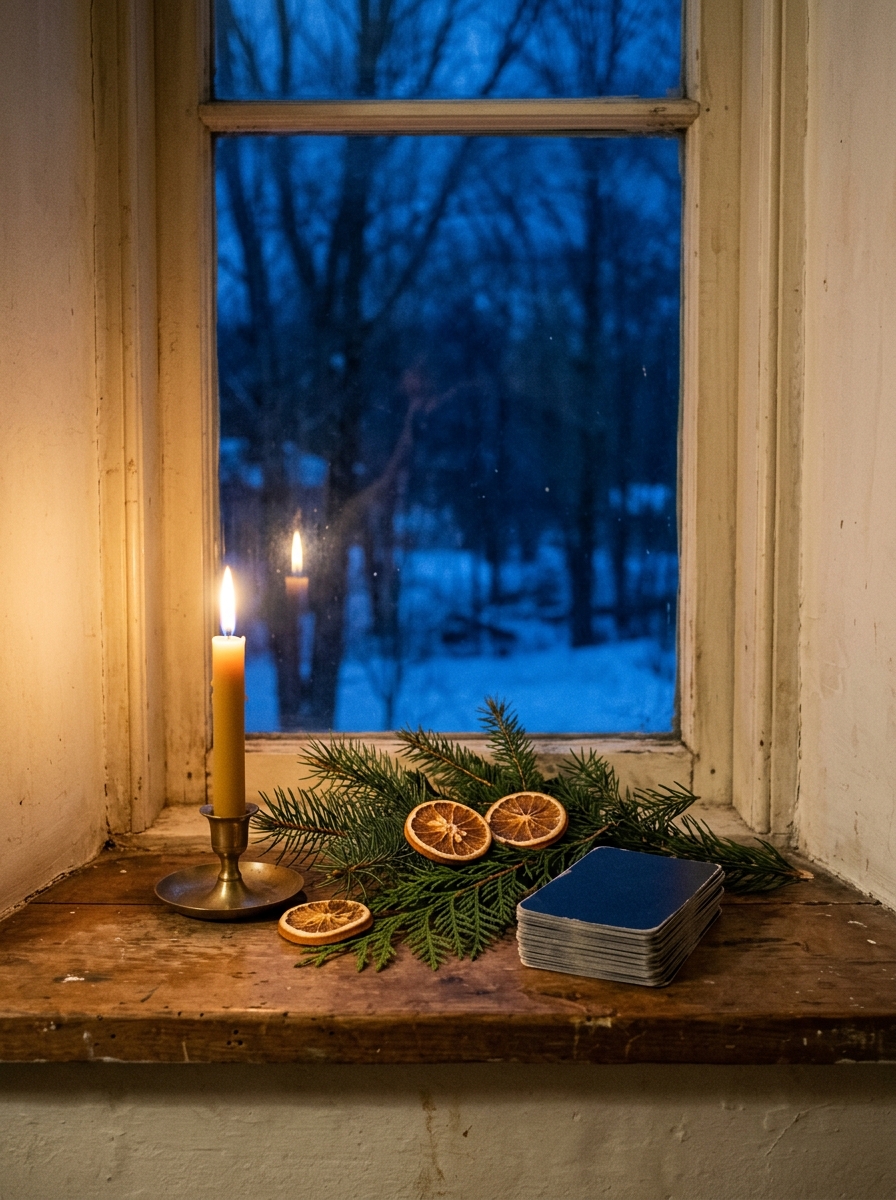
What Is Yule?
Yule is a midwinter festival attested in the Germanic and Norse world, surviving in Old Norse as jol and Old English as geol. It sat in the dead middle of winter, and in medieval Icelandic sources it is a feast: drinking, meat, oath-making, and light in the darkest stretch of the year.
The word outlived the festival. It rolled into Christmas and stayed there, which is why English speakers still say Yuletide in December without thinking about where it came from.
Modern Yule, the one most people mean when they search for it now, is observed at the winter solstice around December 21. It is the longest night of the year in the northern hemisphere, and the point after which the light starts coming back.
That last part matters more than any list below. Yule is not a festival about darkness. It is a festival held in darkness, about the turn.
Before the Cheat Sheet: What Is Old and What Is Not
I want to be straight about this, because the tidy version circulates faster than the honest one.
The festival is old. Evergreens carried indoors at midwinter are old and widely documented across Europe. The Yule log is a genuine European custom with a long paper trail, even if its origins are argued over. Wassailing the orchard is real, though it sits closer to the new year than to the solstice itself.
The correspondence table itself is modern. Neat lists pairing a color with a stone with a herb with an intention are largely a twentieth century development, assembled in the ceremonial and Wiccan revival and expanded ever since. They are not a recovered ancient system.
That does not make them worthless. It makes them a vocabulary rather than a rulebook. A vocabulary is genuinely useful: it gives you a shorthand for the season and something to do with your hands. It just will not do anything on its own, and no book has the authoritative version because there is not one.
Use the list below the way you would use a recipe you intend to change.
The Yule Correspondences Cheat Sheet
This is the whole card. Screenshot it, print it, tuck it in a deck box or tape it inside a cupboard door where you will actually see it in December.
Colors
- Deep green. The evergreen that did not die. Continuance.
- Red. Holly berries, winter apples, blood warmth. Life kept going.
- Gold and white. Returning light, low sun, snow glare.
- Black and deep blue. The long night itself, which the other colors are answering.
Greens and Herbs
- Pine, fir, spruce. The standard midwinter greens. Scent, needles, presence.
- Holly. Sharp, berried, deeply associated with the season in British folk custom.
- Ivy. Holly’s traditional pair in carol and custom.
- Mistletoe. Recorded by Pliny in a druidic context, and carrying a great deal of later legend on top of that thin classical mention.
- Rosemary, bay, cinnamon, clove, orange peel. The warm kitchen end of the list. These are the ones you already own.
Woods and Incense
- Oak. The Yule log wood in most accounts. Endurance and the turning year.
- Ash and birch. Regional alternatives depending on what actually grew nearby.
- Frankincense and pine resin. Midwinter smoke, if you burn anything at all.
Stones
- Garnet and ruby. Held for the red end of the palette.
- Clear quartz. Held for light and ice.
- Bloodstone and jet. The darker, heavier register of the season.
Stones are the most purely modern entry on this sheet. Treat them as a color and texture vocabulary and you will not go wrong.
Food and Drink
- Apples and pears. Storage fruit, what was still good in December.
- Nuts. Kept, cracked, shared.
- Spiced cider or mulled wine. Warm, shared, slow.
- Anything long-cooked. The point is the hours, not the dish.
Themes to Work With
- Rest you choose rather than collapse into
- Endurance, and what has kept its leaves
- Return, and what you want the returning light to find you doing
- Hospitality, warmth, and the table
How to Actually Use the Cheat Sheet
A correspondence list is inert until it is attached to an evening. Three ways to attach it, in rising order of effort.
Pick Three, Not Thirty
Choose one color, one green, one food. That is a complete winter solstice celebration. A red candle, a cut branch of pine on the table, and a pan of cider on the stove will change a room more than a full altar assembled at speed and resented by nine o’clock.
I say this every season and I will keep saying it: the fastest way to ruin a solstice evening is to turn it into a checklist.
Build a Small Solstice Altar
A windowsill is enough. One green thing, one red thing, one light, and one written line about what you want to carry into the coming year. If you want the longer walkthrough, my altar starter kit covers the basics without the shopping list.
Leave it up until the light noticeably changes. That is usually later than you expect.
Sit the Longest Night Out
The simplest practice on this page. Turn every light off. Sit in the dark for longer than is comfortable, the way you would on the other side of the year at Samhain. Then light one candle and let it be the only light until you go to bed.
The dark part is not the preamble. It is the practice. The candle only means something because of what came before it.
Yule Crafts Worth the Evening
Most Yule crafts are an excuse to handle the season with your hands for an hour, which is a perfectly good reason to do them.
- Dried orange slices. Low oven, several hours, the whole house smells like December. Then string them.
- An evergreen bundle for the door. Three cuttings and garden twine. No wreath frame, no wire, no florist.
- A pomander. An orange and a box of cloves. Deeply old, genuinely tedious, worth doing once.
- A rolled beeswax candle. Ten minutes, and you get to light something you made on the longest night.
Choose one. The craft is not the point; the hour with your hands busy while it gets dark at four in the afternoon is the point.
Cards at the Solstice
Many of the old midwinter divination customs were games as much as anything: apple peels, nuts in the fire, names drawn for the year ahead. They were played for the turn of the year, and they were played out loud, at a table, with other people.
I do not read that way, and the oracle decks I make are not built to predict anything. They hand you a question, a pattern, or a phrase, and then the work is yours.
What suits the solstice is a page with two halves, written by candlelight:
What I am setting down before the light returns
What I want the returning light to find me doing
Pull one card for each side if a blank page is hard. Journaling with an oracle deck goes further into that method if you want the longer version.
Giving an Oracle Deck as a Gift
December is the one month of the year I get asked this directly, so here is the honest answer: oracle cards and tarot cards are not interchangeable, and giving the wrong one is the most common way this gift misses.
Tarot decks run on a fixed structure of seventy-eight cards with established meanings. There is a real learning curve, and for someone who has not asked for that, a tarot deck can sit in a drawer out of politeness. Oracle cards have no fixed system. Each deck sets its own size, its own language, and its own subject, so a person can open one and use it the same evening.
If you are buying for someone who has never used either, an oracle deck is the safer gift. A few things worth checking before you do:
- Does the subject actually sound like them? A deck about hearth and land reads very differently from one about the nervous system. The subject matters far more than the art.
- Is there a real guidebook? A deck without one is a set of pictures. The book is where the deck teaches.
- Would they want to be seen using it? This is a genuine consideration. Some people want something quiet on a bedside table, not a statement on a coffee table.
- Can they try the feel of it first? If they can, the gift stops being a gamble.
That last one is easy to arrange. Send them a free three-card reading and let them meet a deck before it arrives wrapped. If you would rather browse by subject than by cover, the collections are grouped that way on purpose.
Happy Winter Solstice
Pick three things off the sheet. One color, one green, one warm thing on the stove.
For the folk-practice end of the year, the deck I keep on the table through the dark half is the Hearth & Hedge Oracle. It is built around hearth, land, threshold, and witness, which is most of what this night is about.
The year turns whether or not you mark it. Marking it is just a way of being present for the hinge instead of finding out in February that the light came back without you.
Zara