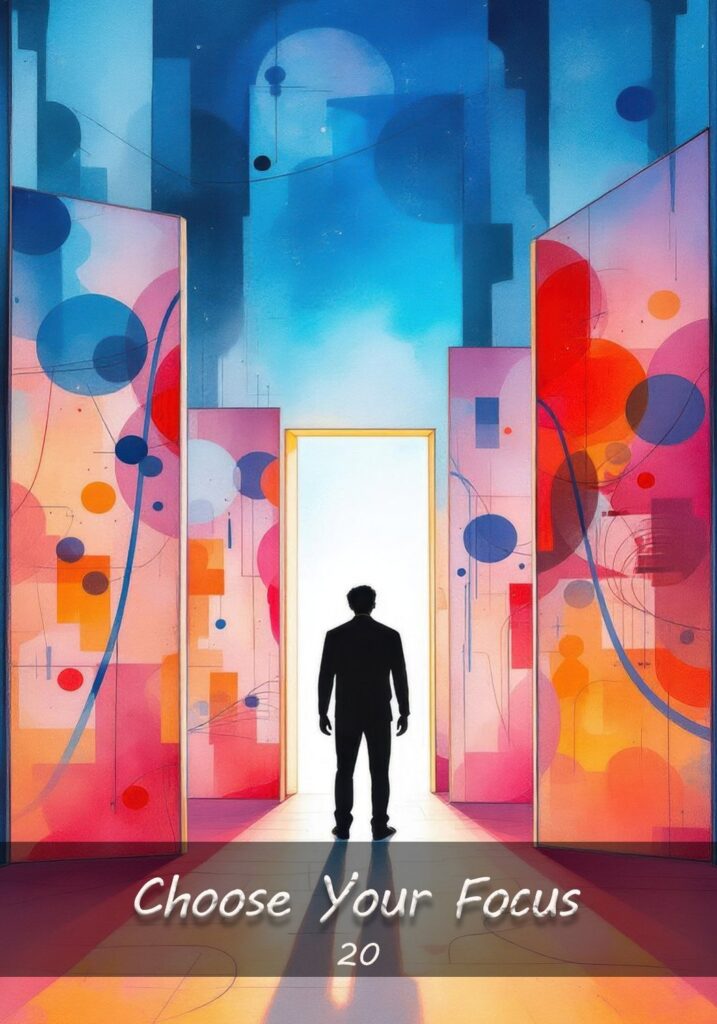
What Choose Your Focus means
To overcome temptation and distractions, be disciplined about what you allow in your mind and environment. Where focus goes, energy flows. Close the door to negativity and open the door to positivity. Mindful awareness requires disciplined attention, directing energy toward solutions rather than unhelpful stimuli.
People reach Choose Your Focus at moments when they know exactly what is pulling at them and have not yet decided to do anything about it. The phone that ends up in the hand at every pause. The news feed checked before getting out of bed. Each pull is small enough to excuse, and together they set the direction of the day. The card's real subject is authorship. On the face, a figure walks between tall colored panels toward a single lit doorway. The panels are bright, and they are not the destination. The card asks who is deciding what gets attention: the person, or whatever happened to be loudest that morning.
Where it goes wrong is discipline about attention hardening into a filter against anything unwelcome. A person can decide that every hard conversation, every worried friend, every piece of bad news counts as negativity, and close the door on all of it. That narrows the view without choosing anything. Some uncomfortable things deserve attention precisely because they are uncomfortable: the strange noise the furnace makes, the coworker who seems off, the letter from the bank. Choosing focus means actually choosing, which includes looking at difficult things on purpose and resting without guilt.
I overcome distractions by choosing my focus with discipline. My energy flows where I direct it.
When Choose Your Focus appears in a reading
With Choose Your Focus, I skip the list of distractions and ask a different question: what would the person look at if those were gone? That answer often takes longer to arrive. I ask whether what they name is something they want or something they think they should want. I also ask about the difference between a distraction and a refuge. Scrolling at midnight can be a habit worth breaking, or it can be the one moment in a hard day that asks nothing of them, so I ask which it is for them, and the card reads differently depending on the answer.
My practice with the card is changing the room before I try to change myself. Willpower is a poor gatekeeper, so I move the doors instead. The apps that pull hardest live on the last screen of my phone. When I sit down to do something that matters, I close every tab that is not part of it and keep a sticky note for whatever I am tempted to look up, so I can look later. If rearranging a whole phone is more than the day allows, I start with one app: I log out of it, so opening it takes a password and a moment of choosing. That pause is usually enough to show me whether I want to go in.
Where I keep Choose Your Focus distinct from Focus Your Energy is the stage of the work. Choose Your Focus is the gate: deciding what gets in. Focus Your Energy is what happens after the gate, gathering what is left into one direction. Beside Release Mental Clutter, I read the pair as clearing and guarding, the birds let out of the cage and then the decision about what comes back in. Beside Listen Before Speaking, the question moves into conversation, and the distraction worth noticing may be the reply a person is drafting while someone else is still talking.
One small mindful act
Unsubscribe from three emails or alerts you never read, and notice whether you feel lighter or oddly reluctant as you press each button.
Choose Your Focus in the Past, Present, Future Spread
The Mindful Awareness Oracle guidebook’s three-card spread is the Past, Present, Future Spread, for seeing a situation in context. Laid left to right, the first card shows what is still shaping it, the second the central theme right now, and the third a potential outcome on the current path, which I read as a direction worth noticing rather than a verdict. In each position this card tends to say:
- The Past. In the Past position, Choose Your Focus may be describing attention shaped by default during an earlier busy stretch, through habits and inputs nobody quite chose; does that setup still hold?
- The Present. In the Present position, the central theme is the gap between what holds the person's attention and what they would pick if asked. Narrowing that gap is the work at hand.
- The Future. In the Future position, the card describes a next stretch of attention directed on purpose, including toward difficult news that deserves a hearing, if the person keeps acting as their own gatekeeper.
Journal prompts
- What are the main temptations or distractions I need to "overcome" in my life right now?
- What does "closing the window that triggers me" mean in a practical sense for one of these distractions?
- Where do I want my energy to flow? What focus would best serve my goals and well-being?