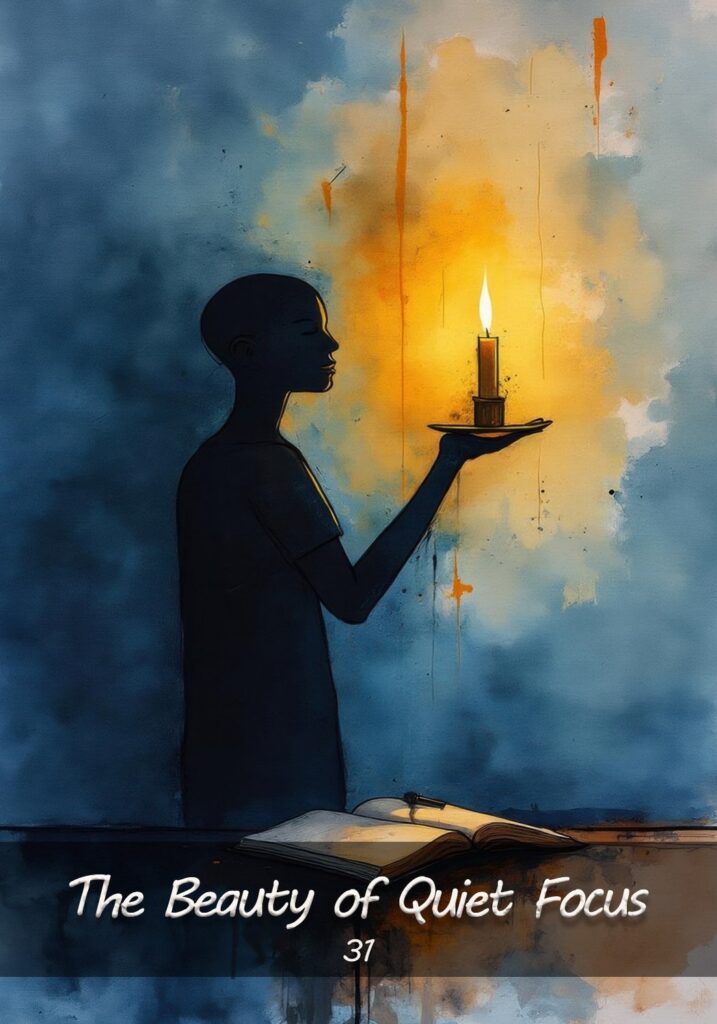
What The Beauty of Quiet Focus means
This card encourages living quietly and doing meaningful work without seeking constant approval. Create silence for deep focus and clear thinking. Minimize distractions. Mindful awareness grows with focus. In noise, silence restores the mind, sharpens thinking, and boosts purposeful work. Quiet focus saves energy for meaningful tasks.
People reach The Beauty of Quiet Focus at moments when work has started to feel like a performance. The draft gets shared before it is finished, the post gets checked every twenty minutes, and three people are asked about an idea that is still half formed. Sometimes that is a way of never being alone with the work long enough to find out what it is. The Beauty of Quiet Focus treats the need for applause as its own kind of noise, as loud as any notification. The face shows a figure holding a single lit candle. A candle lights a small circle and asks to be held steady. It is a good picture of attention: close, warm, limited, and enough for the task at hand.
Where it goes wrong is when quiet turns into hiding. The person retreats into deep focus and never comes out with anything, polishing the same piece for years because sharing it would mean being judged. Not chasing approval is healthy. Refusing every opinion, including the useful ones, is something else, and it can leave good work sitting in a drawer and a person cut off from the people who could help. The card values the candle for the light it gives. If you want the work to reach others, choose a point at which you will share it rather than polishing indefinitely.
I embrace quiet focus and silence's power. I limit distractions, connect with clarity, and work with presence.
When The Beauty of Quiet Focus appears in a reading
With The Beauty of Quiet Focus, I start by asking how many tabs are open right now. I invite the person to describe where their attention went in the last hour, honestly, and then to name one piece of work that has been waiting for a clear stretch that never seems to arrive. Then I ask who they are working for. If someone else's reaction keeps coming up ("my boss is going to think" or "people liked it"), I point that out and ask whether approval is part of the noise, or whether plain interruptions are the bigger problem. Many have some of both, and I let them choose which to look at first.
My practice with this card is a candle and a timer, though a lamp works just as well. When I need to focus, I light it, set the phone face down out of reach, close every window on the screen except the one I need, and work for twenty-five minutes. If twenty-five minutes of silence is too much, I start with ten. If real silence is not possible where I am, I use the same piece of plain background sound every time, so my mind learns it as a signal rather than a distraction. When the timer ends, I blow out the candle and write one sentence about what I did, for no one but myself.
The difference between The Beauty of Quiet Focus and Choose Your Focus is the question being asked. Choose Your Focus is about which door to walk through. This card picks up once you are inside the room and the door is shut. Paired with The Gift of Alone Time, this card reads as solitude put to work, the quiet hours aimed at something the person cares about making. Beside Wisdom in Stillness, the candle is less about producing anything and more about listening, and the next step may be to stop working and simply sit with the problem.
One small mindful act
Spend ten minutes on a piece of work before showing it to anyone, then write down what you think of it before asking for feedback.
The Beauty of Quiet Focus in the Past, Present, Future Spread
The Mindful Awareness Oracle guidebook’s three-card spread is the Past, Present, Future Spread, for seeing a situation in context. Laid left to right, the first card shows what is still shaping it, the second the central theme right now, and the third a potential outcome on the current path, which I read as a direction worth noticing rather than a verdict. In each position this card tends to say:
- The Past. In the Past position, The Beauty of Quiet Focus asks whether a stretch of working in noise, or of needing a reaction before trusting that something was good, still shapes how scattered the work feels.
- The Present. In the Present position, the core of the situation is one piece of meaningful work that needs fewer witnesses and longer stretches of undivided attention than it has been getting.
- The Future. In the Future position, the road ahead looks like a steadier relationship with the work if the noise comes down, with the person deciding for themselves when feedback is useful.
Journal prompts
- What does "living a quiet life" mean to me? Do I desire more of it?
- What distractions should I limit for deeper focus?
- How can I create more silence for focus and productivity?