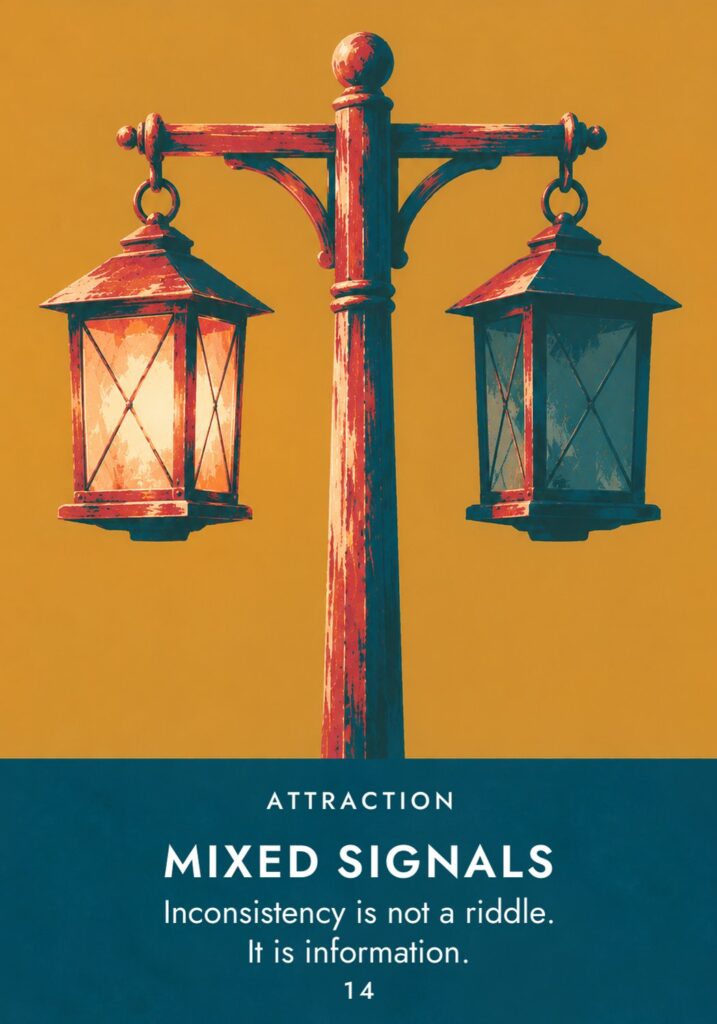
What Mixed Signals means
Warm on Tuesday, gone by Friday, back with a joke on Sunday. The pull of a mixed signal is that it looks like a riddle, and a riddle feels solvable if you read it closely enough. It is not a riddle. Inconsistency is already an answer about where things stand, whatever the private reasons. You do not have to decode it. Decide what you need, say it plainly, and watch what happens. Waiting is yours to end.
Mixed Signals comes up when the person has a spreadsheet. Not a real one, usually. A mental one, with every warm message and every cold week lined up, and a running theory about what the pattern means. The person is tired and sharp and oddly energized, the way people get when they are close to solving something. I read the card as an interruption to the solving. The inconsistency is not a puzzle with a hidden answer underneath. It is the answer, sitting on the surface, and the reason it has not been accepted is that it is not the answer the person wanted. The card does not say why the other person is inconsistent. It says the why is not required.
In shadow, this becomes cracking the code instead of asking, or treating one busy week as betrayal. The code-cracking is a full-time job that feels like intimacy: reading tone, timing, punctuation, the choice of emoji, building a model of someone's inner life out of their texting habits. The model is more consistent than the person, because the person did not help build it. The other failure is the flip side, the person so braced for inconsistency that a single quiet week, a work crisis, a sick parent, gets read as the beginning of the end. Not every gap is a signal. Some are a week.
I can name what I need without solving them first.
When Mixed Signals appears in a reading
My first question with Mixed Signals is whether the person has asked. Not hinted, not tested, not left a door open to see if anyone walks through it. Asked, in words, what this is. The answer is nearly every time no, and the reason is usually that asking might end the ambiguity in the wrong direction. I understand that. I also point out that the ambiguity is already ending them, slowly, one decoded Tuesday at a time. Then I ask what they would need to see, in plain behavior, to call this consistent, and I write that sentence down for them.
The way I work this card for myself is to write the pattern as a stranger would, with no theory attached. "Warm for three days, then quiet for four, repeated six times since August." Just the shape. Then I write the one sentence I would have to say to stop guessing. "I like you and I'd like to know if this is going anywhere." Then, and this is the part that matters, I pick a day. Not "soon." A day. The sentence gets said on that day, or I admit that I prefer the guessing to the answer, which is also information, about me.
Beside Worth Without Proof, I read the pair as a warning that the decoding has turned inward, and that every cold week is being scored as a judgment rather than a fact. Where I keep Mixed Signals distinct from Chase and Retreat is that chase and retreat is a cycle with two participants and a shape you can draw. Mixed signals, as this card means them, are one person's inconsistency observed by another. The person drawing the card is not in the dance yet. They are standing beside it, trying to work out the steps.
One small honest step
Say the sentence that would end the guessing to one person today, even if that person is a friend and not the one you are guessing about, so the words exist outside your head.
Mixed Signals in the You, Me, Us Spread
The Second Question guidebook’s three-card love reading is You, Me, Us, the classic layout with the positions changed so that none of them asks for mind reading. The first card is what I bring, the second is what their behavior has actually shown so far, and the third is what the dynamic needs for its next honest step. In each position this card tends to say:
- What I Bring. As What I Bring, the card says you are carrying a tolerance for ambiguity into this connection that may be costing more than it looks, and a habit of solving where you could be asking.
- What Their Behavior Shows. As What Their Behavior Shows, it asks you to write the inconsistency down as a plain shape, warm then gone then back, and to treat that shape as the information it is, rather than as a riddle with a kinder answer underneath.
- What the Dynamic Needs. As What the Dynamic Needs, it points at one direct question, spoken on a day you choose, as the step that would replace the spreadsheet with an answer.
Journal prompts
- What am I calling a mystery that is really just an answer I did not want?
- What would consistent interest look like, in behavior I could actually see?