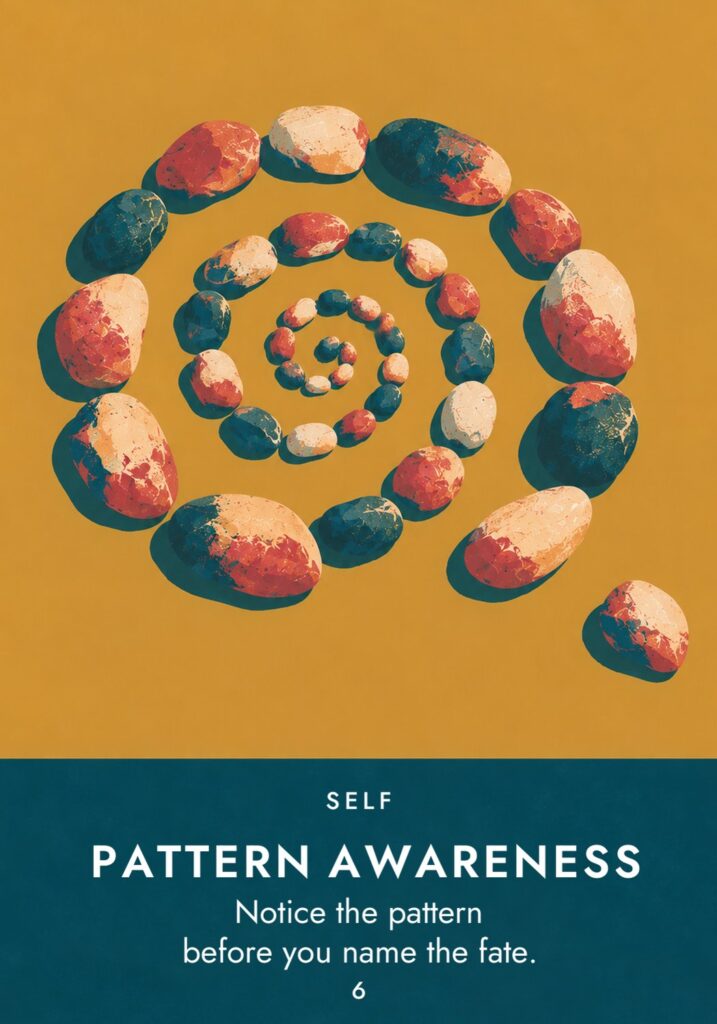
What Pattern Awareness means
Familiarity can feel like meaning, and the research says expectations learned in earlier bonds do shape later ones. It also says attachment is not fixed. Noticing a pattern is not about proving every partner is the same. It is about finding the step where you have a choice. Chasing ambiguity. Retreating when affection becomes real. Overfunctioning to earn love. Describe it the way a mechanic would: trigger, story, feeling, protective move, result.
Pattern Awareness usually shows up for someone who has just said "this always happens to me," and heard it. The third partner who went quiet around month four. The second friend who said the same careful thing about the new person. A breakup that rhymed with the last one so closely it felt like a rerun. I read the card as an invitation to get curious before getting fatalistic. The person is standing at the edge of a conclusion about themselves, and the card asks them to turn the conclusion back into a sequence, step by step, because a sequence has joints in it and a conclusion does not. Somewhere in the joints is a place where a different move was available.
In shadow, this becomes turning a pattern into a diagnosis, or into a curse you must obey. The first version sounds like insight: "I attract unavailable people," said with a sad, knowing smile, as if the matter were settled and the next unavailable person already booked. The curse version is the same sentence with less smile and more dread. Both skip the useful part. A pattern seen clearly has a step in it where the person chose, and both readings erase that step, one by calling it fate and one by calling it character. Either way the person is excused from the one thing in the sequence that was ever theirs.
A pattern is a hypothesis, not a sentence.
When Pattern Awareness appears in a reading
When this card shows up, I ask the person to tell me the story of the most recent repeat, and I stop them at the first verb that was theirs. Not "he pulled away," but what they did in the hour after noticing. Texted twice. Made a joke. Booked a trip to force the question. That is where I slow down. I listen for the protective move, the thing the person does to not feel the thing, and I ask whether that move has appeared in the earlier stories too. It usually has. The partners change. The move is the constant.
My practice with the card is to write the sequence on one line, like a recipe, and then read it backward. Result, protective move, feeling, story, trigger. Reading it backward keeps me from skipping to the moral. Then I pick the one step where a different action was physically possible, not a different feeling, an action, and I write what the smaller version of that action would look like. If the protective move is "go quiet for three days," the smaller version might be "go quiet for one evening and say so." I try the smaller version the next time the trigger comes around. One joint at a time.
Beside Projection Mirror, I read the pair as a question about what the pattern is projecting: the old story being laid over a new face. Where I keep Pattern Awareness distinct from Back Is Not Better is that this card is about a sequence inside me, across several people, and that card is about a sequence inside one relationship. A person can draw this card while single and get a complete reading from it. The partners were never the point.
One small honest step
Describe one recurring situation to a friend in five plain steps, trigger to result, and ask them which step they would have done differently.
Pattern Awareness in the You, Me, Us Spread
The Second Question guidebook’s three-card love reading is You, Me, Us, the classic layout with the positions changed so that none of them asks for mind reading. The first card is what I bring, the second is what their behavior has actually shown so far, and the third is what the dynamic needs for its next honest step. In each position this card tends to say:
- What I Bring. As What I Bring, the card says you are carrying a well-worn sequence into this connection, and the new person is likely to be cast in an old role before they have had a chance to audition for a new one.
- What Their Behavior Shows. As What Their Behavior Shows, it asks you to separate what this particular person has done from what previous people did, since familiarity can make a new behavior look like an old one before the evidence is in.
- What the Dynamic Needs. As What the Dynamic Needs, it points to the one step in the loop where you have a say, and suggests the next honest move is a different action at that joint, however small.
Journal prompts
- What sequence has repeated often enough to deserve my attention?
- Where in that sequence do I actually have a say?