Use this spread when
Family boundaries are hard because the people involved know your soft spots and remember who you were at twelve. I use this spread when I notice the same small thing wearing on me every visit: the hug I do not want, the chore that is somehow mine every year, the question that is never really a question. The spread does not make anyone wrong. It moves me from quietly putting up with it to one clear sentence I can actually say, which is usually the hardest step.
How to lay it
- Hold the question loosely. "What do I keep putting up with at family gatherings?" works better than "How do I make them stop?"
- Shuffle and lay three cards face down, left to right.
- Turn What I Tolerate and write it as a plain fact, one line, no villains.
- Turn What I Need and rewrite the problem as a need you could ask for.
- Turn How to Say It last. Draft one sentence, say it aloud once, and cut anything that sounds like a defense.
What each position means
- 1What I TolerateThe thing you keep putting up with, named without blame.
The first card points at what I have been absorbing. I write it as a fact, not an accusation: this happens, and I go along with it. Naming it without blame matters, because the next two cards are much harder to read if I have already turned the person into a villain.
- 2What I NeedWhat you actually need instead, stated as a need and not a complaint.
The middle card turns the tolerance around. Not what I want them to stop, but what I need: space, a choice, a seat that does not box me in, a turn at the dishes for someone else. A need is something I can ask for. A complaint is something I just keep holding.
- 3How to Say ItOne short sentence that carries the boundary, kindly.
The third card shapes the words. I aim for one sentence I could say in a hallway without rehearsing it for an hour. A kind boundary is still a boundary, and it does not need a speech, a history, or an apology attached. Kindness is the aim, not the condition: the boundary still stands if someone dislikes hearing it.
A worked example with Table of Connection
Here is how the spread reads with three cards from The Table of Connection Oracle. Suppose I am wondering how to handle my uncle, who greets everyone with a long bear hug and a comment, and the three cards are Tactile Truth, Seating Sovereignty, and Generous Boundary.

1 · What I Tolerate
My comfort with touch is mine to set
What I Tolerate is the hug I do not want. The card treats my discomfort as information worth trusting rather than rudeness, which is the permission I needed. It also names the cost of going along with it silently: the hug ends in two seconds and I stay tense for an hour, which is a poor trade for keeping the peace.
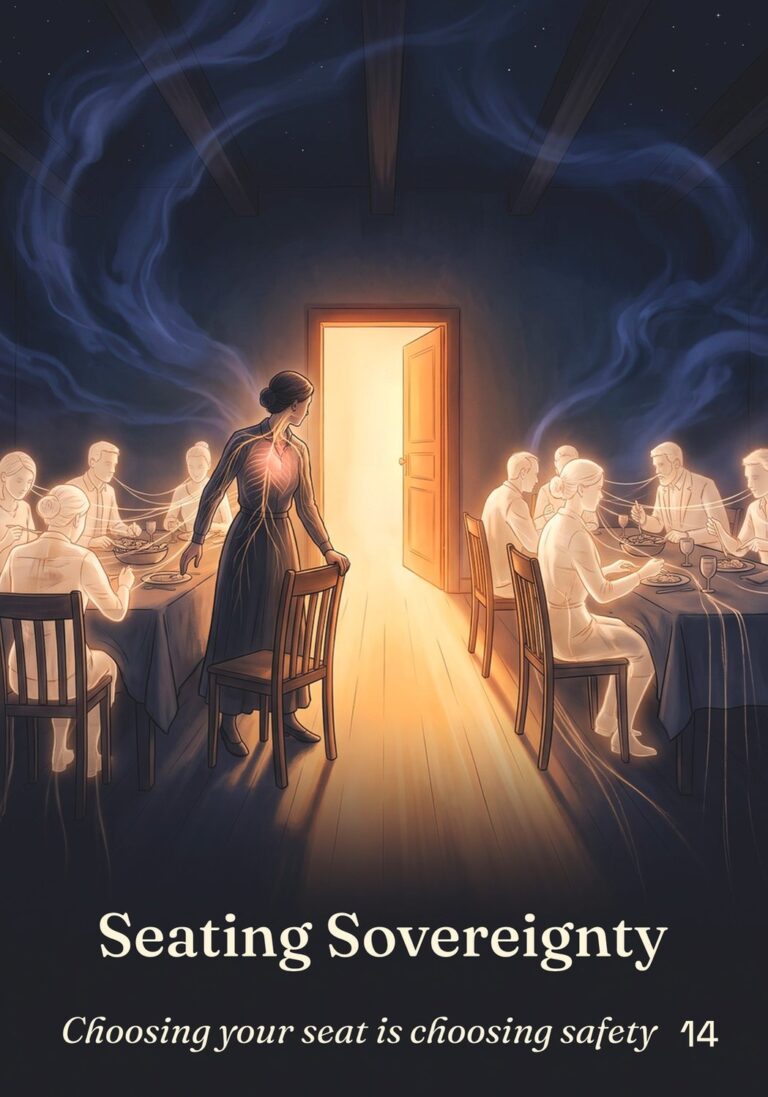
2 · What I Need
Choosing your seat is choosing safety
What I Need turns out to be less about the hug and more about space. I end up beside him at the table every year and feel cornered for three hours. The card says choosing my seat is a reasonable act of care. Its edge is turning the evening into a strategy game, so the need is simple: a seat with room on either side.

3 · How to Say It
A kind boundary is still a boundary
How to Say It gives me the shape: brief, warm, and free of apology. At the door I will offer a wave and a big hello before he reaches me. If he leans in anyway, "I'm more of a wave person, but it is good to see you" is the whole sentence. The card warns against the opposite failure, a boundary delivered with a lecture attached.
Read together
I have been tolerating two things, the hug and the seat, and calling it one bad evening. What I need is a greeting I choose and a place at the table with some room. The sentence is short enough to say at a front door. He may be surprised. That does not mean I have done anything wrong, or that the parts of our relationship I actually like have to change.
If you keep putting up with something at family gatherings and want to say so kindly, lay the three cards now. The reading tool below lays these same three positions with The Table of Connection Oracle.