Use this spread when
I lay this one when a conversation has been running in my head for days and I have already won it several times. The spread is the deck's central sort, and it exists because this work usually goes wrong in one of two directions: everything is their fault, or everything is mine. Three cards keep both honest.
How to lay it
- Hold the question loosely. "What is going on between us?" works better than "Who was right?"
- Before you shuffle, write the event in one sentence a camera would agree with. Keep it beside you.
- Shuffle and lay three cards face down, left to right.
- Turn The Charge and check it against your camera sentence. Then turn Their Half and let it be true, even if it is unflattering to them.
- Turn Your Share last. Read the three together, and notice which column you wanted to leave empty.
What each position means
- 1The ChargeWhat actually happened, named the way a camera would name it, with no interpretation attached.
I write this one as a plain sentence before I turn the card, because by the time I lay a spread the event has been rewritten several times in memory. If the card names something I left out of my version, that is the reading beginning.
- 2Their HalfWhat genuinely belongs to the other person or to the situation. This card exists so you do not talk yourself out of an accurate perception.
The position that keeps me honest in the other direction. Some people really do behave badly, and this card holds their part steady so the third card cannot swallow it.
- 3Your ShareWhat you are adding: the old story, the familiar ache, the meaning that arrived faster than the facts. This is the part you can work.
Not the whole thing. The addition. The meaning that arrived before the facts did, the ache that is older than this person, the reaction that was too large for its cause. This is the only column I can do anything about, and it is nearly always fuller than I expected.
A worked example with Gold in the Dark
Here is how the spread reads with three cards from The Gold in the Dark. Suppose I am wondering why a friend cancelling on me at the last minute, for the third time this season, produced a reply from me so cold that we have not spoken since, and the three cards are The Plain Sentence, The Fire Escape, and The Match and the Barn.

1 · The Charge
Say it without the cushion around it. The cushion was never for them.
The charge, named plainly, is short: she cancelled by text an hour before, and I sent one line back with no warmth in it. The card is about padding, and my version of the event has grown a great deal of it. Two texts are the event.
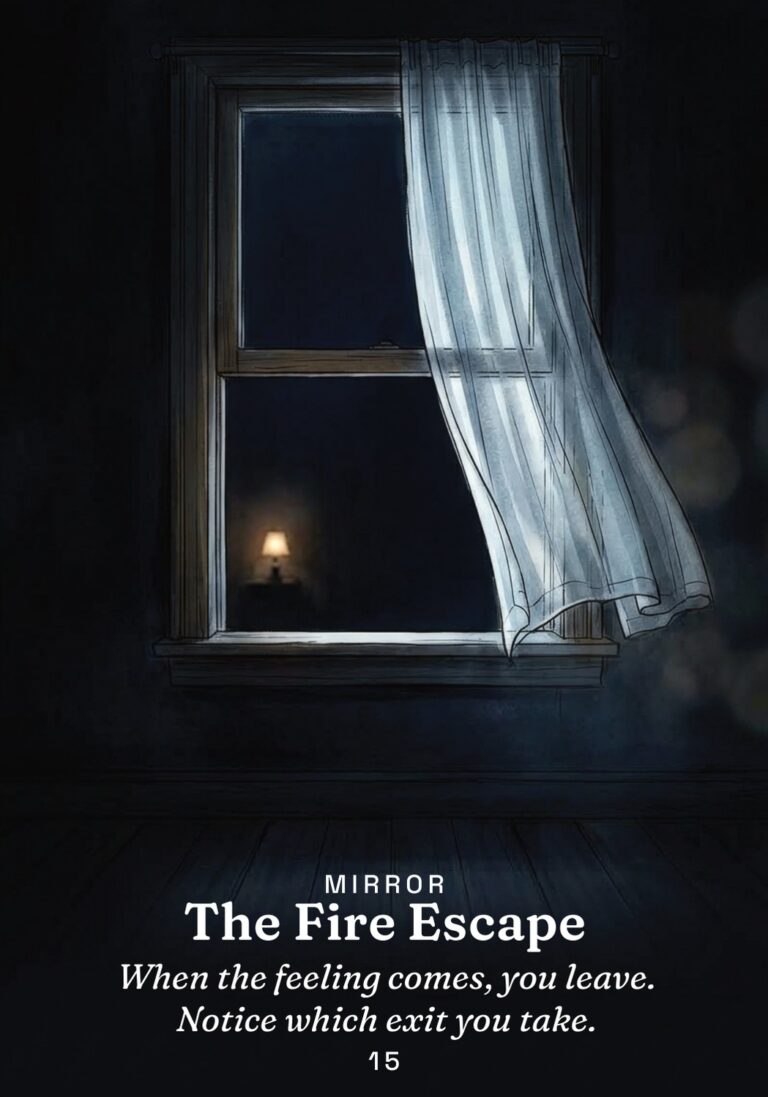
2 · Their Half
When the feeling comes, you leave. Notice which exit you take.
Their half is an exit, and the card is precise about what kind. She leaves when a feeling starts, and she has a fast, well-practiced route for doing it. That is real and it is hers. The card also warns me off adding shame to it on her behalf. She is very good at a door she built a long time ago.

3 · Your Share
The spark was small. The barn was already dry.
My share is the size of the reaction. Three cancellations is a small spark, and the card asks what had been drying out in me while I called the friendship fine. The answer is a spring of feeling like the one who always accommodates, in several relationships at once. She got the fire that belonged to a whole season.
Read together
What happened is two texts. Her half is a habit of leaving, which I can name to her without diagnosing it. My share is a dry barn that predates her by months, and that part is mine to deal with somewhere other than in her inbox. The next move is one warm message that says the cancellations are a problem, and one honest afternoon with the barn.
If you keep arguing with someone in your head, lay the three cards now. The reading tool below lays these same three positions with The Gold in the Dark.