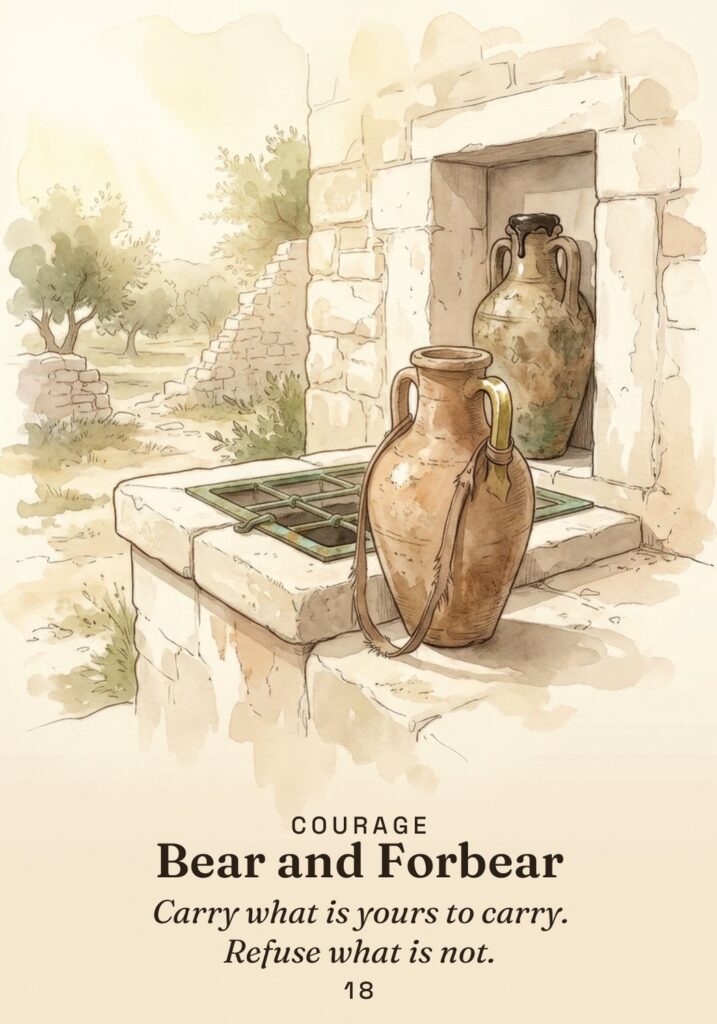
What Bear and Forbear means
Asked to compress the whole philosophy, Epictetus gave two words: bear and forbear (preserved as his fragment in Aulus Gellius). Endure what is yours to endure without theatrics, and refuse what is yours to refuse without apology. Two verbs, one spine. Most hard situations are asking you for exactly one of them, and knowing which one is the day's real question.
The person who draws Bear and Forbear is usually tired and cannot say why, and the reason is often that the two verbs have been swapped. They sit through a meeting where they are spoken over and call it professionalism. They refuse the boring chore that is plainly theirs and call it boundaries. Nothing is landing on the right side. In a reading I treat the card as a sorting of today's weight by one question, and I am less interested in the weight itself than in who has been deciding which verb it gets. Usually it has been habit deciding, or fear, and not the person.
Where it goes wrong is doing both halves with the wrong face. Bearing becomes a performance, the sigh loud enough for the room, the weight narrated to everyone who will listen, which is not endurance but a bid for witnesses. Refusing becomes an essay, three paragraphs of apology around one sentence of no, which invites the negotiation the refusal was meant to end. There are deeper versions. Bearing as martyrdom, where the weight has become an identity. Refusing as reflex, where everything uncomfortable gets declined, including the things that are plainly the person's own to carry. The card wants quiet carrying and clean refusing, and it is strict about both.
I can endure without drama and decline without guilt.
When Bear and Forbear appears in a reading
When this card shows up, I ask the person to name the heaviest thing on them right now and then put one question to it: does carrying this fall within your own judgment, effort, or response, or does it sit on someone else's side of the line? Who handed it over is not the test. A weight can arrive from someone else and still be yours, and a weight you picked up yourself can still be one to set down. The question does not settle every case, but it sorts most of them in under a minute, and the person's face tends to answer before their mouth does.
My practice with the card has two halves. When I am bearing, I try one day without narration: I do not tell the story of the weight to the room, and I notice how much lighter a load gets when it stops being described. One trusted person can still hear it. The experiment is about the audience, not about silence. When I am refusing, I write the sentence, cut every word after the first period, and send what is left. If sending it is too much for today, I say the sentence out loud to an empty room first. The room never objects, and the mouth learns the shape of the words.
Beside The Dichotomy, I read the pair as two sortings, first by ownership and then by verb: what is mine, and of what is mine, which parts are for carrying and which for setting down. Beside Plain Speech, the refusal finds its volume. Where I keep Bear and Forbear distinct from The Leash is the direction of the pull. The Leash is about desire, the wanting that walks you. Bear and Forbear is about burden, the weight you carry or decline. One trains an appetite and the other trains a spine.
One small move on your side of the line
Decline one small request today with a single polite sentence and no explanation, and notice that the room does not fall in.
Bear and Forbear in the Dichotomy Spread
The Stoic Oracle guidebook’s three-card spread is The Dichotomy Spread, for any situation that will not stop churning: a conflict, a waiting game, a decision that circles. Laid left to right, it sorts the situation along the one line the Stoics trusted: what is yours, what is not, and the next right act. In each position this card tends to say:
- What Is Yours. In the What Is Yours position, Bear and Forbear says the choice of verb is yours. Whether this weight gets carried or set down is a decision you make, not a sentence passed on you.
- What Is Not. In the What Is Not position, it names the weight that belongs to someone else's judgment, effort, or outcome. Carrying it has felt like duty, and the card says it was never on your side of the line.
- The Next Right Act. As The Next Right Act, it asks you to pick one thing and do its verb cleanly today: bear it without turning it into a story, or refuse it in one sentence and send it.
Journal prompts
- What am I enduring that I should be refusing?
- What am I refusing that is simply mine to carry?