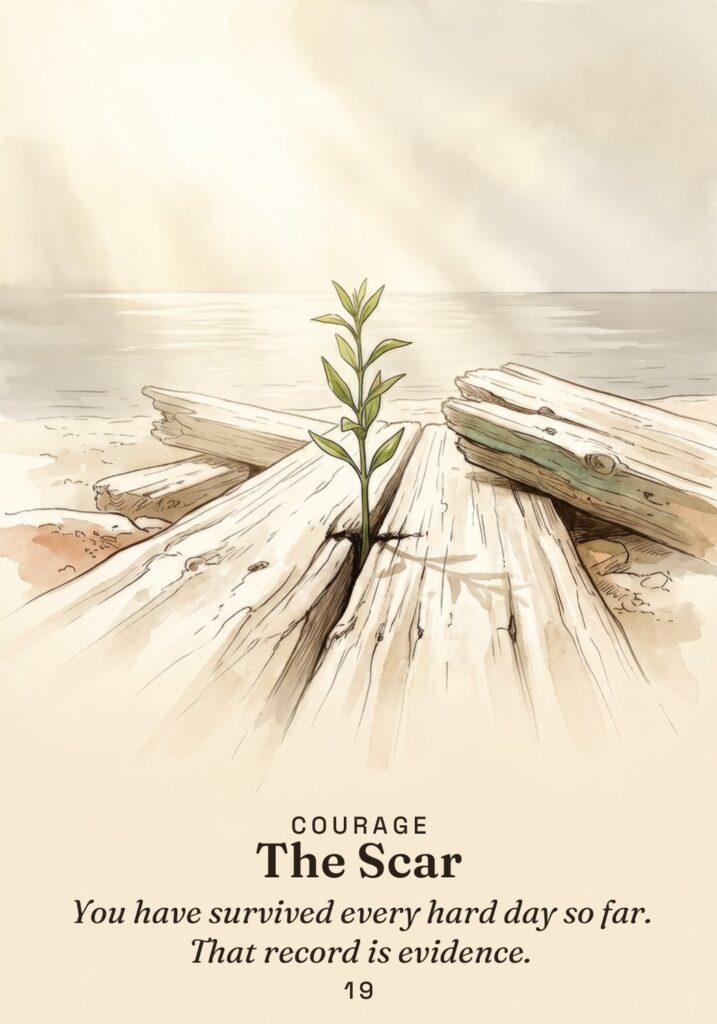
What The Scar means
Zeno lost everything in a shipwreck, wandered into an Athens bookshop, and stayed to found Stoicism. "I made a prosperous voyage when I suffered shipwreck," he said later (Diogenes Laertius 7.5, tr. Hicks). Your record is not the absence of wrecks. It is that you are here, reading, after all of them. That is not luck. That is evidence.
The Scar arrives when a person's confidence has gone quiet, usually in the middle of a crisis that has convinced them they have never handled anything in their life. The present storm has erased the record. In a reading I do not argue with the fear and I do not offer comfort about the outcome. I ask them to look at the ledger. Every hard day they have ever had is in it, and they are at the table reading the cards, which means every one of those days closed. The card is not warm, exactly. It is accurate, and accuracy is what a frightened person can actually use.
Where it goes wrong is turning survival into a boast or a blunt instrument. I have been through worse becomes a way to dismiss the current pain, or a thing said to someone else who is suffering, which is cruelty with a philosophical accent. A second failure is reading the scar as a guarantee: because the last storm passed, this one will pass the same way. The card offers evidence, not a promise, and the difference matters. A third is refusing to count the wrecks at all because surviving them felt like luck. Luck or not, the person is here. The record stands whether or not they feel they earned it.
My survival rate for hard days is, so far, perfect.
When The Scar appears in a reading
When this card shows up, I ask the person for one hard thing from more than five years ago, and then what they would say to the self who was living inside it. They tend to speak to that earlier self kindly, with a patience they are not offering themselves today. I point that out. The kindness is clearly available, since they just produced it, and the reading becomes a question of why it is reserved for the past. The scar is not just evidence of survival. It is evidence of what the person already knows how to do.
My practice with the card is a short list in the back of a notebook: three dates and three sentences, each one a thing that exists in my life because a bad season ended. I read it on bad days, not good ones, because on good days it reads like nostalgia and on bad days it reads like a map. If three feels like too many to write at once, I start with one. One entry is enough to begin the habit, and the second one tends to arrive on its own the next time something hard closes.
Beside The Wrestler, I read the pair as the stance and the record: one card gets up and the other remembers getting up. Beside Amor Fati, the wreck stops being argued with and starts being worked with. Where I keep The Scar distinct from The Rehearsal is the direction of the look. The Rehearsal walks forward into a feared scene. The Scar walks back into a survived one. Both are courage, but one is a map of what might come and the other is a ledger of what already did.
One small move on your side of the line
Write one sentence of thanks to a past version of yourself for a specific hard month, and put it somewhere you will find it by accident.
The Scar in the Dichotomy Spread
The Stoic Oracle guidebook’s three-card spread is The Dichotomy Spread, for any situation that will not stop churning: a conflict, a waiting game, a decision that circles. Laid left to right, it sorts the situation along the one line the Stoics trusted: what is yours, what is not, and the next right act. In each position this card tends to say:
- What Is Yours. In the What Is Yours position, The Scar says the record is yours to read. The storms were not chosen, but the fact that you came through every one of them is a fact about you.
- What Is Not. In the What Is Not position, it names the next storm. Whether it comes and what it brings are outside your control, and the scar does not promise anything about it.
- The Next Right Act. As The Next Right Act, it asks you to write down one thing that exists in your life because a hard season ended, and to keep it where a bad day will find it.
Journal prompts
- Which wreck quietly built my best cargo?
- What do I know about myself only because of what I survived?