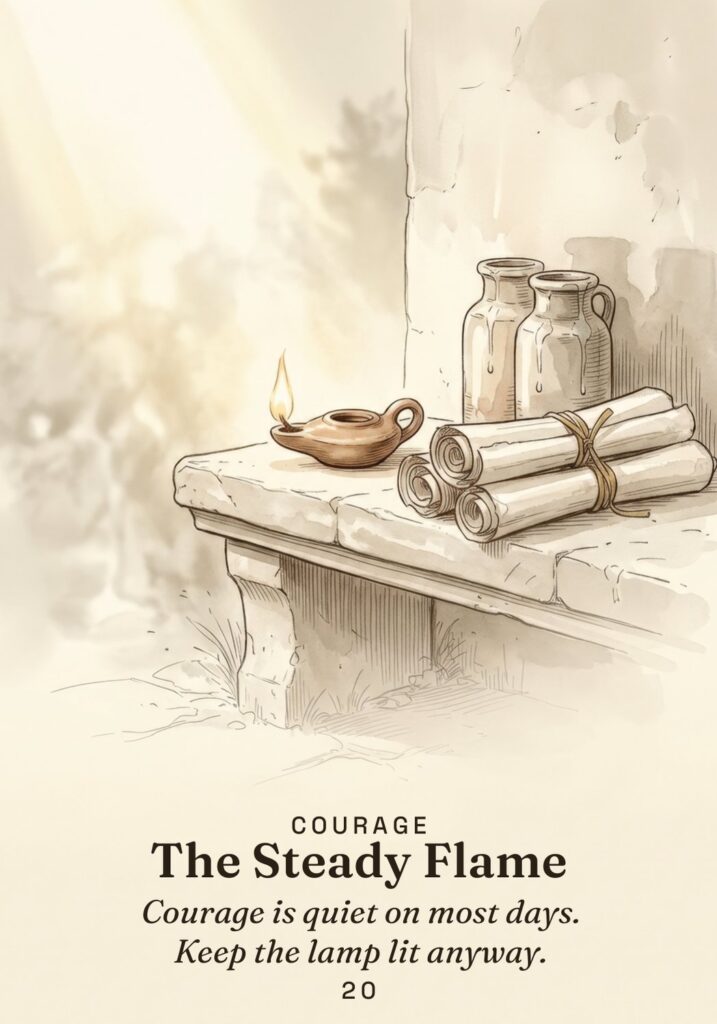
What The Steady Flame means
Cleanthes, who led the Stoa after Zeno, was a boxer who hauled water all night in gardens so he could study philosophy by day, for years, without applause (Diogenes Laertius 7.168). Courage has a loud face and a quiet one, and the quiet one does most of the work: showing up again, unpaid and unseen, for the thing that matters.
The Steady Flame tends to come for the person who is doing the right work and has stopped feeling it count. Nobody has noticed. Nobody will. They are tempted to quit, and when I ask why, the answer is never that it is too hard. It is that it is unseen. In a reading I name the unseen work as courage, out loud, because most people have never heard it called that and the word changes the weight of it. The fatigue does not vanish. But fatigue in the service of something is a different thing from fatigue in the dark, and the card turns on the light.
Where it goes wrong is confusing the steady flame with the grim slog. Some work should have been set down long ago, and calling the refusal to set it down endurance is a way of avoiding a decision. The flame is for the thing that matters, not for every unpaid thing. A second failure is performing the invisibility, dropping hints about how hard and how unseen the work is, so that someone will finally clap, which turns night water into a stage. A third is letting the flame go out in resentment because the applause never came. The card asks for showing up regardless. It does not ask for a grievance kept warm beside the lamp.
I keep showing up when nobody is clapping.
When The Steady Flame appears in a reading
If you draw this card, start with what you do that nobody knows about, and then ask whether you would keep doing it if nobody ever found out. The first answer comes easily. The second one is the reading. If yes, it is a flame, and the work is tending it without an audience. If no, it is a debt, something being paid off in the hope of being seen, and the question becomes what you actually want and who you want it from.
My practice with the card is to name the night water out loud before I start it: "This is the water." Then I do that evening's portion, no more, and I say one sentence when it is done: it happened. Nobody else hears either sentence. That is the point. If the full portion is more than I have on a given night, I do five minutes of it and still say the sentence, because the habit of showing up is the thing being kept lit, and five minutes keeps it lit as surely as an hour.
Beside Little by Little, I read the pair as reps nobody counts: the flame is kept by the same small actions that build any habit, done unseen. Beside The Common Work, the unseen effort finds its reason, since some of what the flame funds belongs to other people. Where I keep The Steady Flame distinct from The Morning Task is the hour. The Morning Task is the first negotiation of the day. The Steady Flame is the long middle, the hundredth evening of the same unglamorous thing, and it is the middle that tests people.
One small move on your side of the line
Thank one person for a piece of invisible work they do that you have benefited from, naming the work specifically enough that they know you saw it.
The Steady Flame in the Dichotomy Spread
The Stoic Oracle guidebook’s three-card spread is The Dichotomy Spread, for any situation that will not stop churning: a conflict, a waiting game, a decision that circles. Laid left to right, it sorts the situation along the one line the Stoics trusted: what is yours, what is not, and the next right act. In each position this card tends to say:
- What Is Yours. In the What Is Yours position, The Steady Flame says the showing up is yours. Whether you do tonight's portion of the unglamorous work is entirely in your hands.
- What Is Not. In the What Is Not position, it names the applause. Whether anyone ever notices, thanks you, or pays you back was never yours to arrange, and the flame does not depend on it.
- The Next Right Act. As The Next Right Act, it asks you to do one portion of the unseen work tonight, on purpose, and to let it be enough that you know it happened.
Journal prompts
- What faithful, invisible effort of mine deserves acknowledgment?
- Where do I quit not from pain but from lack of applause?