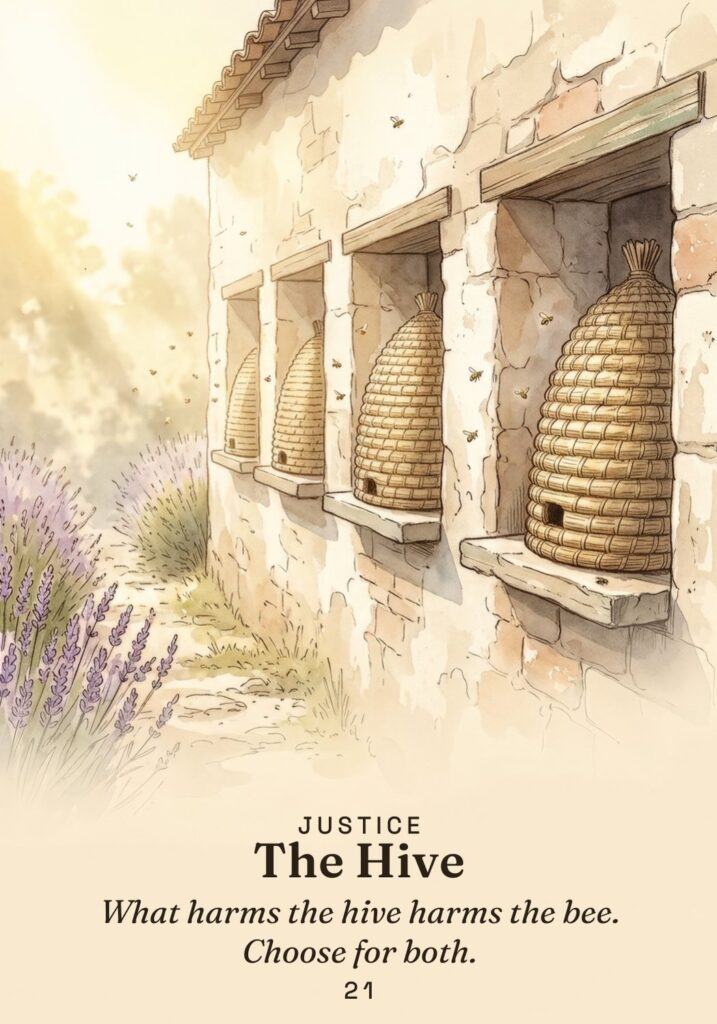
What The Hive means
"That which is not good for the swarm, neither is it good for the bee" (Meditations 6.54, tr. Long). Marcus kept reminding himself that private advantage bought at the group's expense is a bad trade even for the buyer. You live inside families, teams, and towns the way a bee lives inside a hive: your good and theirs are braided together, whether or not today's mood admits it.
In a reading, The Hive tends to arrive when a decision is already half made and the person wants permission for it. A job offer that moves the family, a shortcut at work that a colleague will absorb, a purchase that quietly comes out of a shared pot. The question on the table is rarely whether the thing is allowed. It is who else is standing inside the decision. I read the card as a widening of the frame. The person has been scoring the choice on one line, and the card adds a second line underneath it, with other names on it.
Where it goes wrong is calling a private win a shared one, or the mirror mistake, giving up something real for a hive that never asked for it. The first version tends to dress itself in generous language: the raise that is really for the kids, the move that is really for the marriage, when the kids and the marriage were not consulted. The second version looks nobler and corrodes faster. Someone sacrifices on the group's behalf, keeps a silent ledger, and the resentment comes due years later at a dinner table. The card asks for the two scores to be run honestly and out loud, not for one of them to be hidden.
I make choices my whole hive could live with.
When The Hive appears in a reading
When this card shows up, I ask the person to name the hive. Not in general. Which one, this time? Household, team, friend group, street, the three people who would actually be affected. Most decisions touch one hive hard and the others barely at all, and the fog in the reading usually comes from treating all of them as one swarm. Once the hive has names, I ask a plainer question: have any of them been asked? The silence after that question is often the whole reading.
My practice with the card is a smaller version of the two scores. Before I run the full exercise, I write the decision in one line and put two initials under it: the person it helps most and the person it costs most. If both initials are mine, I look once more for the people who pay indirectly, the ones who absorb my absence or my shortcut without being named, and if nobody turns up I am probably overthinking. If they are different people, I owe the second person a conversation before anything else, and that conversation is the first step, not the scoring. The ten minutes of looking for a version that closes the gap come after that, and they go better once the other person has had a say.
Beside The Common Work, I read the pair as a bill arriving twice: the card asks what is owed, and The Hive asks whom it is owed to. Beside Enough, the question turns inward, because a person who has not settled their own enough will keep taking from the swarm without noticing. Where I keep The Hive distinct from Hands and Eyelids is direction. Hands and Eyelids is about asking for help. The Hive is about who pays for what I take. One is a request and the other is an accounting.
One small move on your side of the line
Before you decide, send the person your choice will cost the most a two-line message that names the decision and asks what it would mean for them.
The Hive in the Dichotomy Spread
The Stoic Oracle guidebook’s three-card spread is The Dichotomy Spread, for any situation that will not stop churning: a conflict, a waiting game, a decision that circles. Laid left to right, it sorts the situation along the one line the Stoics trusted: what is yours, what is not, and the next right act. In each position this card tends to say:
- What Is Yours. In the What Is Yours position, The Hive points at the part of the decision you can actually run both ways: the honest second score, and the willingness to look at it.
- What Is Not. In the What Is Not position, it names what you have been carrying for the group that nobody handed you: the role of the one who pays so no one else has to.
- The Next Right Act. As The Next Right Act, it asks for one conversation with the person your choice lands on hardest, before the choice is final.
Journal prompts
- Where am I winning in a way my hive is quietly paying for?
- Which hive of mine needs tending more than my own lot does?