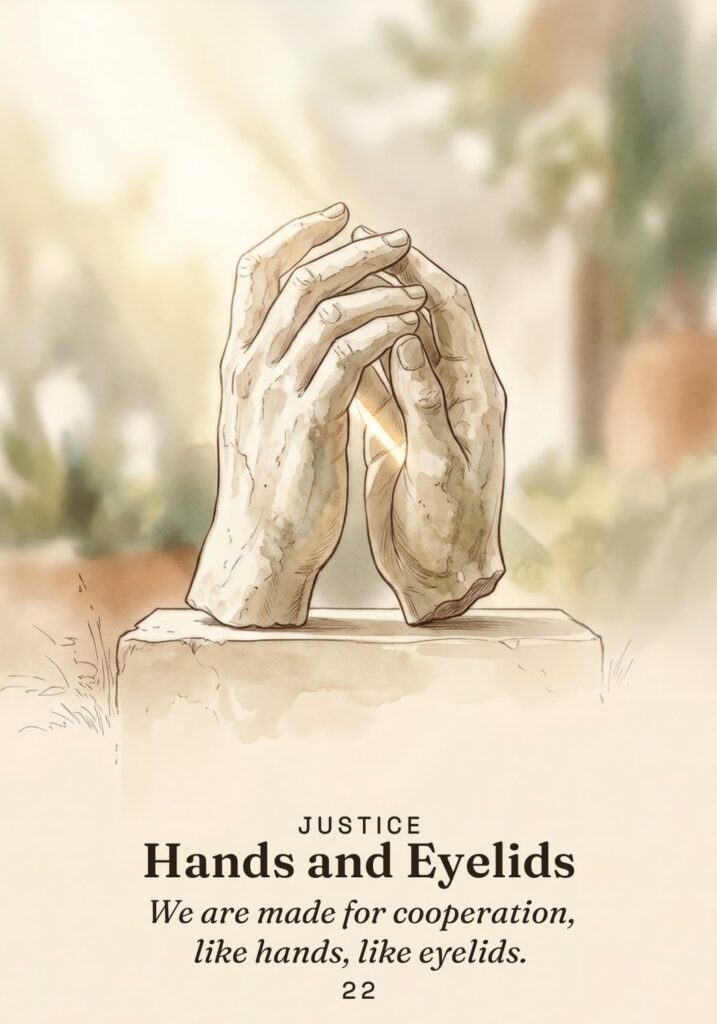
What Hands and Eyelids means
"We are made for co-operation, like feet, like hands, like eyelids, like the rows of the upper and lower teeth," Marcus writes (Meditations 2.1, tr. Long). Working against one another, he concludes, is working against nature. Somewhere in your week is a task you are grinding through alone that was built for two hands, and the second hand is one honest ask away.
Hands and Eyelids rarely points at a dramatic crisis. It points at a Tuesday. The person is behind on something ordinary, has been behind for weeks, and has built a small identity around handling it alone. When I ask what would change if someone took half of it, the answer is often immediate and physical: shoulders drop, a long breath. The card reads the gap between how heavy the thing is and how long it has been carried in silence. The ask has usually been written in the person's head a dozen times. It has not been sent.
Where it goes wrong is treating a request for help as a confession. The person imagines that asking admits something: that they are not coping, not competent, not the one who holds it together. So the ask gets rehearsed and softened and finally dropped, and the task gets finished late, at a cost nobody saw. The other failure is the vague ask, the kind that sounds like a sigh. "If anyone has some time," sent to a group, is not an ask. It is a hope. The card is not satisfied by a hope.
Asking for help is how I was designed to work.
When Hands and Eyelids appears in a reading
The person who draws Hands and Eyelids is usually proud of the exact thing the card is questioning. So I do not open with the help. I open with the task. What is it, how long has it been running, who else could physically do a piece of it? Then I ask the question that tends to land: who would you want to be asked by, if the positions were reversed? Almost everyone has a name. That name is the reading's answer to who, and the rest is wording.
My way of working the card is to shrink the ask until it is embarrassingly small, because a small specific ask gets sent and a large vague one does not. Not "can you help with the move," but "can you take the kitchen boxes Saturday morning." One piece, one person, one sentence. I write it, notice the flinch, and send it before I have edited it a third time. If the first ask is too much, I pick a smaller piece rather than a kinder sentence. The size is what makes it possible.
Beside The Common Work, I read the pair as the two halves of one body: one card gives, the other receives, and a person who draws both is being asked which half has gone unused. Beside The Inner Citadel, the reading often turns out to be about an old rule that asking is weakness, and the citadel card is there to say that rule can be refused. Where I keep Hands and Eyelids distinct from The Widening Circle is that the circle is about who you let in. This card is about what you let them carry.
One small move on your side of the line
Name the one person you would most want to be asked by, and send them a single-piece request today with a day and a time attached.
Hands and Eyelids in the Dichotomy Spread
The Stoic Oracle guidebook’s three-card spread is The Dichotomy Spread, for any situation that will not stop churning: a conflict, a waiting game, a decision that circles. Laid left to right, it sorts the situation along the one line the Stoics trusted: what is yours, what is not, and the next right act. In each position this card tends to say:
- What Is Yours. In the What Is Yours position, Hands and Eyelids points at the sentence you can send and the willingness to be seen needing it.
- What Is Not. In the What Is Not position, it names the other person's yes, their willingness to pick up a piece, which is theirs to give and not yours to assume or to control.
- The Next Right Act. As The Next Right Act, it is one specific ask, to one specific person, sent before it has been polished.
Journal prompts
- Where did I learn that needing others is a failure?
- Who is waiting to be asked, the way I wait to be asked?