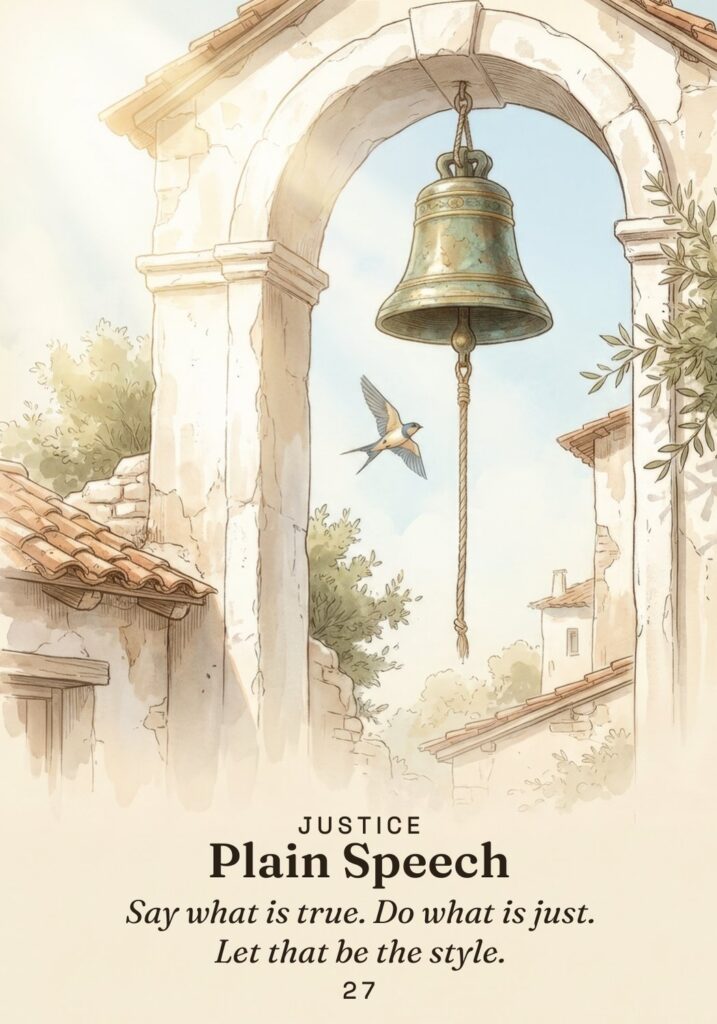
What Plain Speech means
Zeno warned that it is better to stumble with the feet than with the tongue (rendered from Diogenes Laertius 7.26), and he trained his students in fewer, truer words. Speech is action. Every hedge, bit of flattery, and dodge is a small deed with a small consequence, and they compound. The Stoic style is not bluntness for sport. It is saying the true thing at the kind volume.
In a reading, Plain Speech almost never points at a lie. It points at a conversation that has been going in circles, often for months, because the one true sentence at its center has not been said. The person knows the sentence. They have said versions of it, wrapped in so much qualification that the other party could not find it. I read the card as a question about fog. What is the sentence, who does it belong to, and what is the padding protecting? Usually the padding protects the speaker, not the listener.
Where it goes wrong is confusing bluntness for honesty. Some people hear this card as permission to finally say the harsh thing at full volume, and they do, and they call the wreckage candor. That is the tongue stumbling in the other direction. The card asks for the true thing at the kind volume, and the volume is half the instruction. The other failure is quieter: the person finds the true sentence, admires it, and keeps it in a notebook. A true sentence that stays unsaid has not stumbled. It has not walked at all.
I say the true thing at the kind volume.
When Plain Speech appears in a reading
The person who draws Plain Speech usually wants to tell me the whole circular conversation, and I stop them early and ask for the one sentence. Not the context. The sentence. It takes a few tries, because the first versions are still padded: "I just feel like maybe sometimes." I keep asking until it comes out plain, usually something like "I don't want to host this year" or "I need you to stop doing that." Once it is on the table, the reading is mostly about who it belongs to and when it gets delivered.
My practice is to write the center sentence and then strip it twice. First pass removes the hedges: just, maybe, kind of, I feel like. Second pass removes the apology that has attached itself to the front. What is left is usually under fifteen words. Then I decide the volume, which means deciding the setting: in person if I can, by voice if not, and in writing when writing is the safer or clearer way to be heard. If saying the whole thing today is more than I can manage, I say the first half and let it stand. Half a true sentence, delivered, moves more than a whole one rehearsed.
Beside Bear and Forbear, I read the pair as a decision about which verb the sentence serves: is this the thing I am declining, or the thing I am agreeing to carry, said out loud at last. Beside The Other Mind, the reading asks for the listener's reasons to be understood before the sentence is delivered, which changes the volume more than the words. Where I keep Plain Speech distinct from Kindness Unfeigned is that kindness can be silent. Plain speech cannot. It is the card for the thing that has to be said.
One small move on your side of the line
Take the conversation you keep circling and tell the other person, in one unhedged sentence, what you have actually been trying to say, in a setting where you can hear their reply.
Plain Speech in the Dichotomy Spread
The Stoic Oracle guidebook’s three-card spread is The Dichotomy Spread, for any situation that will not stop churning: a conflict, a waiting game, a decision that circles. Laid left to right, it sorts the situation along the one line the Stoics trusted: what is yours, what is not, and the next right act. In each position this card tends to say:
- What Is Yours. In the What Is Yours position, Plain Speech points at the sentence and its volume, both of which you choose, and neither of which the fog chose for you.
- What Is Not. In the What Is Not position, it names the other person's reaction to hearing the truth, which you have been trying to manage with padding and cannot.
- The Next Right Act. As The Next Right Act, it is the stripped sentence, said once, to the one person it belongs to.
Journal prompts
- What true sentence have I been dressing in fog?
- Where does my tongue stumble most: flattery, hedging, or heat?