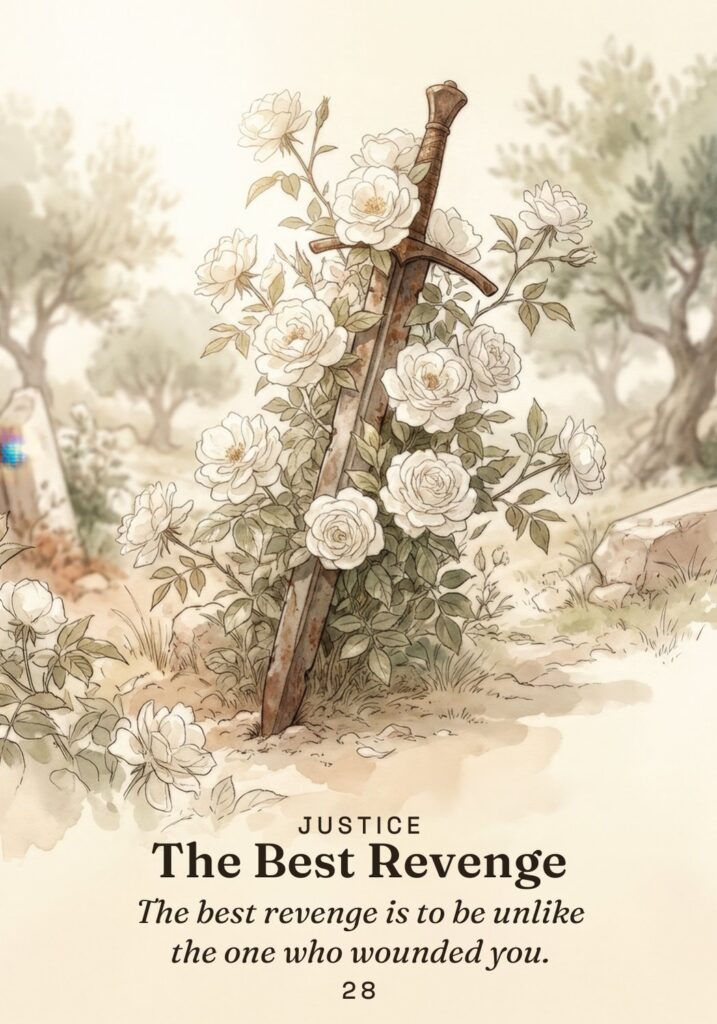
What The Best Revenge means
"The best way of avenging thyself is not to become like the wrongdoer" (Meditations 6.6, tr. Long). Marcus does not pretend you were not wronged. He asks what you will let the wrong turn you into. Bitterness is the injury signing a lease. The clean response is to stay yourself anyway: they showed you their character, and you declined the copy.
The Best Revenge arrives with an injury that is older than the person wants to admit. They say it happened a while ago. When I ask how often they think about it, the answer is daily. The wound itself is rarely the reading's subject. What the card points at is the slow change in the person since: the new suspicion, the sharper tongue, the habit of expecting the worst from everyone who resembles the one who did it. I read the card as a question about authorship. Who is writing your lines now, you or them?
Where it goes wrong is calling the copy self-protection. The person becomes guarded and calls it wisdom, keeps everyone at arm's length and calls all of it boundaries, becomes cruel in small ways and calls it finally standing up for themselves. Some of that may be real growth, and a boundary that keeps a harmful person at a distance is a clean response, not a copy of anyone. Some of it is the injury signing the lease the card warns about, and the difference is hard to see from inside. The other failure is forcing a forgiveness that has not arrived, which is its own kind of copy, a performance aimed at the wrongdoer. The card asks for neither. It asks you to stay yourself.
I will not let an injury author my character.
When The Best Revenge appears in a reading
When this card shows up, I do not ask what was done to the person. I ask what they have started doing since. The list comes slowly and it is honest: snapping at people who did nothing, checking phones, assuming the worst in a tone of voice. Then I ask which items on that list the wrongdoer would recognize as their own. That question lands hard and it is the reading. The injury was real. The imitation is the part that is still open.
My practice with the card is one deliberate act that is the opposite of what the wound is teaching me, done for my own sake and nowhere near the person who caused it. If they were dismissive, I give someone my full attention. If they lied, I tell someone a slightly inconvenient truth. If they were cold, I am warm to a person who cannot pay me back. One act, chosen, finished, unannounced. When even one act feels like more than I have, I write the two columns and stop there for the day, because seeing the second column clearly is already a refusal to sign.
Beside Kindness Unfeigned, I read the pair as the refusal made visible: not becoming them, and then being something real instead. Beside The Scar, the reading tends to turn toward what survived the injury, and what in your life now exists because you came through it. Where I keep The Best Revenge distinct from The Other Mind is that the other mind asks you to understand the wrongdoer. This card does not require that. You can decline the copy without ever understanding why they handed it to you.
One small move on your side of the line
Do one small thing today that is the exact opposite of what the person who hurt you taught you to expect from people, and do it for someone who had nothing to do with it.
The Best Revenge in the Dichotomy Spread
The Stoic Oracle guidebook’s three-card spread is The Dichotomy Spread, for any situation that will not stop churning: a conflict, a waiting game, a decision that circles. Laid left to right, it sorts the situation along the one line the Stoics trusted: what is yours, what is not, and the next right act. In each position this card tends to say:
- What Is Yours. In the What Is Yours position, The Best Revenge points at your character from here forward, which the injury touched but does not get to author.
- What Is Not. In the What Is Not position, it names the wrongdoer's reckoning, their remorse or their comeuppance, which you have been waiting on and cannot schedule.
- The Next Right Act. As The Next Right Act, it is one act that is unlike them, done for your own sake, where they will never see it.
Journal prompts
- Which injury is still writing lines in my script?
- Who wronged me and never became my teacher of bitterness? How?