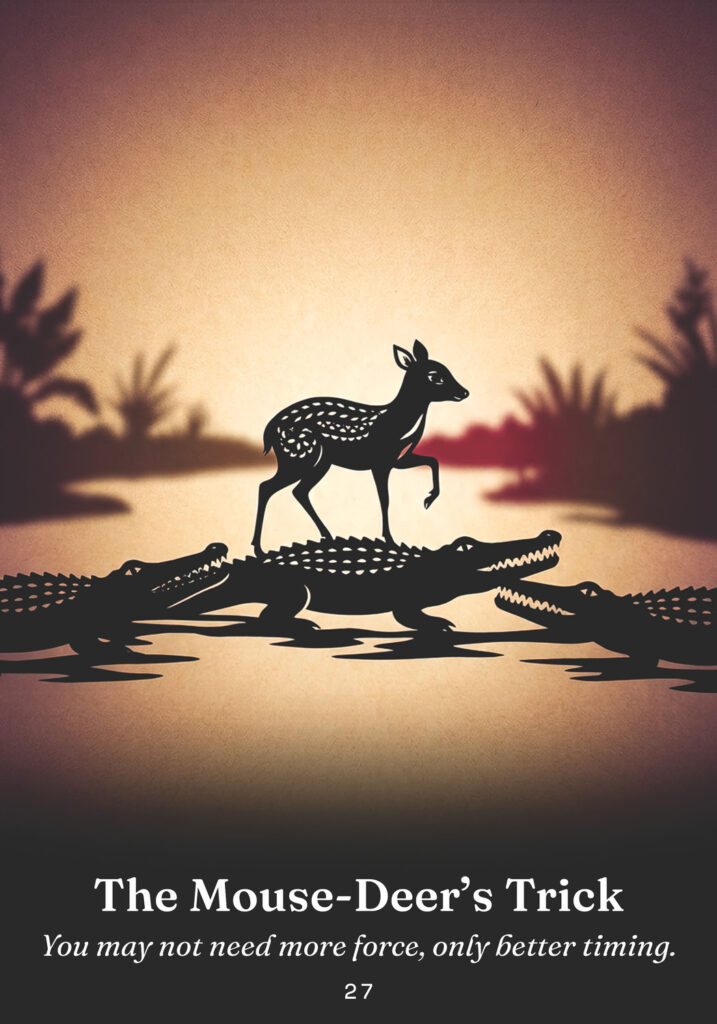
What The Mouse-Deer's Trick means
In Philippine mouse-deer stories, told under names like Pilandok and Pilanduk in different communities, the tiny animal escapes crocodiles and outwits larger beasts through timing, nerve, and a precise sense of what they will believe. You do not need more force. You need better timing and a smaller footprint. Being underestimated is a resource, until you start underestimating everyone else.
The Mouse-Deer's Trick comes when I have been pushing harder against something bigger than me and the pushing has become the whole plan. The card takes force off the table entirely. What it puts there instead is timing, nerve, and a precise sense of what the other side will believe, which is a harder skill and a far cheaper one. Being underestimated is a resource, and the mouse-deer spends it carefully, once, at the moment it is worth the most.
In shadow, the card is lies multiplying faster than the escape route. The first trick was elegant. The second one, needed to cover the first, was less so. By the third the crocodiles are learning. The resource runs out the moment I start doing the underestimating, and the card asks me to watch for that turn.
I use timing and nerve where force would fail.
When The Mouse-Deer's Trick appears in a reading
The Mouse-Deer's Trick appears when effort has become a substitute for a plan. In a reading I ask what the smallest version of the move looks like, and when it would land best. Those two questions have carried me further than any amount of pushing, and they take an afternoon instead of a season.
What I watch for is the assumption sitting under the trick. The crocodiles in these stories are not stupid, they are unhurried, and a slow response is not the same as no response. When a move works the first time I want to believe it was skill. Half the time it was a delay I mistook for a win.
When it lands beside The Backfire, I read the pair as a warning that clever timing can become cleverness for its own sake.
One small sideways move
Find the one place you are pushing by force and replace the push with a pause.
The Mouse-Deer's Trick in the Crossroads Spread
The Trickster Oracle guidebook’s three-card Crossroads Spread does not find the correct road. It exposes the structure of the choice: the threshold that is actually present, the route you overlooked, and the cost you have not counted. In each position this card tends to say:
- The Threshold. The threshold is a larger opponent. Force will not carry you across.
- The Unexpected Route. The route is timing, nerve, and a smaller footprint. Being underestimated is the opening.
- The Hidden Cost. The cost is the second lie required to cover the first. Escape routes narrow quickly.
Journal prompts
- Where am I trying to win by force?
- What does the larger party believe that I could use with a clear conscience?