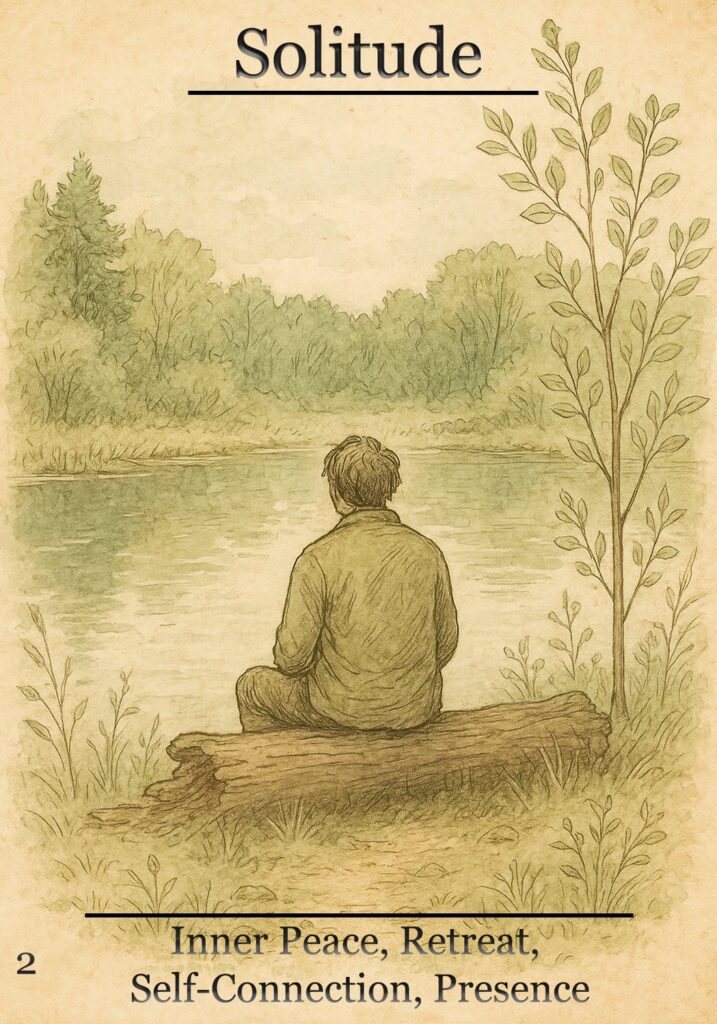
What Solitude means
True solitude is not loneliness; it is an active choice to be present with oneself and the natural world. This card invites you to seek moments of quiet reflection and deep self-connection. It suggests that by stepping away from the noise of others, you can hear the wisdom of your own soul.
Solitude usually arrives for someone who is rarely alone and somehow still lonely: the parent with a full house, the worker in an open office, the person whose phone lights up every few minutes all evening. Sometimes it arrives for the opposite person, who has plenty of time alone and dreads every hour of it. I read the card as a question about the quality of the time, not the quantity. Thoreau wrote, "I never found the companion that was so companionable as solitude." That line is easy to admire and harder to live, because the companion in question is yourself, and many people have not spent an unscheduled hour in that company for years.
Where it goes wrong is when the card becomes a polite name for hiding. A person can retreat from a hard conversation, a friendship that needs repair, or a room that makes them uncomfortable, and call the retreat rest. Real solitude has a door that opens both ways; the person goes in to listen and comes back out with something. Avoidance has a door that locks. The test is simple and slightly unwelcome: after the time alone, is there more of you available to the people you love, or less? If it is steadily less, the card is pointing at a wall, not a clearing.
I am never truly alone when I am with myself.
When Solitude appears in a reading
The person who draws Solitude is usually asking a question they have not let themselves finish. My first move is to ask what they would hear if everything went quiet for an hour, and then to wait. Some people answer at once with a worry. Some cannot answer at all, and that blankness is useful information. I listen for whether the silence sounds restful or frightening to them, because the card reads very differently in each case. For one person it is permission. For the other it is an invitation they will need to accept slowly, a few minutes at a time.
My practice with the card is small and dull on purpose. Fifteen minutes, no phone in the room, no book, no podcast, sitting somewhere with a window or a tree in view. A park bench works, a back step works, a kitchen chair works. I do not try to meditate or improve anything; I notice what my mind reaches for first and let it reach. If fifteen minutes is too much, I start with five and add a little each time. The length matters less than the lesson underneath it: the quiet will not swallow me, so I can stop filling it before it has a chance to say anything.
Where I keep Solitude distinct from The Walden Hermit is purpose. Solitude is the practice of being alone well. The Hermit is the character that grows out of that practice: self-trust, less need for applause. Beside Winter Visitors, I read the pair as a rhythm rather than a contradiction, time alone and time with others feeding each other. Beside The Fading Light, the card leans toward rest, and I tell the person the quiet they are craving may simply be tiredness asking for an early night.
One small deliberate act
Leave your phone in another room for fifteen minutes today, sit where you can see the sky or a tree, and write down the first thing your mind reaches for.
Solitude in the Pond Spread
The Walden Oracle guidebook’s three-card spread is The Pond Spread, for any situation that looks one way from the outside and feels another underneath. The cards are laid in a vertical line like layers of water: the surface, the depths, and the bottom. In each layer this card tends to say:
- The Surface. Solitude can look like withdrawal: someone stepping back from the group, declining invitations, going quiet in conversations.
- The Depths. It names a need for quiet that has been treated as selfish, and the fatigue that comes from never answering it.
- The Bottom. It says your own company is a resource you have barely used, and that it has been waiting the whole time.
Journal prompts
- What fears or discomforts arise when I consider being alone, and what message are they trying to send me?
- How can I intentionally carve out time for solitude in my daily or weekly routine?