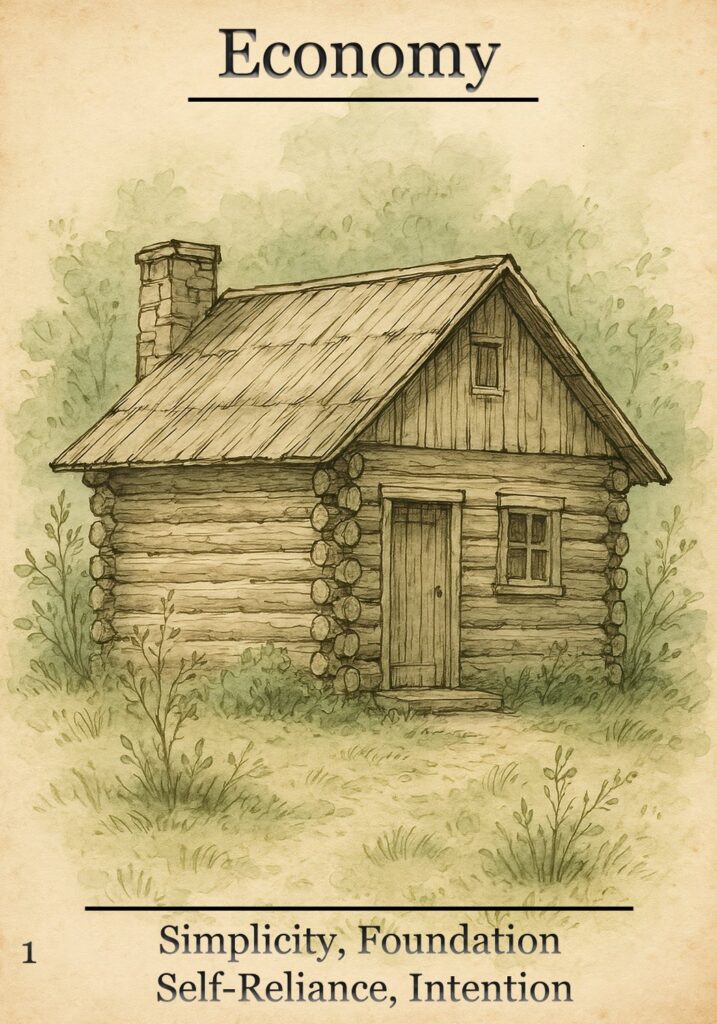
What Economy means
This card is a call to examine the true costs of your life, not just in terms of money, but time, energy, and freedom. It asks you to simplify, to shed the unnecessary, and to build a strong, intentional foundation for your life based on true needs rather than societal expectations.
In a reading, Economy tends to show up for someone who is busy and slightly broke in more than one currency. The calendar is full, the account is thin, and the evenings disappear into upkeep: of things, of appearances, of commitments nobody remembers agreeing to. I read the card as an audit, not a scolding. It asks what each piece of the life actually costs once the hours are counted alongside the dollars. Counted that way, a cheap purchase can be expensive, and a free favor can cost a month of Saturdays.
Where it goes wrong is turning the ledger into a hair shirt. Some people draw Economy and hear a command to deny themselves everything, then spend more energy policing small pleasures than the pleasures ever cost. That is still a life organized around things, just in reverse. The other wrong turn is the aesthetic version: buying the linen apron, the handmade bowls, the tidy pantry jars, and calling the new shopping simple living. The card is not asking for a look. It is asking which costs buy something you would choose again, and which ones you are paying out of habit or out of fear of being seen to have less.
I have all that I need to live a rich and meaningful life.
When Economy appears in a reading
When this card shows up, I ask the person to name the three things that take the most of their time in an ordinary week, and then the three they would say matter most. The lists rarely match, and the distance between them is where I start. I listen for the word "have," as in "I have to keep the second car" or "I have to go to that dinner." Some of those are true. Some are inherited. The card does not sort them for anyone, but it does make the person say each one out loud, and a few of them sound different once they are spoken.
My practice with Economy starts from Thoreau's line that "the cost of a thing is the amount of what I will call life which is required to be exchanged for it, immediately or in the long run." So my one-page ledger has two columns: money and hours. I pick a single recurring cost, a subscription, a storage unit, a standing obligation, and write down what it takes in both columns over a month. If a whole ledger feels like too much, I do one line on the back of a receipt. Then I ask one question: would I sign up for this today, knowing what I know? If the answer is no, I do not have to cancel it this minute. I put a date on the calendar to decide, because a decision with a date gets made and a vague intention gets renewed automatically.
Beside The Loaf of Bread, I read the pair as a reminder that cutting costs is half the work; the other half is noticing what already nourishes and protecting it. Beside The Telegraph, the expensive item is usually attention, not money. Where I keep Economy distinct from The Walden Hermit is direction. Economy looks outward at what the life is spending. The Hermit looks inward at whose approval the spending was meant to buy. They often travel together, but the first question is arithmetic and the second is character.
One small deliberate act
Pick one recurring expense or obligation, write its monthly cost in dollars and in hours on a sticky note, and put the note where you will see it before it renews.
Economy in the Pond Spread
The Walden Oracle guidebook’s three-card spread is The Pond Spread, for any situation that looks one way from the outside and feels another underneath. The cards are laid in a vertical line like layers of water: the surface, the depths, and the bottom. In each layer this card tends to say:
- The Surface. Economy shows a budget problem: not enough money, not enough time, a schedule that will not close no matter how it is shuffled.
- The Depths. It points at a cost you have stopped counting because paying it has become part of who you think you are.
- The Bottom. It says the foundation is smaller than the life built on top of it, and that trimming the top may be easier than you fear.
Journal prompts
- What are the "true costs" of the possessions in my life, beyond their price tag?
- If I were to live with only what is essential, what would my life look like?