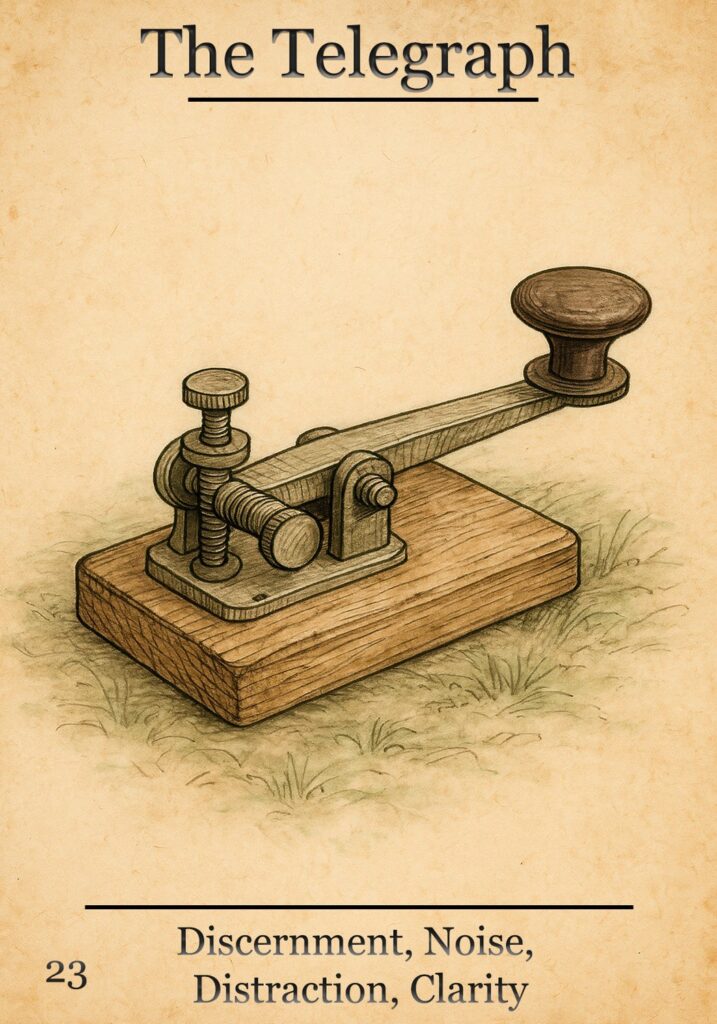
What The Telegraph means
Thoreau famously noted that the telegraph was a "hurry of letters," a communication that often lacked true meaning. This card is a warning about the distractions in our wired world. It asks you to discern what is truly important from what is merely a "hurry" and to find moments of quiet to listen to your own inner voice.
The Telegraph shows up most for people who are informed about everything and clear about nothing. They have read every update on the situation, scrolled every opinion, answered every message within minutes, and still cannot say what they think. I read the card as a question about signal. Not every message is a message; plenty of it is motion dressed up as news. The card does not ask anyone to throw the phone in the pond. It asks them to notice how much of the day's traffic actually changed a decision, and how much merely changed their mood.
Where it goes wrong is turning discernment into one more performance of being busy. The person declares a digital detox, announces it everywhere, and spends the quiet hours checking whether anyone noticed. Another version is cutting off the useful lines along with the noise: missing the school notice, the friend's real news, the one email that mattered, and calling it simple living. The card is not against connection. It is against volume that drowns out the person's own voice. A line kept open on purpose is fine; a line kept open out of fear of missing something is the hurry the card warns about.
I hear the message and ignore the noise.
When The Telegraph appears in a reading
When this card shows up, I ask the person what they checked first this morning and what it told them that they needed. Usually the honest answer is nothing they needed, and a little dread they did not. Then I ask what message they are waiting for. There is often one specific thing under all the scrolling: a reply, a result, a decision someone else is making. The constant checking is a way of standing next to that mailbox. Naming the real message tends to quiet the rest.
My practice with the card is sorting the lines rather than cutting them. I list every channel that can interrupt me, then mark each one: a person who may need me, a source I chose on purpose, or noise. Alerts from the third group get switched off first, and that alone usually halves the traffic. For the other two, I pick two or three times a day to check instead of answering every tap. If that is too much, I begin smaller: one hour each evening with the phone face down in another room, and a notebook to catch whatever my own mind says in the gap.
Beside The Unspoken Word, I read the pair as a voice that has been trying to speak for some time and keeps being talked over. Beside The Walden Clock, the pair says the noise has also taken over the person's pace, so every ping sets the tempo. Where I keep The Telegraph distinct from Solitude is that Solitude asks for time apart, while The Telegraph asks for better filters while staying in the world. A person can live in a crowded city with a full inbox and still answer this card well.
One small deliberate act
Before you look at messages after lunch today, write one sentence about what you actually want from the afternoon, and read it back before reading anything else.
The Telegraph in the Pond Spread
The Walden Oracle guidebook’s three-card spread is The Pond Spread, for any situation that looks one way from the outside and feels another underneath. The cards are laid in a vertical line like layers of water: the surface, the depths, and the bottom. In each layer this card tends to say:
- The Surface. The Telegraph shows a situation buzzing with updates, opinions, and urgency that may have very little to do with what you actually need to decide.
- The Depths. It names the fear of being the last to know, which keeps every line open and every alert switched on.
- The Bottom. The card's truth is that your own judgment needs quiet to be heard, and quiet has to be arranged.
Journal prompts
- What "hurry of letters" (unnecessary emails, social media feeds, or mental chatter) is distracting me from what's important?
- How can I create boundaries around technology and information to better hear my own inner voice?