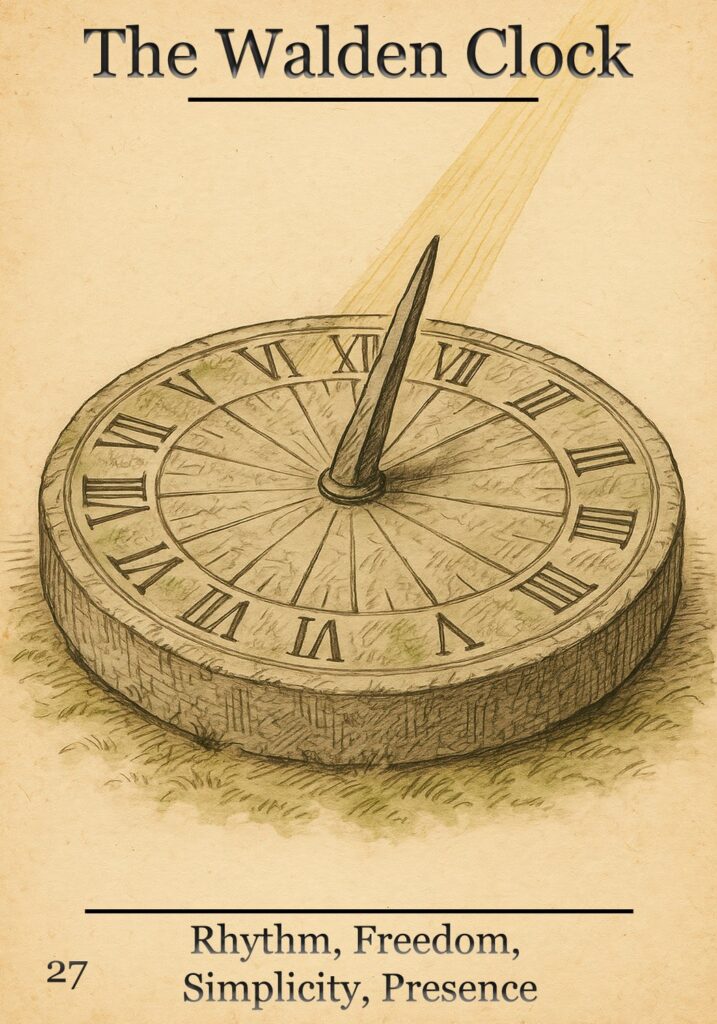
What The Walden Clock means
This card represents the freeing concept of living by your own internal rhythm rather than the rigid, external clock of society. It invites you to release the pressure of time and deadlines and to find your own natural rhythm for work, rest, and play. It is a sign to slow down and listen to the beat of your own life.
The Walden Clock tends to visit people who feel perpetually behind, even when they are not. Their days are sliced into fifteen-minute blocks, their evenings carry tomorrow's list, and rest has become something scheduled and then skipped. I read the card as a different way of keeping time. The face of the card is a sundial, a clock that works by light and season instead of by alarm. Thoreau wrote, "Time is but the stream I go a-fishing in." The card asks whether time is something the person moves through, or something that keeps chasing them.
Where it goes wrong is reading the card as permission to ignore every clock. Real deadlines, the bus, the pickup time, the bill due on the fifteenth, do not vanish because a person has decided to honor their own rhythm, and the people waiting on them pay the cost. The opposite failure is turning slowness into a new performance, an anxious project of being relaxed. The card is about finding the natural rhythm underneath the obligations, so that work, rest, and play each get their real season. A sundial still tells the time. It simply tells it by the sun.
My life unfolds in its own perfect timing, and I release the need to rush.
When The Walden Clock appears in a reading
The person who draws The Walden Clock is usually worn down by urgency they did not choose. In a reading I ask them to walk me through yesterday hour by hour, and I listen for the moments when they felt most like themselves. Often there are one or two: a morning coffee, the drive home, an hour in the garden. Those are clues to their natural rhythm. Then I ask which of the day's deadlines were real and which were habits, and the second list is usually longer.
My practice with the card is finding my own tempo inside the fixed points. I write down the true deadlines in the days ahead, the ones with a real person or consequence on the other end, and treat everything else as movable. Then I notice when I naturally do my best thinking and when I fade, and I move the movable tasks toward those hours. One small part of simple living, for me, is leaving one stretch of the day unclaimed, even twenty minutes, so the day has a pause built into it.
Beside The Telegraph, I read the pair as a pace dictated by pings and alerts instead of by the person's own sense of time. Beside High Tide in the Soul, the pair says to work hard while the water is high and rest without guilt when it goes out. Where I keep The Walden Clock distinct from The Fading Light is choice. The Fading Light is the season slowing you down. The Walden Clock asks you to set the pace yourself, any day of the year.
One small deliberate act
Remove one self-imposed deadline from today's list, one that nobody else is waiting on, and give that time to something unhurried instead.
The Walden Clock in the Pond Spread
The Walden Oracle guidebook’s three-card spread is The Pond Spread, for any situation that looks one way from the outside and feels another underneath. The cards are laid in a vertical line like layers of water: the surface, the depths, and the bottom. In each layer this card tends to say:
- The Surface. The Walden Clock shows a situation dominated by time pressure, a schedule so full that every choice feels rushed.
- The Depths. It names a belief that rest must be earned by finishing everything first, which means it never quite arrives.
- The Bottom. The card's truth is that your life has its own tempo, and listening for it is part of the work, not a break from it.
Journal prompts
- What is one way I can break free from the "external clock" today and honor my own natural rhythm?
- What would it feel like to live without the pressure of time, and how can I bring a piece of that feeling into my life?