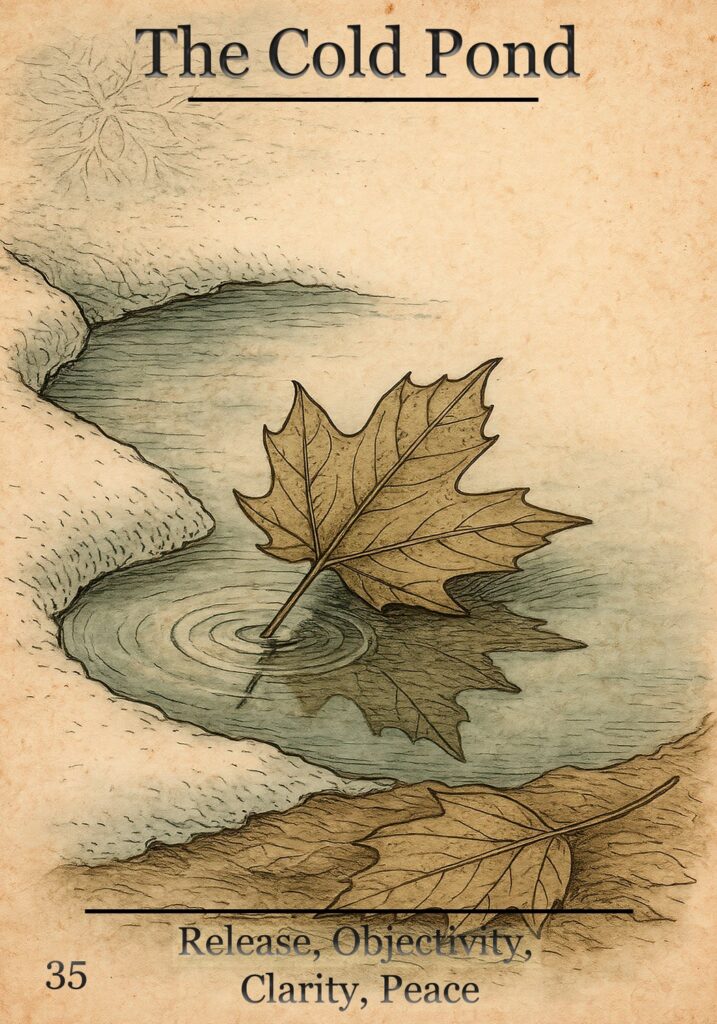
What The Cold Pond means
As the pond cools in autumn, it symbolizes a time for emotional objectivity and release. It suggests moving on from situations or states that no longer serve you, and finding clarity and peace by viewing things with a calm, balanced perspective, free from the heat of emotion.
The Cold Pond usually comes up after a heated stretch: an argument, a blowup at work, a family flare at the dinner table. The person is still running hot, replaying lines and drafting the comeback they did not say. I read the card as cooling time. It does not promise resolution yet, but it suggests the water has started to settle enough that the bottom is visible again. On the card, a single fallen leaf rests near the pond's edge as the margin begins to freeze. The event is still there, plain to see. It is simply no longer churning.
Where it goes wrong is mistaking cold for clear. Detachment can be numbness in disguise, or contempt, a way of not caring so that nothing has to be felt. Going icy on someone is not objectivity. Neither is "I'm just being rational" used to wave off another person's feelings. A calm perspective does not mean the original emotion was wrong; it means the emotion is no longer steering. And even a cold pond is alive below the surface. The card cools the water, it does not empty it.
I release old emotions and find peace and clarity in the present moment.
When The Cold Pond appears in a reading
The person who draws The Cold Pond is usually still mid-argument in their head. I ask them to tell me what happened as if it had happened to a friend, in the third person, with names. I listen for the moment the story changes temperature, when the adjectives drop away and the facts get shorter and plainer. That shift is the cooling the card describes, and it often shows the person what actually matters in the situation.
My practice with the card is a cooling interval before I answer anything heated. I write the hot version in full, every sharp line, and I do not send it. The next day I rewrite it with two parts: what happened, and what I want now. If a reply cannot wait a day, I send a holding line instead: "I want to answer this properly. I'll get back to you tomorrow." Then I go outside for a few minutes, because cold air does some of the work that willpower cannot.
Beside The Telegraph, I read the pair simply: do not send it yet. Where I keep The Cold Pond distinct from The Purity of Snow is what happens to the past. The Purity of Snow offers a fresh start, a clean field. The Cold Pond keeps the old situation in view and changes the distance from which it is seen, which is often more useful than pretending it never happened.
One small deliberate act
Draft the reply you want to send about the thing still bothering you, save it unsent, and decide tomorrow, with cooler eyes, whether it needs sending at all.
The Cold Pond in the Pond Spread
The Walden Oracle guidebook’s three-card spread is The Pond Spread, for any situation that looks one way from the outside and feels another underneath. The cards are laid in a vertical line like layers of water: the surface, the depths, and the bottom. In each layer this card tends to say:
- The Surface. The Cold Pond shows a situation that has gone quiet after conflict, with a stillness that could be peace or could be a chill.
- The Depths. It names feelings that are still warm underneath a composed face, and a wish to be seen fairly once the noise is gone.
- The Bottom. The core lesson is that distance brings clarity, and stepping back from the heat lets the person respond rather than react.
Journal prompts
- What is one emotional situation that I need to step back from and view with more objectivity?
- What would it feel like to approach my current challenges with a "cool" and calm perspective?