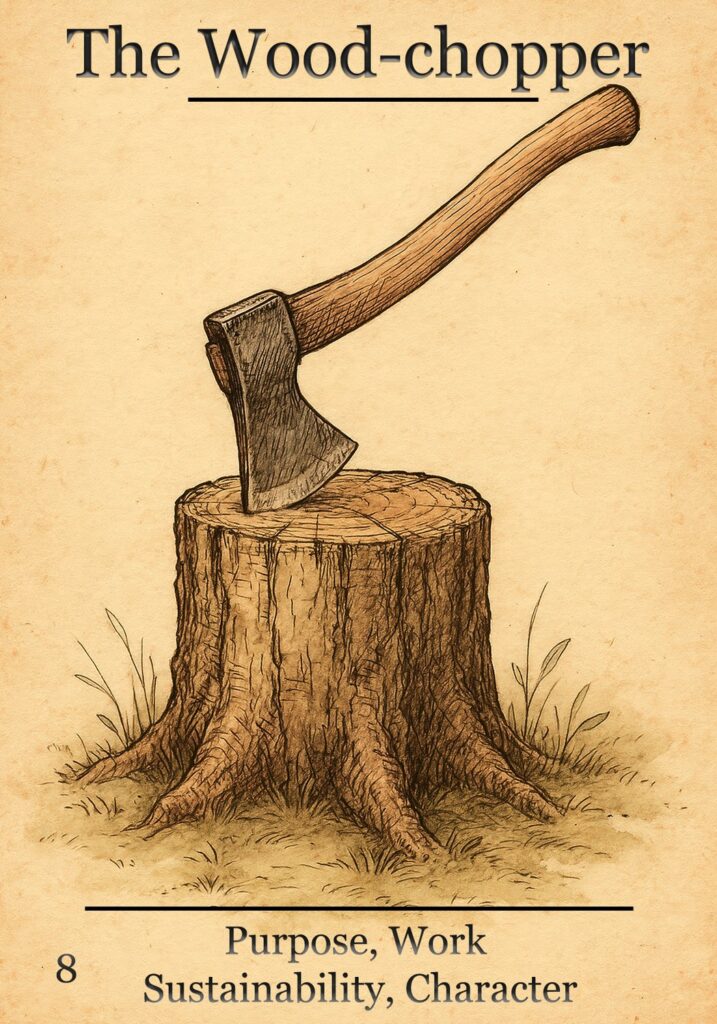
What The Wood-chopper means
The wood-chopper symbolizes the honest, physical labor that sustains life and builds character. This card encourages you to find meaning and purpose in your daily work, whatever it may be. It reminds you that tangible, purposeful effort is a powerful way to connect with yourself and the world.
The Wood-chopper tends to come up when work has turned abstract. The person spends the day moving information from one screen to another and goes to bed unsure what they made. Or the work is physical and repetitive, and they have started to resent it. I read the card as a return to the plain satisfaction of a task with a beginning, a middle, and an end. Thoreau noticed it: "Every man looks at his wood-pile with a kind of affection." A stack of split wood is visible, countable, and useful in a way a cleared inbox rarely feels. The card asks where that feeling is still available in the person's week.
Where it goes wrong is mistaking grind for virtue. Some people draw The Wood-chopper and decide the answer to every problem is more effort, longer hours, harder labor, as if exhaustion built character by itself. Work does build something, but not when it swallows rest and every other part of a life. The opposite failure is waiting for meaningful work to arrive before doing ordinary work well. Simple living has involved chores from the start. The card asks the person to stay present with the task in front of them, not to romanticize it and not to escape it.
My hands are a tool for meaningful creation and a life of purpose.
When The Wood-chopper appears in a reading
In a reading, The Wood-chopper asks me to look at the person's hands, figuratively. What do they actually do all day, and which parts of it leave something behind? I ask them to name one task in the last week that felt satisfying to finish. Sometimes it is a spreadsheet; sometimes it is a repaired drawer or a swept porch. Then I ask what made it satisfying. The answer usually points to a quality the card cares about: the work was visible, it had an end, and the person did it with attention instead of half their mind somewhere else.
My practice with the card is to choose one repetitive task each day and do it with full attention, start to finish. Folding laundry, washing dishes, sweeping a floor, splitting kindling if that is the life. No phone, no podcast for those few minutes. I notice the weight of things, the sound, the moment the task is done. It sounds trivial, and it is supposed to be. Over a few weeks the chores stop feeling like interruptions and start feeling like the places where the day is anchored. On days when that is too much, I give the first two minutes my attention and let the rest go however it goes.
Beside The Bean-Field, I read the pair as labor and patience together, the work done now and the harvest that comes later. Beside The Walden Clock, the card asks for work at a human pace rather than a frantic one. Where I keep The Wood-chopper distinct from The Path of Purpose is scale. The Path of Purpose asks about vocation, the big question of what a life's work should be. The Wood-chopper asks about this afternoon's work and whether you were present for it.
One small deliberate act
Pick one chore you usually rush, do it today from start to finish with your phone in another room, and notice how it feels when it is done.
The Wood-chopper in the Pond Spread
The Walden Oracle guidebook’s three-card spread is The Pond Spread, for any situation that looks one way from the outside and feels another underneath. The cards are laid in a vertical line like layers of water: the surface, the depths, and the bottom. In each layer this card tends to say:
- The Surface. The Wood-chopper shows a stretch of work: effort, routine, a pile that needs moving before anything else can happen.
- The Depths. It points at work that has gone invisible, done on autopilot and therefore giving nothing back to the person doing it.
- The Bottom. It says the meaning is in the doing, and that ordinary labor counts when you show up for it.
Journal prompts
- How can I bring more intentionality and presence to the small, repetitive tasks in my day?
- What kind of "wood" am I chopping in my life, and how is it sustaining my soul?