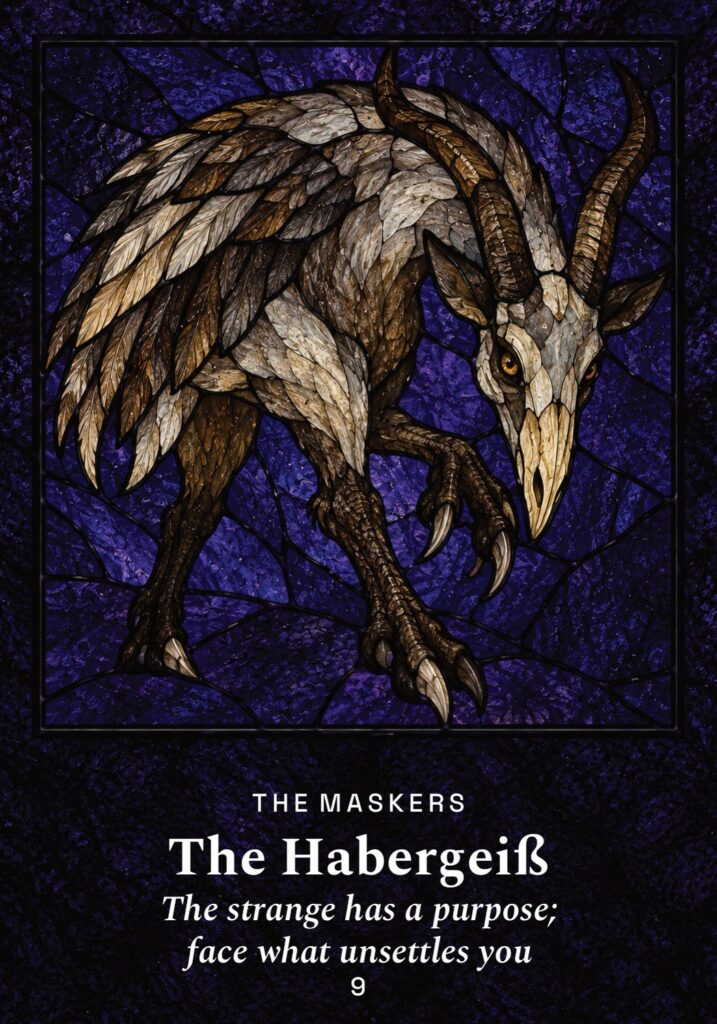
What The Habergeiß means
In parts of the Austrian Alps a Habergeiß stalks the winter nights, in some valleys a three-legged thing, part goat and part bird, in others long-necked or stranger still. The form shifts from village to village. The job does not. It exists to unsettle. Old winter kept a place for the grotesque, because what disturbs you carries information that comfort cannot deliver. This card asks you to turn toward the strange thing instead of away, and to ask what it knows.
When The Habergeiß comes up, the reading is about the thing the person keeps flinching past. A memory, a verdict on their own behavior, a dream that returns, a feeling that has no name and a definite shape. They describe it as disturbing and they are right. What the card refuses is the idea that disturbing means wrong. I read this beast as a messenger with a difficult face, and I ask the person to look at it long enough to hear what it came to say. Whatever shape it takes, its errand is the same, and so is the news it is carrying.
In shadow, feeding fear for the spectacle of it, in yourself or others, is the Habergeiß with no purpose left, and discomfort should teach rather than just circle. There is a way of being fascinated by your own darkness that is really a way of avoiding your own ordinary life. The strange thing gets described, redescribed, dramatized, dined out on, and never once asked what it wants. The card is not impressed by that. It wants the unsettling thing faced so it can deliver its message and leave, not kept as a pet.
I can look directly at what disturbs me and learn its name.
When The Habergeiß appears in a reading
When this card leads a reading, I ask the person what they keep flinching past, and then I ask them to describe it as a creature. Three legs or long neck, part goat or part bird, whatever shape it takes in their valley. The exercise sounds whimsical and it is not. Giving the disturbing thing a form makes it something that can be faced, and the Habergeiß's teaching is that it wants to be faced because it has something to say. So I ask what the creature would say if it were allowed one sentence. The answer usually arrives faster than the person expects, and it is usually useful.
The way I work it is to take the topic I have been avoiding and give it ten unflinching minutes on paper, with a timer, so that the flinch has nowhere to go. I do not analyze what comes out. I let the strange thing speak in its own voice for the length of the timer and then I close the book. What the practice teaches is that the discomfort was carrying information the whole time, and that ten minutes of looking is far less costly than a winter of not looking, which is the trade I had been making without noticing.
Beside The Canada Lynx, I read the pair as seeing and being seen, and I ask which one the person is more afraid of. Beside The Common Raven, the reading has to check whether the unsettling thing is new information or an old grievance the mind keeps circling. Where I keep the Habergeiß distinct from Krampus is that Krampus brings a consequence you earned. The goat-bird brings a message you have not yet let yourself hear.
One small sideways move
Ask one person what they find strangest about you, and listen to the whole answer without defending anything.
The Habergeiß in the Long Night Spread
The Yule Beasts guidebook’s three-card Long Night Spread is the deck’s core reading, for a season that is ending while the next one has not started. Laid left to right, it names what is ending, what holds you in the deepest part of the dark, and what is quietly returning. In each position this card tends to say:
- Dusk. At Dusk, what is ending is the flinch: the reflex that has been turning you away from the same strange thing every time it walked past the window.
- Midnight. At Midnight, the creature is in the room, and what holds you is the choice to look at it directly and let it say the thing comfort could not.
- Dawn. At Dawn, what returns is the ordinary and true, the plain life the grotesque was pointing back toward the whole time.
Journal prompts
- What keeps unsettling me, and what might it be trying to say?
- Where do I use the grotesque and dramatic to avoid the ordinary and true?