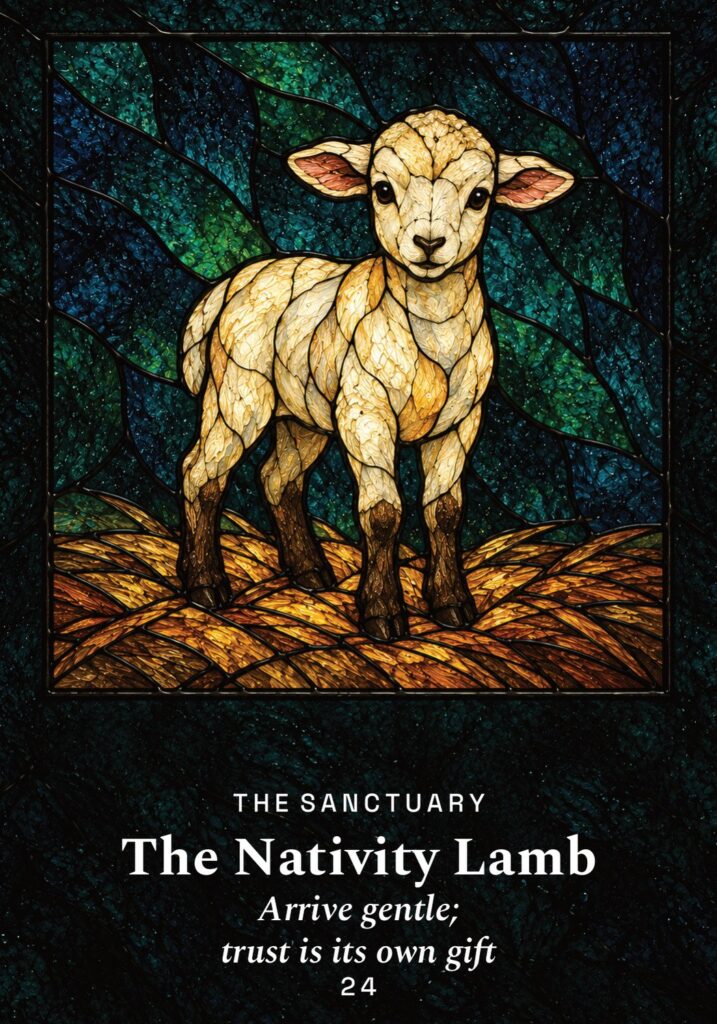
What The Nativity Lamb means
Luke sends shepherds to the manger but gives them nothing to carry. The lamb in their arms comes from later art and from a thousand crèches, and the tradition read every meaning into it. Underneath the theology sits something simple: the lamb arrives without armor and is received without suspicion. This card asks you to let yourself arrive somewhere gentle and unguarded, and to receive someone else's unguarded arrival with the care it deserves.
When The Nativity Lamb comes up, the person is usually armored in a room where the armor is not needed. A friendship that has earned their trust, a partner who has been gentle for years, a group that has shown them nothing but care, and still they arrive braced. The lamb is received without suspicion because it arrived without armor, and the card asks the person to try that where it is safe. I read it two ways at once: as an invitation to arrive gentle somewhere, and as a responsibility to receive someone else's unguarded arrival with the care it deserves, because the second half is the one people forget.
In shadow, gentleness is a gift and not a permanent posture in every room, because some doors deserve your trust and some have not earned it, and innocence is not obligated to be endless. The card is not a command to be soft everywhere. I have seen people take it that way and get hurt, and then decide that softness was the mistake. It was not. The mistake was the room. The lamb was carried into a stable that had made space for it. It was not sent alone into the fields where the wolves were.
I can be soft here and remain safe.
When The Nativity Lamb appears in a reading
When this card leads a reading, I ask where in the person's life it is safe to be unguarded, and then whether they are using that safety. The two answers rarely match. There is usually at least one room, one friendship, one bed where the armor could come off, and the person keeps it on out of habit, or out of a fear that was formed somewhere else and never updated. The Lamb asks to be carried into that room. I also ask the reverse question, because the card carries both halves: whose unguarded arrival has the person received lately, and how carefully did they hold it?
The way I work it is to drop the armor in one low-stakes moment: I say the honest thing, I ask the sincere question, I admit that I do not know. Low stakes is the discipline. I do not test gentleness on the hardest door in my life. I test it where the floor is soft, and I notice what happens, which is usually nothing terrible and often something warm. What the practice teaches me is that the armor had been costing more than it protected, in that particular room, and that the room had been waiting.
Beside The Mari Lwyd, the two cards argue about the right entrance and I ask which door this is, the one that wants a verse or the one that wants softness. Beside The Nativity Ox, I read the pair as the whole gentle stable and take it as a green light. Where I keep The Nativity Lamb distinct from The Stoat is that the stoat's white coat is a line held against pressure. The lamb's softness is not a line at all. It is an arrival, and it needs a room that has earned it.
One small sideways move
Say I do not know, out loud, in a conversation where you would normally bluff.
The Nativity Lamb in the Long Night Spread
The Yule Beasts guidebook’s three-card Long Night Spread is the deck’s core reading, for a season that is ending while the next one has not started. Laid left to right, it names what is ending, what holds you in the deepest part of the dark, and what is quietly returning. In each position this card tends to say:
- Dusk. At Dusk, what is ending is the reflex of arriving braced everywhere, including the rooms that stopped needing armor years ago.
- Midnight. At Midnight, the stable is quiet and what holds you is the unguarded arrival, yours or someone else's, received without suspicion in a place that made room for it.
- Dawn. At Dawn, what returns is trust as a thing given and held, and the discovery of which doors had earned it all along.
Journal prompts
- Where in my life is it actually safe to be unguarded, and am I using that safety?
- Whose trust arrived gently in my hands lately, and how did I hold it?