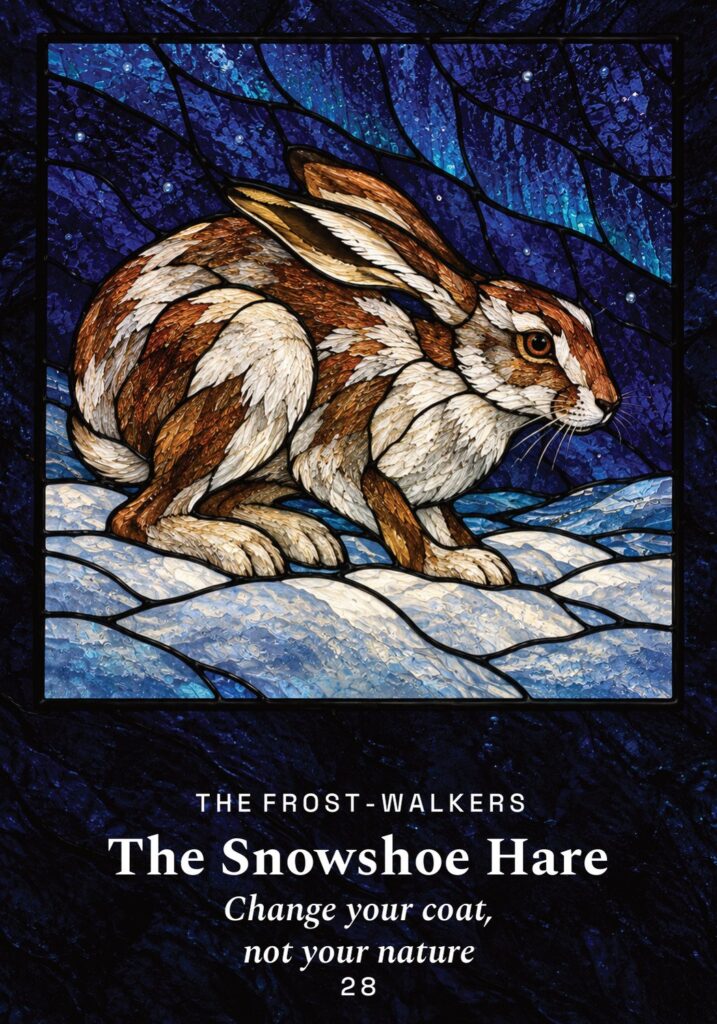
What The Snowshoe Hare means
Twice a year the hare remakes itself, brown to white and back. Its hind feet are already snowshoes, broad and thickly furred, carrying it over crust that swallows whatever is chasing it. Irish and Scottish tradition is full of the hare as a shape a witch takes, and the animal itself simply refuses to be caught by a changed season. This card is about adaptation without self-betrayal. Change your coat as the ground changes. Keep the creature underneath intact.
When The Snowshoe Hare comes up, the season has changed around the person and they are still wearing the coat from the last one. A routine built for a job they no longer have, a way of parenting built for a child who has grown, a set of defenses built for a relationship that ended. The ground is white and the coat is brown, and everything that hunts can see them. I read the hare as a permission to change the coat, with one non-negotiable attached: the creature underneath stays exactly what it was. Adaptation is the skill. Self-betrayal is a different thing wearing its clothes.
In shadow, camouflage held too long becomes disappearance, and if no one has seen the real color of you in a long while, the coat is no longer protection but hiding. I check for this by asking when the person was last seen, really seen, by someone who knew them before the change. If the answer is a shrug, the coat has grown into the skin. The hare changes twice a year because the ground changes twice a year. A hare that is white in July is not adapted. It is missing, and the reading has to say so.
I can adapt to this season and still be entirely myself.
When The Snowshoe Hare appears in a reading
When this card leads a reading, I ask what season changed around the person while they kept wearing the old coat. They can usually name it quickly: the job ended, the children left, the marriage changed shape, the body did, the town did. The coat is the set of habits and defenses that made sense on ground that has since melted away. Then I ask the harder question, which is what is underneath the coat and whether it has changed. The Snowshoe Hare says it has not, and should not, and the reading's task is to help the person change the outside without losing track of the creature.
The way I work it is to identify one habit or routine built for a season of life that is over and to swap it for one that fits the ground I am actually standing on. One habit, not a whole new self. The morning shaped around a commute that ended years ago. The way of spending Sundays that belonged to a household that has changed. I make the swap, I wear it, and I check whether I still recognize myself in it, and I give it two weeks before judging. What the practice teaches me is that the coat change is easier than the fear predicted, and the fear was mostly about the creature, which turns out to be fine.
Beside The Winter Wren, I read the pair as a change of coat and a change of station arriving together, and I tell the person to expect both to feel like loss before they feel like fit. Beside The Stoat, the two white coats are having different conversations, one about adaptation and one about integrity, and I keep them apart. Where I keep The Snowshoe Hare distinct from The Moose is that the moose holds still and waits for melt. The hare changes to meet the snow and keeps moving over it.
One small sideways move
Swap one daily routine that belongs to an earlier life for one that fits this one, and give it two weeks before you judge it.
The Snowshoe Hare in the Long Night Spread
The Yule Beasts guidebook’s three-card Long Night Spread is the deck’s core reading, for a season that is ending while the next one has not started. Laid left to right, it names what is ending, what holds you in the deepest part of the dark, and what is quietly returning. In each position this card tends to say:
- Dusk. At Dusk, what is ending is the old coat: the brown fur worn onto white ground, the habits of a season that has already turned.
- Midnight. At Midnight, the ground is white and the coat is changing, and what holds you is the creature underneath, unchanged, carrying you over the crust.
- Dawn. At Dawn, what returns is fit: a self that matches the season it is living in, and has lost nothing of itself in the matching.
Journal prompts
- What season changed around me while I kept wearing the old coat?
- Where have I blended in so well that I have gone missing?