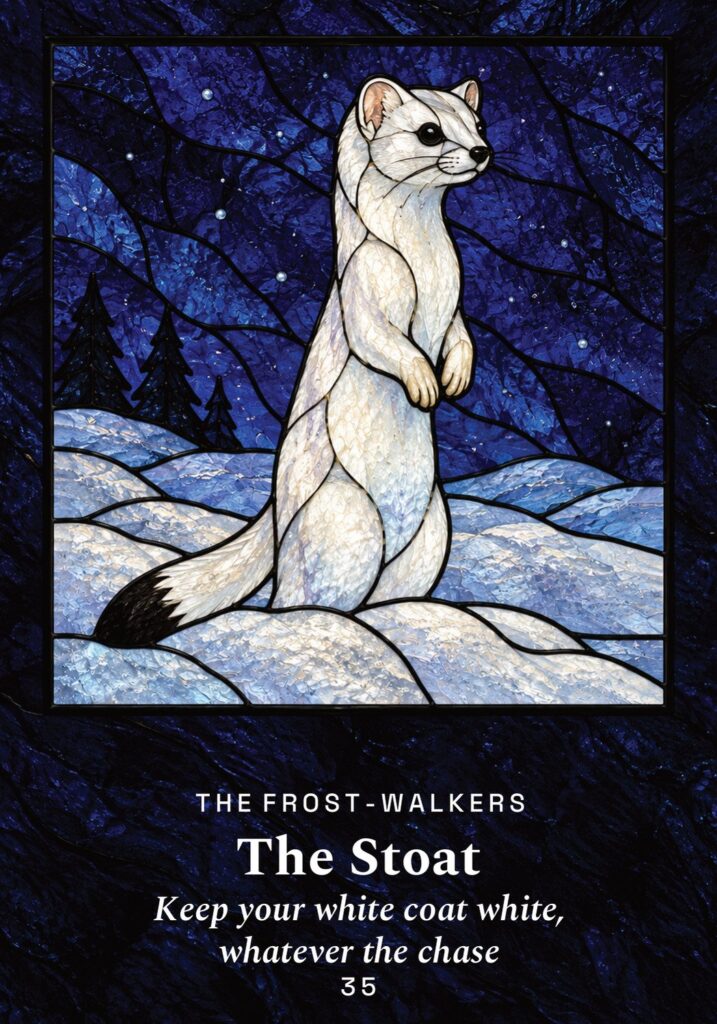
What The Stoat means
In winter the stoat becomes the ermine, white as the drift with a single black tip to its tail, and medieval Europe made it the very emblem of integrity: the legend said it would rather die than soil its coat, and kings wore its winter white to borrow the claim. This card is about your coat: the standard you keep when keeping it costs something. Small animal, absolute line. Know where yours is.
This card lands in readings about a line the person is being pressured to cross. A small compromise at work, a loyalty that is being tested, a version of themselves they could sell for a good price. They want to know whether it matters, and The Stoat says the line is what they are. Not the reputation, not the coat as other people see it. The thing held when holding it is expensive. So I ask the person to name the non-negotiable, in one sentence, and I notice that most people have one and have never written it down, and that the not writing is part of how it gets crossed.
In shadow, purity turns to vanity when the coat matters more than the creature and to rigidity when every small stain is treated as ruin, because integrity bends to mend and does not bend just to be bought. Both failures wear white. The vain one polishes an image and calls the polishing principle. The rigid one cannot forgive a smudge, in themselves or anyone else, and has confused integrity with an inability to be forgiven. The ermine's coat is not clean because the animal never touched the ground. It is clean because the animal knows which dirt it will not lie down in.
There are lines I do not cross, and they are what I am.
When The Stoat appears in a reading
When this card leads a reading, I ask what line of the person's has never been written down and has held for years. They know it. It comes out in one sentence, and it is usually not the line they would put on a profile. It is smaller and more absolute. Then I ask the stoat's question, which is what keeping it has cost, and whether it is being tested right now, because The Stoat tends to arrive when the coat is about to be offered a price. I also ask where the person might be polishing an image and calling it integrity, because the two can look identical from the outside and feel different from within.
My practice with it is to name the one non-negotiable for the season in a single sentence and put it where I will read it on the hard days. The single sentence is the discipline. A list of values is a decoration. A sentence is a line, and a line can be kept or crossed, which is the only condition under which it means anything. Then I read it on the day the price is offered, and I notice whether the animal underneath the coat is the one that wrote it.
Beside Krampus, I read the pair as a line already crossed and the reckoning that follows, and I do not pretend the coat cleans itself. Beside Gullinbursti, the white coat and the golden vow are the same card in two colors, both about a word that holds. Where I keep The Stoat distinct from The Snowshoe Hare is that the hare's white coat is camouflage that changes with the ground. The stoat's white coat is the standard that does not change, whatever the ground is doing.
One small sideways move
Write your one non-negotiable on a card and put it in your wallet, in front of the money.
The Stoat in the Long Night Spread
The Yule Beasts guidebook’s three-card Long Night Spread is the deck’s core reading, for a season that is ending while the next one has not started. Laid left to right, it names what is ending, what holds you in the deepest part of the dark, and what is quietly returning. In each position this card tends to say:
- Dusk. At Dusk, what is ending is the unwritten line: the standard you have kept for years without ever saying so, and the vagueness that let it be pressured.
- Midnight. At Midnight, the price is on the table and what holds you is the coat itself, white against the drift, kept clean because the creature knows what it will not lie down in.
- Dawn. At Dawn, what returns is the line made plain, one sentence, and a self that can name what it is because it named what it would not do.
Journal prompts
- What line of mine has never been written down but has always been there?
- Where am I polishing my image and calling it integrity?