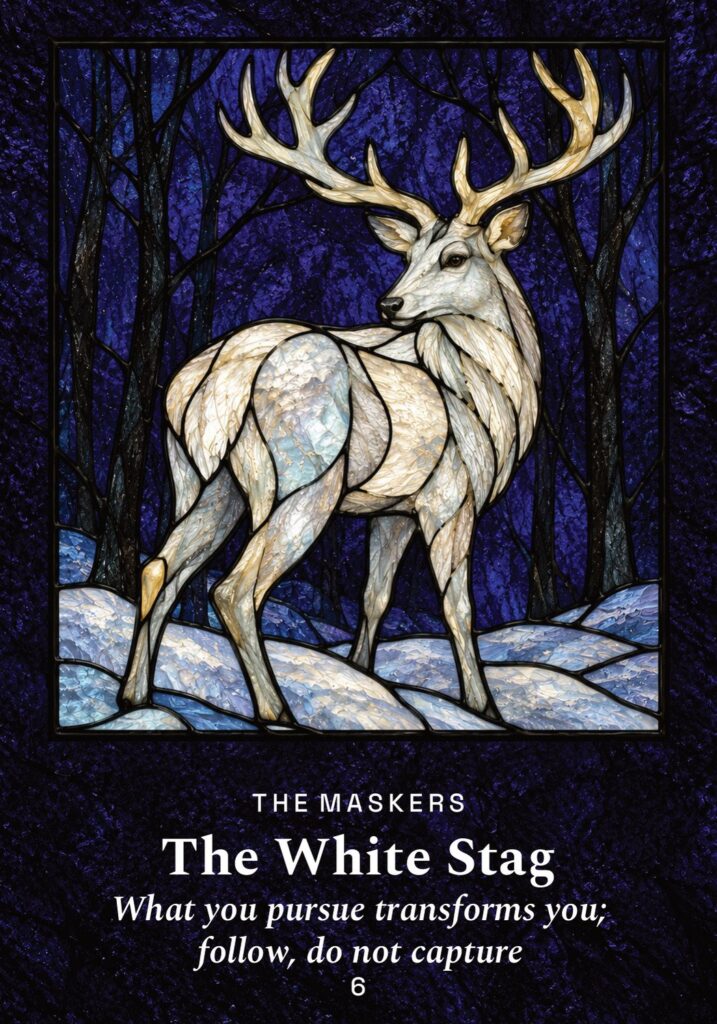
What The White Stag means
In medieval romance, especially the Arthurian and Breton tales, a white stag appears at the edge of the wood and will not be caught. It draws hunters over boundaries into the otherworld, into new kingdoms, into changed lives. The point was never the capture. This card says the elusive thing you are pursuing is doing its work by moving: it is leading you somewhere. Follow with attention, and stop demanding that the chase end in possession.
When The White Stag comes up, the person is usually chasing something they can name in one word and cannot explain in a paragraph. A calling, a place, a craft, a person, an idea that keeps stepping back into the trees exactly when they think they have it. They ask whether they will catch it, and the card declines to answer that question, because it is the wrong one. I read this stag as a guide, and I read the chase as the journey it has been leading them on all along. Around the winter solstice the woods are bare enough to see where you have actually been walking, and that is usually the reading's real news.
In shadow, an endless chase can become a way to never arrive anywhere, and if the stag has led you in circles for years, the reading has to ask what standing still might show you. There is a kind of seeker who needs the stag to stay uncaught, because arriving would mean being someone specific in a specific place with specific responsibilities. The pursuit is romantic. The arrival is a Tuesday. If the card comes up for someone who has been following for a very long time and cannot say where they are, I ask them to stop walking for a moment and describe the clearing they are standing in.
I let the pursuit change me instead of demanding it end.
When The White Stag appears in a reading
When this card leads a reading, I do not ask what the person is chasing. I ask where the chase has taken them. They will list the places without noticing what they are doing: the city they moved to, the skills they picked up, the people they met along the way, the version of themselves that did not exist before the pursuit began. The White Stag has been leading the whole time. So the reading's work is to turn the person around for a moment, look back at the boundary they crossed without noticing, and see that the elusive thing has already done most of what it came to do.
My practice with it is to spend a stretch of time on the pursuit with the goal deliberately removed. Twenty minutes with the craft, the idea, the search, and no intention of finishing, capturing or deciding anything. Then I write down where it led, because it leads somewhere, and the somewhere is the point. The discipline is not in the following. It is in refusing to demand that the following end in possession, which is the demand that makes people miserable and does not make the stag any easier to catch.
Beside The Red Fox, I read the pair as two kinds of pursuit: the fox listens and then leaps, the stag asks you to follow and never leap at all, and the reading has to say which one this is. Beside The Moose, the stag's motion and the moose's holding are a real argument and I settle it by season. Where I keep The White Stag distinct from The Snowy Owl is that the owl wants you still so you can see. The stag wants you moving so you can be changed.
One small sideways move
Walk somewhere you have never been on purpose, with no destination, and come home by a different way.
The White Stag in the Long Night Spread
The Yule Beasts guidebook’s three-card Long Night Spread is the deck’s core reading, for a season that is ending while the next one has not started. Laid left to right, it names what is ending, what holds you in the deepest part of the dark, and what is quietly returning. In each position this card tends to say:
- Dusk. At Dusk, what is ending is the belief that the chase has a finish line, and the frustration you have been carrying because you never reached it.
- Midnight. At Midnight, what holds you is the edge of the wood, the stag just visible and just out of reach, and the dark between where you stand and where it went.
- Dawn. At Dawn, what returns is the sight of your own trail: every boundary crossed, every kingdom entered, and the person the pursuit made while you were watching the stag.
Journal prompts
- What have I been chasing, and who have I become while chasing it?
- What would I have to feel if I stopped pursuing and simply arrived here?