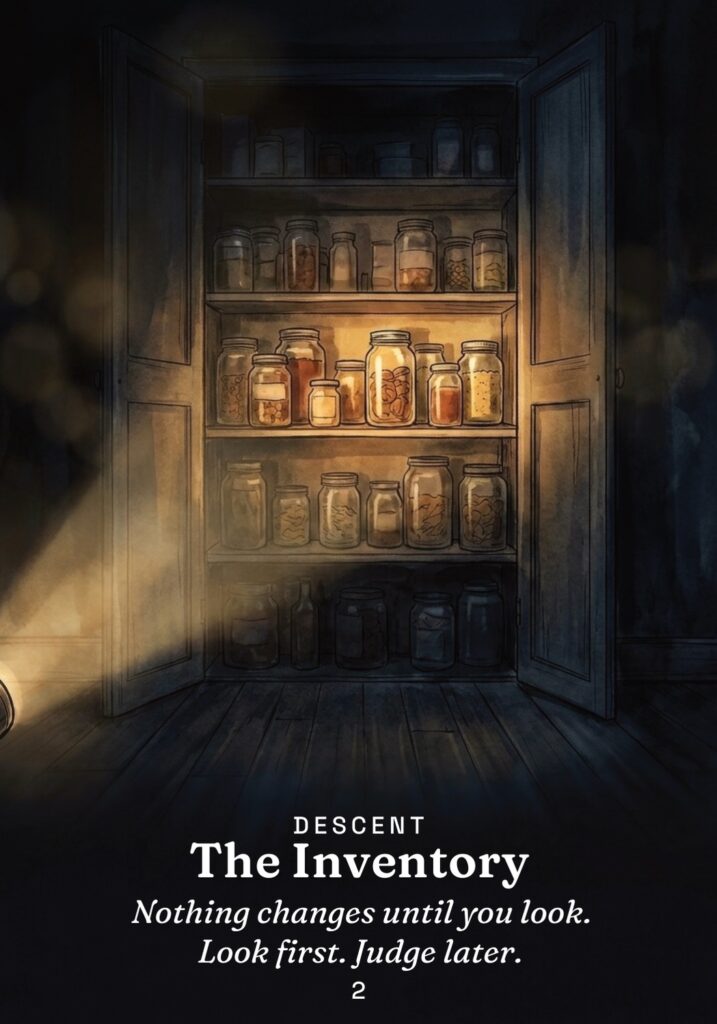
What The Inventory means
Nothing in here changes while you are still deciding whether what you find is allowed to be there. The instinct is to sort as you go, to flinch at an item and file it as proof that something is wrong with you. That is not looking. That is sentencing. An inventory is a clerical act. You write down what is on the shelf. The verdict comes later and is smaller than you fear.
When The Inventory comes up, the situation is usually that I have started looking at myself and immediately started arguing. Each thing I find gets a verdict before it gets a name. The card asks for a different posture, a clerk's rather than a judge's, and it tends to show up before a decision, when I am tempted to decide who I am before I have looked at what I do. Most of what I flinch at is smaller on the page than it was in my chest.
Where it goes wrong is turning the list into evidence for the prosecution. The page fills up and I read it back as a case against myself, which quietly ends the looking, because nobody keeps inspecting a room they have already condemned. The card's answer is that the inventory and the verdict are two separate afternoons, and the second one is smaller than the fear predicts. Data first. Meaning later, if at all. An honest inventory is the first act of shadow work, and the least dramatic.
I can write it down without deciding what it means.
When The Inventory appears in a reading
I use this card as a reset for a reading that has turned into a trial. If the other cards have me building a case for or against myself, The Inventory tells me to stop arguing and start counting. The tone of the whole spread changes the moment the nouns replace the adjectives.
The practice is a timed page: ten minutes, everything I would not say aloud, no ranking, and the page closed unread when the timer ends. The closing is the part people skip. Reading it back the same day turns a clerk into a prosecutor within about three lines. Tomorrow is soon enough.
Beside The Sneer, I read the pair as contempt about to be aimed inward, and I slow the reading down. Beside Both Things Are True, the inventory becomes easier, because the card next to it already says that two contradictory items can sit on the same shelf.
One small shadow-work move
Write down one thing about yourself today in the flattest sentence you can manage, then leave it alone.
The Inventory in the Descent and Return spread
The Gold in the Dark guidebook’s three-card Descent and Return spread is the deck’s signature shadow work reading, for a pattern you have been circling for years rather than a fight you had on Tuesday. It names what you sent away, what keeping it buried has cost, and what is ready to come back. In each position this card tends to say:
- What Went Down. What went down was the ability to look at yourself without a verdict attached. It usually went early.
- What It Cost. The cost is that you have been living with a self you never actually inspected, only judged.
- What Comes Back. What comes back is the clerk: a version of you who can list what is there and let the meaning wait.
Journal prompts
- Which item did I almost not write, and what stopped my hand?
- What would change if none of this were evidence of anything?