How to Choose Your First Oracle Deck: Start With What You Are Carrying
Skip the best-deck lists. The deck that stays with you is the one that speaks to what you are already living through.
The first oracle deck I ever bought, I chose for its cover. Midnight blue, gold foil, a moon on every card. I was in the middle of a long, tiring winter, and every card I pulled told me to manifest abundance. I used it twice. Then it lived in a drawer.
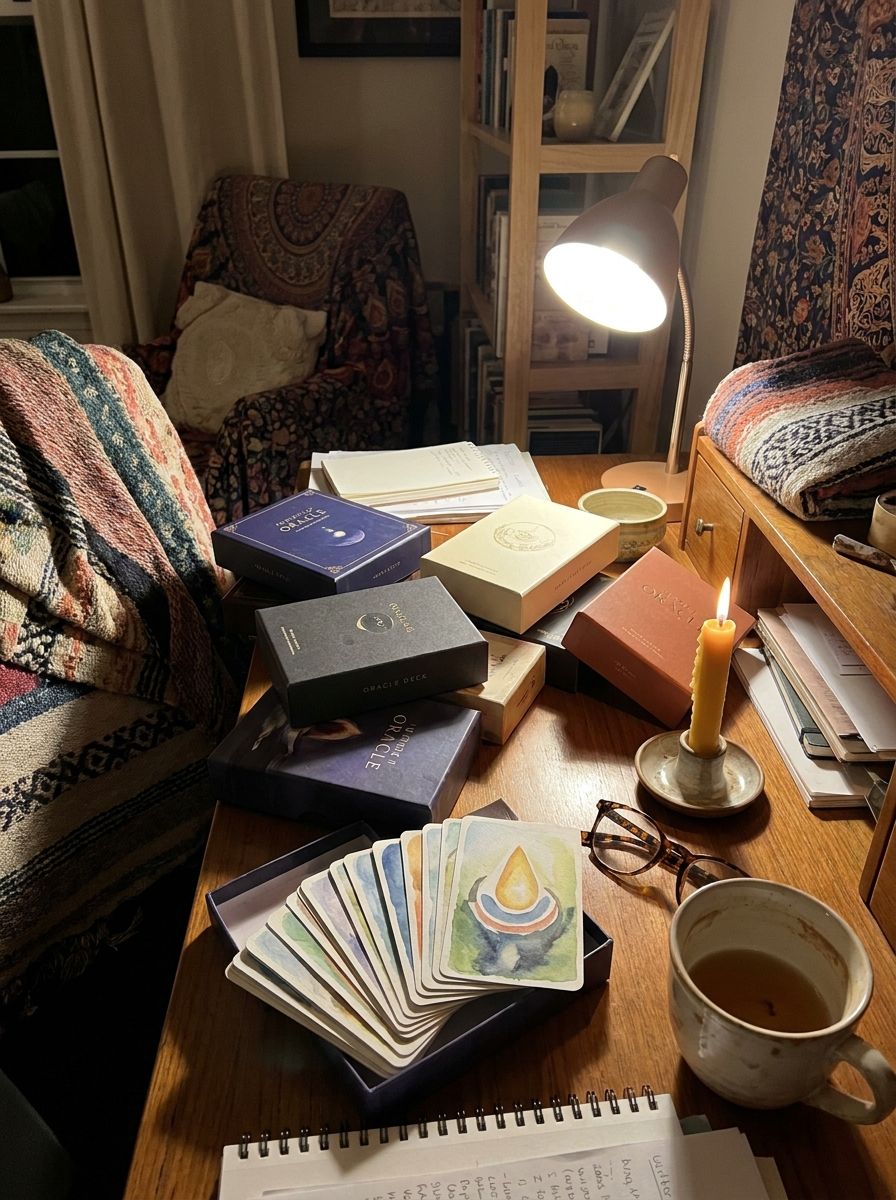
The deck I kept was the one I chose for a different reason. I knew what I was carrying, and that deck was about exactly that. It gave me words for it.
Start with what you are carrying
Most guides tell you to choose by the art, and art matters. You will spend a lot of time looking at these cards. But a beautiful deck that talks about the wrong thing ends up in a drawer, the way mine did.
So before you look at a single cover, finish this sentence: Right now I keep coming back to… Grief. A body that will not settle. A decision. A family table you dread. Whatever you wrote is the theme to look for.
Choose by what you are working through
I group my own decks this way on the collections page. Here is the short version.
Coming home to the body
- Gut-Brain Harmony. For when stress lands in your stomach first, and you want to listen to it instead of arguing with it.
- Vagal Compass. For when your nervous system runs hot and you want a small daily way back to steady.
- The Table of Connection. For holiday gatherings and shared meals, when the table itself is the hard part.
- Mindful Awareness. For a gentle daily ritual of stillness and presence.
Solitude and the wider sky
- Walden. For simplicity, and the part of you that wants fewer, quieter things.
- The Emerson Oracle. For when other people’s voices are getting louder than your own.
- Transcendent Ecstasy. For self-discovery and the flow state, when you want wonder more than answers.
- The Stoic Oracle. For sorting the day into what is yours to control and what is not.
For hard seasons
- Resilience Blueprint. For the long, hard stretches, and the strength you keep finding underneath them. It was the first deck I made.
- Cognitive Reappraisal. For loosening an old story about a hard moment so you can meet it from steadier ground.
- Overcoming Loneliness. For when the world feels far away and you are finding your way back to people.
- The Gold in the Dark. For shadow work: what you buried, and what it cost.
Old stories, living practice
- Hearth & Hedge. For hearth and hedge craft: herbs, household ritual, and the real folk history behind them.
- The Trickster Oracle. For when you are stuck inside a frame you cannot see, told through trickster stories from around the world.
- The Yule Beasts. For the long nights of winter, told through forty animals from midwinter folklore and the wild, from the Yule Goat to the bear asleep in its den.
Three things to check before you buy
- Words on the cards. Some decks are image only. A title and a short line on the card face let a single draw make sense before you open the book.
- The guidebook. A good one gives each card more than a keyword. Each of my decks comes with a full guidebook and an entry for every card.
- The size. My decks come in 36, 40, and 44 cards. A smaller deck is quicker to get to know. Neither is better; it depends on how much time you want to spend learning it.
Meet the deck before you buy it
You do not have to judge a deck from a box photo. Every deck in my shop has a View Cards button that opens the whole deck, card by card, art on one side and meaning on the other.
If you want to feel how a deck answers, the free reading lets you pick a deck and flip three cards, up to three readings a day. And if you have heard that your first deck has to be a gift, you can set that rule down.
One small next step
Write your sentence on paper: Right now I keep coming back to… Find the group above that holds your answer, and open one deck from it, card by card.
If a card makes you stop and read it twice, that pause is worth trusting.
Zara