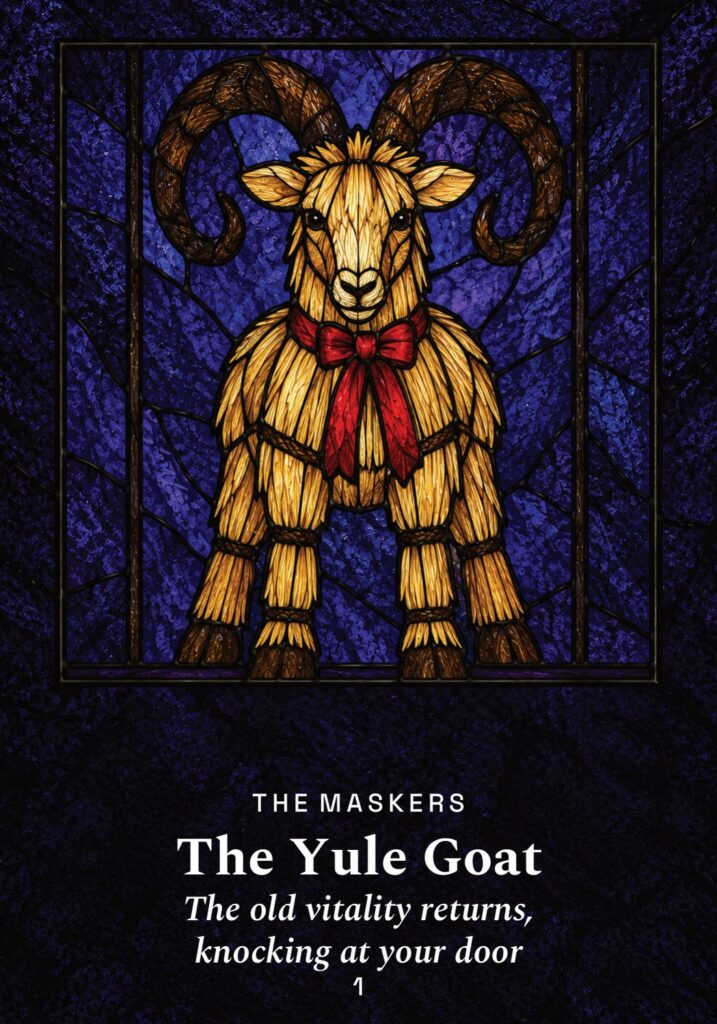
What The Yule Goat means
In Sweden the julbock was a frightening visitor who later turned gift-bringer, and in Finland the nuuttipukki went house to house in straw and horn around St. Knut's Day, demanding food and drink. The staged death-and-revival motif belongs farther east, in the Polish and Ukrainian goat plays. Either way the goat carries the harvest's vitality through the dead of winter. This card says the life force in you is not gone. It is at the door, loud and a little rude, asking to be let in.
In a reading this card usually turns up for someone who has been describing themselves as tired for so long that the word has stopped meaning anything. What I look for is whether the life around that tiredness has gone quiet by degrees, and whether the person has started mistaking the quiet for who they are. I read The Yule Goat as a sound at the door in the middle of that quiet: something loud, a little rude, and unmistakably alive, asking whether anyone in the house is still awake enough to answer. Around the winter solstice I draw it more than at any other time of year, which does not surprise me. The dark is when people notice they have gone dim.
In shadow, vitality that demands and never gives becomes a guest no one wants, and the reading has to ask whether you are bringing energy into the room or extracting it. I have met the extracting kind. The person who arrives at full volume, needs an audience for their aliveness, and leaves everyone else drained is not the goat at the door. They are the door itself, jammed open, letting the heat out. The card does not withdraw its welcome from that person. It just asks them to check which way the energy is flowing before they decide they are the life of the party.
I open the door to my own returning strength.
When The Yule Goat appears in a reading
When this card leads a reading, I do not go looking for what drained the person. I go looking for the knock. Something has been trying to get their attention: a pull toward a walk they keep not taking, a song they turned off, a friend's invitation left unanswered, an old appetite that surfaced last week and got filed under later. The Yule Goat is that pull, and it does not go quiet when ignored. It gets ruder. So I ask the person to tell me the most annoying thing that has been asking for their energy lately, and we usually find the goat standing right there.
The way I work it is by letting the body answer before the mind can vote. I pick one physical thing I have been calling myself too tired for, and I do it before I have finished deciding whether I am too tired, because the deciding is where the tiredness lives. The task can be small: a walk to the end of the road, one corner cleared, a kitchen dance to a song I have not played in years. What I am watching for is the moment the energy arrives partway through, which it usually does, and which is the whole news the card came to deliver.
Beside The Brown Bear, I read the pair as a question of timing rather than a contradiction: one card says rest, the other says rise, and the answer is usually that the den has done its work and the person has not noticed. Beside The Kurent, both cards are shouting, and I take that as a reading with no ambiguity at all. Where I keep this card distinct from The Turoń is in who has to move. The Turoń needs the household to revive it. The Yule Goat is already up, already loud, and needs nothing but a door.
One small sideways move
Say yes to the next invitation that makes you sigh, and go.
The Yule Goat in the Long Night Spread
The Yule Beasts guidebook’s three-card Long Night Spread is the deck’s core reading, for a season that is ending while the next one has not started. Laid left to right, it names what is ending, what holds you in the deepest part of the dark, and what is quietly returning. In each position this card tends to say:
- Dusk. At Dusk, what is ending is the long quiet you mistook for your own character, and the settled arrangements that grew up around it while you were dim.
- Midnight. At Midnight, the knock is what holds you: a rude, alive, unignorable demand that you decide whether anyone is awake in the house.
- Dawn. At Dawn, what returns is appetite. Not a plan for aliveness, the thing itself, wanting to be let in and fed before it is understood.
Journal prompts
- What part of my aliveness went dormant this year, and what would welcoming it back look like?
- Where am I waiting for permission to be loud again?