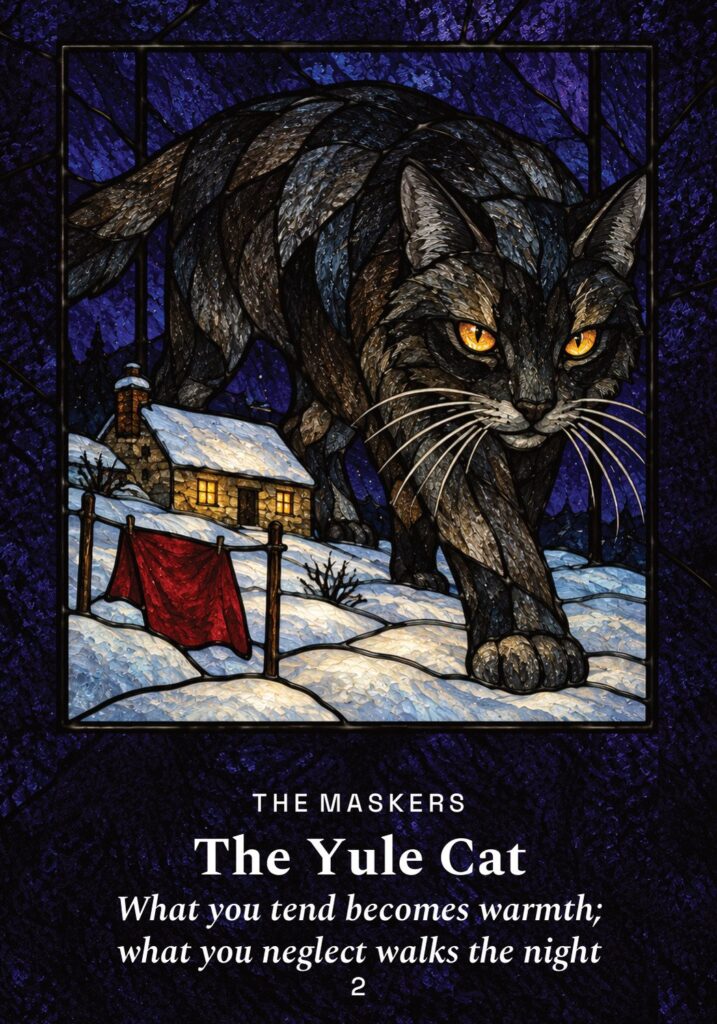
What The Yule Cat means
Icelandic folklore, written down in the 1860s, tells of a monstrous cat that circles the houses on Christmas Eve and takes anyone who received no new clothes. People have long explained it as a spur to finish the autumn's wool work before the holy night, though that reading is younger than the tale. Either way the bargain is the same. This card is about diligence as a form of love. What you tend faithfully becomes warmth for someone.
When The Yule Cat comes up, the reading is usually about something half finished. Not a grand project, usually. A hem, a form, a conversation, a repair that has sat on the counter through two seasons of weather. The person knows exactly what it is before I have finished turning the card over. What I find useful about this beast is that it refuses the sentimental version of care. It does not ask whether you love the people you live with. It asks whether the sleeve got sewn, because the sleeve is the love, and the cold does not accept intentions.
In shadow, the cat turns cruel when worth gets measured in output, and if you are treating rest as a moral failure, in yourself or in others, the beast is wearing your face. I watch for this in readings where the person already works too hard, because the card can be misread as one more lash. It is not. The tale is about finishing what you started for the people who will wear it, not about producing until you drop. A person who cannot sit down without guilt has not been diligent. They have been hunted, and the hunter has their own eyes.
My steady work clothes the people I love, including me.
When The Yule Cat appears in a reading
When this card leads a reading, I go straight for the one sleeve. I ask the person to name the single unfinished thing that they think about most and touch least, and I stop them when they try to answer with a project. A project is not a sleeve. A sleeve is a form that needs a signature, a hem that needs an hour, a message that has been drafted three times and sent zero. The Yule Cat is not interested in the person's whole workload. It is interested in the one piece of tending that, left undone, is letting cold into a room where someone they love is sitting.
My practice with it is to finish that one small thing before the day is out and to stop there, on purpose. Not the next task, not the momentum, not the list. One sleeve, done, and then the needle goes down. What I notice afterward is that the finished thing throws off more warmth than its size explains, because it was never really about the hem. It was about the fact that someone I care for, sometimes myself, has been walking around in an unfinished garment for a season while I circled the work.
Beside The Nativity Donkey, I read the pair as two different kinds of labor: the donkey's is carrying and the cat's is finishing, and a person can be excellent at one and terrible at the other. Beside The Brown Bear, I read the cat as the thing to complete before the den, so the rest is not spent half awake, listening for a sleeve. Where I keep it distinct from Krampus is that Krampus arrives after the neglect has earned its consequence. The Yule Cat arrives while the wool is still on the needles.
One small sideways move
Pick up the thing you drafted three times and never sent, and send it as it stands.
The Yule Cat in the Long Night Spread
The Yule Beasts guidebook’s three-card Long Night Spread is the deck’s core reading, for a season that is ending while the next one has not started. Laid left to right, it names what is ending, what holds you in the deepest part of the dark, and what is quietly returning. In each position this card tends to say:
- Dusk. At Dusk, what is ending is the season of circling: the long habit of keeping the unfinished thing in sight and out of hand.
- Midnight. At Midnight, what holds you is the cost. The neglected sleeve is letting cold into a room, and the cat walks the perimeter, counting who is uncovered.
- Dawn. At Dawn, the returning thing is warmth made by hand, one finished piece at a time, worn by someone who never had to ask for it.
Journal prompts
- What unfinished task is quietly costing me warmth?
- Whose labor kept me clothed this year, and have I said so?