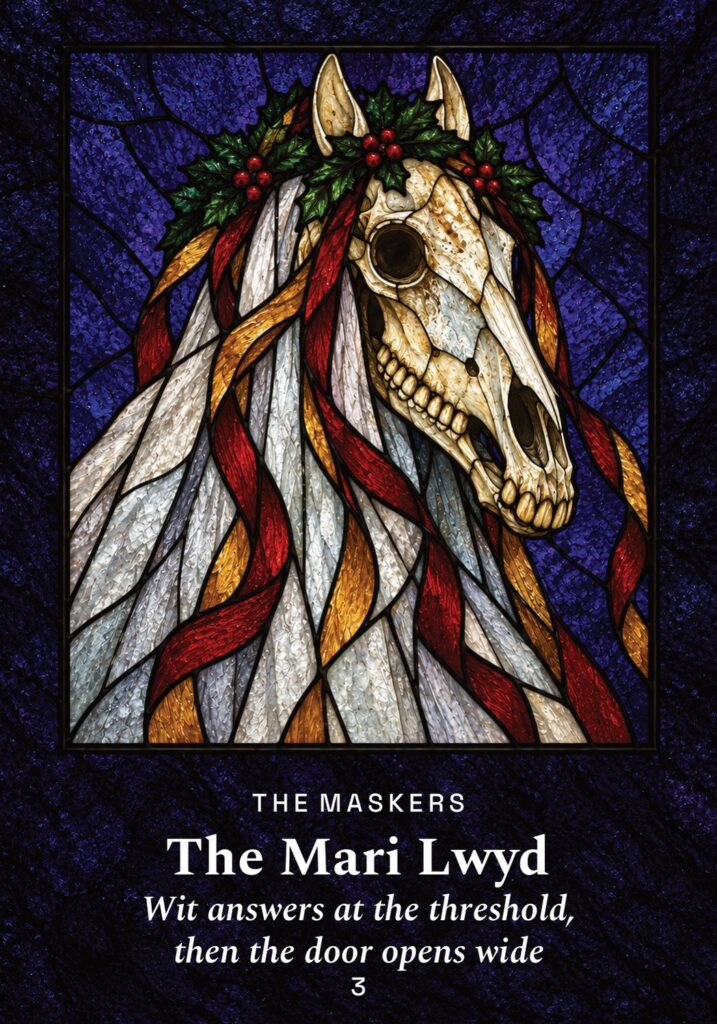
What The Mari Lwyd means
In South Wales, a horse's skull draped in white and ribboned bright is carried to the door at midwinter, and the contest begins: verses traded between the mare and the household, insult and wit, until one side falters and the door opens to food and beer. The custom is real and at least two centuries old. This card brings a challenge that wants engagement, not avoidance. Meet what rattles at your door with wit, and then let it in.
This card lands in readings about a confrontation the person keeps postponing, and the tell is that they have already lost it several times in their head. They have imagined the other side's best lines and their own worst silence. What the Mari Lwyd brings to that is the shape of a contest that is meant to be enjoyed. The skull at the door is grotesque and the verses are rude, and the whole point is that both sides are supposed to be having a good time. I read it as permission to stop treating the dreaded conversation as a trial and start treating it as a game with a table waiting at the end of it.
In shadow, a door kept forever shut wins nothing, and a contest carried past the welcome turns hostile, so the reading has to know when the verses are done and the table should be set. Some people love the sparring so much that they never open the door. They are witty, they are quick, and they are alone on the doorstep at midnight with a horse skull, still trading insults with a house that stopped answering an hour ago. The card admires the wit. It does not admire the wit that forgot what the wit was for.
I can meet what challenges me with humor and still keep my footing.
When The Mari Lwyd appears in a reading
When this card leads a reading, I ask the person to say the opening line of the dreaded conversation out loud, right there, once. Not the whole thing. The first sentence. What usually happens is that they hear how grim they have made it, and the Mari Lwyd's whole gift is to suggest that the line could have a little play in it. The mare at the door is a skull with ribbons, and the verses it trades are meant to be funny. So I ask for a second version of the line, and I ask for it to be a shade lighter, and something in the person's shoulders comes down.
The way I work it is to rehearse only the threshold and never the outcome. I say my first line aloud, I give it some wit, and I stop, because the contest at the door is a few verses long and then the food comes out. Rehearsing the whole exchange to the end is how a person loses it in advance. What I am practicing is entering with a bit of nerve and a bit of humor, which is a different skill from winning, and the one the mare is actually testing.
Beside Krampus, I read the pair as a confrontation that needs both wit and a settled account, and I take the reckoning first. Beside The Nativity Lamb, the two cards argue about armor, and I usually side with the mare: there are doors where softness is the right entrance, but this one is asking for a verse. Where I keep the Mari Lwyd distinct from The Habergeiß is that the goat-bird unsettles you to teach you. The mare challenges you so it can come in and eat.
One small sideways move
Send the message you have been drafting as a wall of text, cut to three lines, with one of them a joke.
The Mari Lwyd in the Long Night Spread
The Yule Beasts guidebook’s three-card Long Night Spread is the deck’s core reading, for a season that is ending while the next one has not started. Laid left to right, it names what is ending, what holds you in the deepest part of the dark, and what is quietly returning. In each position this card tends to say:
- Dusk. At Dusk, what is ending is the avoidance: the long silence you have been keeping at a door that has been rattling for weeks.
- Midnight. At Midnight, what holds you is the contest itself, verses traded in the dark, and the discovery that you are quicker on your feet than the dread predicted.
- Dawn. At Dawn, what returns is the table: the door open, the challenger fed, and a warmth that was on the other side of one sharp exchange the whole time.
Journal prompts
- What challenge am I refusing to answer because I might lose the exchange?
- When did sharp wit last cost me a warm room?