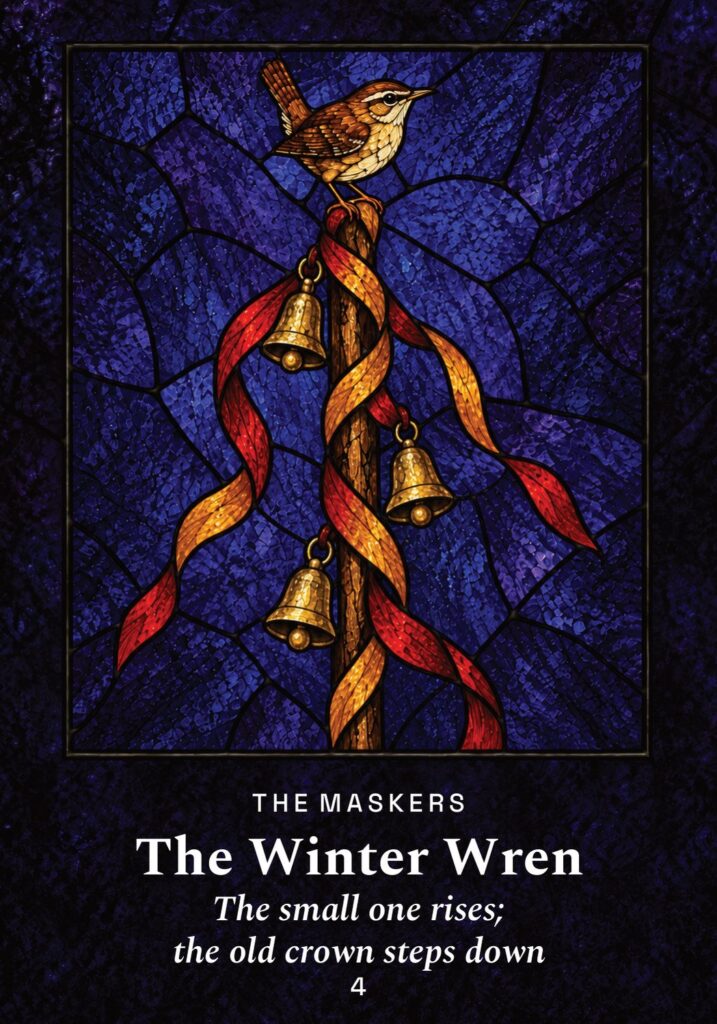
What The Winter Wren means
On St. Stephen's Day in Ireland, wren boys carried a wren on a decorated branch from door to door, singing for coin. The bird is called the king of all birds, and the hunt is often read as the old year's sovereign brought down so the new can rise, though that reading is ours more than theirs. In the fable the wren won its crown by riding hidden on the eagle's back. This card marks a turning of power. Something small rises. Something crowned steps down.
When The Winter Wren appears, I look for the role in the person's life that has quietly outlived its season. It is often something they were proud of: the one who organizes, the one who fixes, the one who holds the family together, the expert, the eldest, the strong one. The role still fits in the mirror. It no longer fits in the room. What the card describes is not a fall from that position but a turning, the kind where a small and overlooked thing, sometimes a younger person, sometimes a quieter part of yourself, is ready to come forward and the old crown has to step down to make the space.
In shadow, the reading has to watch two failures at once: sacrificing the small and blameless to mark an ending, and clinging to a crown the season has already taken, because both keep the year from turning. I see the first one when someone decides that change requires a victim, and picks the one least able to object. I see the second one more often. The crown was heavy and they complained about it for years, and now that it is lifting they discover they had no idea who they were underneath it. The wren rode the eagle's back. It did not fight the eagle for the sky.
I can release an old role without releasing my worth.
When The Winter Wren appears in a reading
When this card leads a reading, I ask the person what they are the outgoing king of. It sounds like a joke and it is not. Everyone has a crown they are still wearing out of momentum: a title at work, a role in the family, an identity from a decade ago that nobody else has updated because they never announced the change. The Winter Wren points at the one that is heaviest right now. Then I ask the second question, which is who or what is small and overlooked and ready to rise, and it is often a part of the person themselves that got no airtime while the crown was on.
My practice with it is to write the old title on a piece of paper and put it where I will see it daily, not to burn it or bury it, just to watch. Watching is the method. Over a week or two the title starts to look like a costume rather than a fact, and that loosening is what lets it come off without a fight. I do not force the abdication. The season does that. I just stop pretending the crown is my head.
Beside The Snowshoe Hare, I read the pair as a change of coat that is also a change of station, and I take the hare's warning about keeping the creature underneath intact. Beside The Brown Bear, the wren tells me which role to leave outside the den. Where I keep it distinct from The Schnabelpercht is that the beaked figures clean corners, and the wren changes who sits on the chair. One is about what you keep in the house. The other is about who you are in it.
One small sideways move
Let someone younger or quieter run the next thing you would normally run, and do not correct them.
The Winter Wren in the Long Night Spread
The Yule Beasts guidebook’s three-card Long Night Spread is the deck’s core reading, for a season that is ending while the next one has not started. Laid left to right, it names what is ending, what holds you in the deepest part of the dark, and what is quietly returning. In each position this card tends to say:
- Dusk. At Dusk, what is ending is a reign: a role, title or place in the order that the season has already taken back whether or not you have handed it over.
- Midnight. At Midnight, what holds you is the space between crowns, when the old one is off and the small thing has not yet risen, and the dark asks who you are without a title.
- Dawn. At Dawn, the returning thing is a smaller sovereign, a quieter part of you or a person you overlooked, lifted up on a branch and given the year.
Journal prompts
- What am I the outgoing king of?
- What small, overlooked part of me is ready to be lifted up?