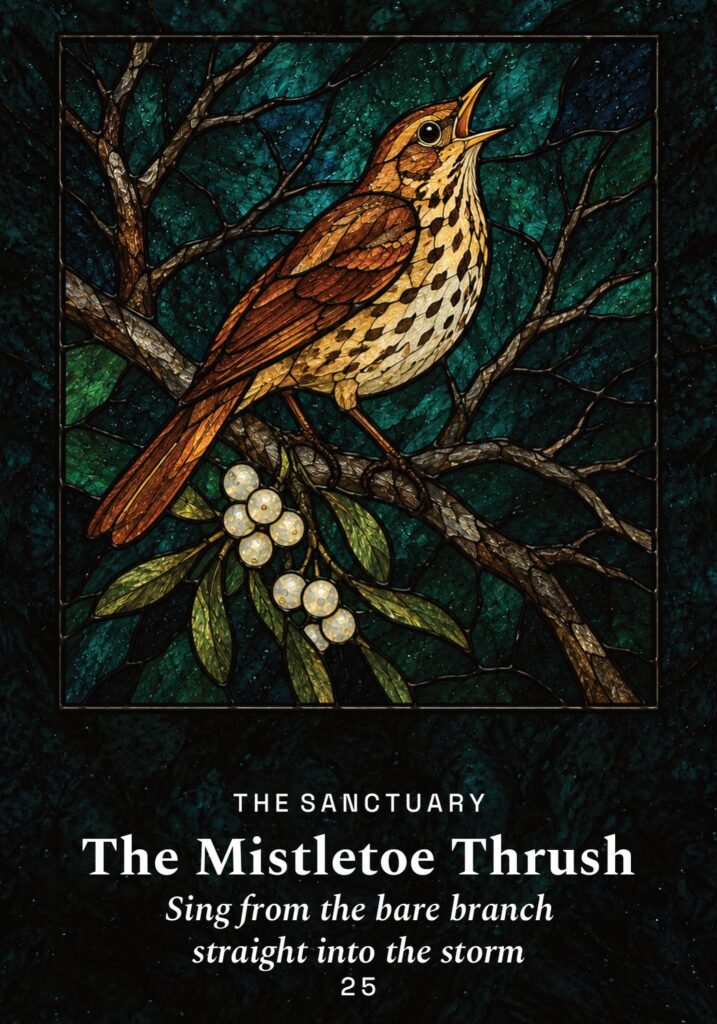
What The Mistletoe Thrush means
English country people named this bird the stormcock, because it sings from the bare top of the tallest tree in wind and rain, and starts in January when almost nothing else has begun. It eats mistletoe berries and carries the seed to new trees, planting the parasite that will take the wood it lives in. This card is defiant joy: the song delivered not after the storm but during it. Sing from the bare branch. It plants more than you know.
In a reading this card belongs to the person who has postponed their joy until conditions improve. The song is ready, the walk is planned, the call is drafted, and all of it is waiting for a better week. The Mistletoe Thrush does not wait. It sings from the highest bare branch in the wind and rain, in January, before anything else has begun, and the singing is what plants the seed. I read the card as a call to do the joyful thing mid-storm rather than after, and I draw it often around the winter solstice, when the storms are long and the temptation to wait them out is strongest.
In shadow, defiance sung alone at the treetop can shade into isolation, and guarding your berries too fiercely starves the spring, so the counsel is to sing into the storm but come down for supper. I watch for the person who has made a whole identity out of being the one who sings anyway. They are admirable and they are up a tree, and the people who love them are at the table below, wondering when the concert ends. The defiance is meant to be for something. Cut off from the supper, it becomes a performance of not needing anyone, and that is not what the stormcock was doing.
My voice does not wait for fair weather.
When The Mistletoe Thrush appears in a reading
When this card leads a reading, I ask what song the person has postponed until conditions improve, and I let song mean whatever it means to them: the call, the walk, the project, the laugh, the dinner with friends. Then I ask what the conditions are, and they describe the storm, and I point out that the Thrush is singing in it. The reading is not about toughness. It is about the timing of joy, and about the fact that a joyful thing done mid-storm plants something that the same thing done afterward does not.
My practice with it is to do the joyful thing in the middle of a hard day rather than saving it for a better one. Mid-storm, not after. I choose it in advance, so that the storm cannot argue me out of it when it arrives, and I do it whether or not I am in the mood, because the mood is the weather and the thrush is not consulting the weather. What the practice teaches me is that the song does not need fair conditions to work. It needs a bare branch and a bird willing to open its throat.
Beside The Kurent, I read the pair as two kinds of noise against the season, one from the treetop and one from the lane, and I take it as a strong prescription for volume. Beside The Snow Goose, the goose reminds the singer to come down for supper and I make sure the person heard it. Where I keep The Mistletoe Thrush distinct from The Christmas Rooster is that the rooster announces a dawn it believes in. The thrush is not announcing anything. It is singing because it sings, and the storm is not a reason to stop.
One small sideways move
On the next bad day, do the thing you were saving for a good one, before noon.
The Mistletoe Thrush in the Long Night Spread
The Yule Beasts guidebook’s three-card Long Night Spread is the deck’s core reading, for a season that is ending while the next one has not started. Laid left to right, it names what is ending, what holds you in the deepest part of the dark, and what is quietly returning. In each position this card tends to say:
- Dusk. At Dusk, what is ending is the postponement: the joy filed under later, waiting for a weather that was never going to arrive on request.
- Midnight. At Midnight, the wind is up and the branch is bare, and what holds you is the song delivered anyway, straight into the storm, planting what it plants.
- Dawn. At Dawn, what returns is the new tree the seed found, and a joy that no longer waits for fair weather to exist.
Journal prompts
- What song have I postponed until conditions improve?
- Where has my defiance stopped protecting me and started isolating me?