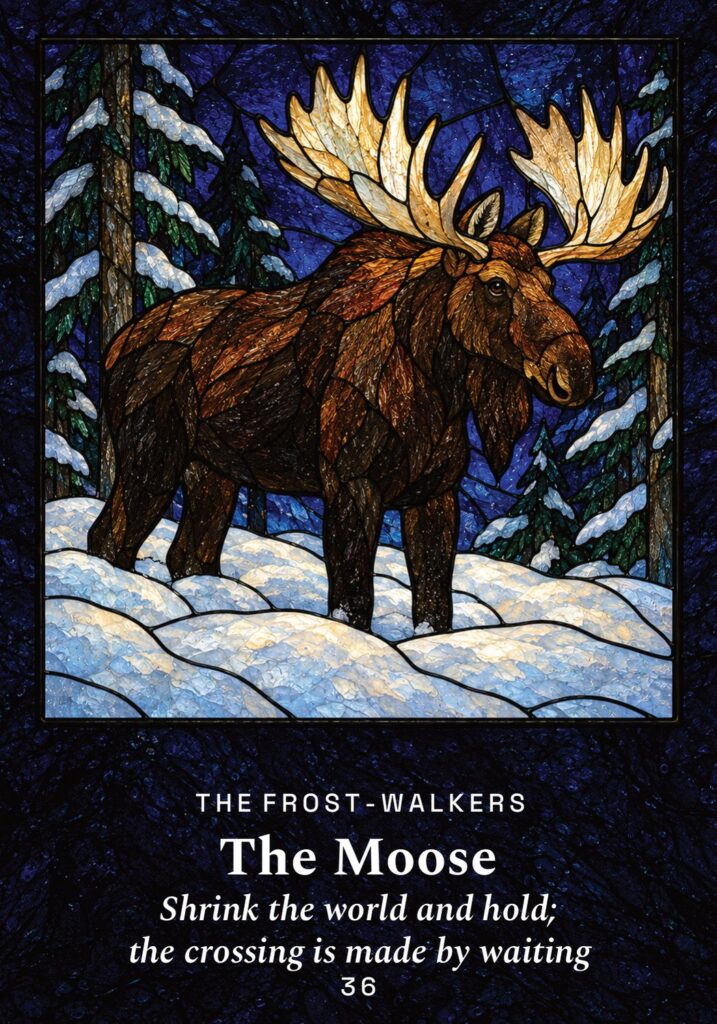
What The Moose means
Long legs suggest the moose walks through anything. It does not. In snow no deeper than your knee it stops covering ground, holding in the mature timber, spending nothing, until melt. That is the strategy: shrink the world rather than fight it. The Anishinaabe call it mooz, the twig-eater, and hang the beard in a tree so the moose is acknowledged among the stars. This card is for the long crossing. Stop pushing.
When The Moose comes up, the person is pushing through something that does not respond to pushing. The snow is deep, every step costs more than it covers, and they have been told all their life that long legs mean walking through anything. The moose does no such thing. It stops, holds in the mature timber, spends nothing, and waits for melt. I read the card as a strategy rather than a surrender: shrink the world to the size that can be held, feed yourself in it, and let the conditions change, because they will, and forcing them will not make them change faster.
In shadow, waiting becomes hiding when the snow has gone and you are still standing in the timber, and stillness that suits the moose can overwinter into isolation that does not suit you. The card is honest about its own risk. A person who learns to hold can forget to move, and the timber that sheltered them becomes the whole world. I check by asking about the snow. If it is still deep, hold. If the person has not looked out of the timber in a while and is not sure, the reading sends them to the edge of the trees to check the depth, because the crossing is made by waiting and then by walking.
I can stop pushing and still be getting through.
When The Moose appears in a reading
When this card leads a reading, I ask what the person is forcing that would move on its own if they waited, and I ask them to separate that from the things that do need pushing. The pile of forced things is usually larger than they thought. The relationship being hurried toward a definition, the project being dragged across a deadline nobody set, the reconciliation being scheduled. The Moose stands in the timber and spends nothing. So I ask the person what holding would look like for one of those things, and what they would eat while they held, because the moose is not starving in the trees. It is feeding.
The way I work it is to take the thing I have been forcing and stop forcing it for one week, and to spend the week holding my ground and feeding myself rather than pacing. The feeding is what makes it a strategy and not a sulk. I keep the routines that keep me alive. I do not check on the forced thing daily. I let the snow do what snow does, which is change. What the practice teaches me is that most of what I pushed at moved anyway, and the pushing had mostly been costing me the energy I would need when the melt came.
Beside The White Stag, the two cards argue about whether to move or hold and I settle it by the depth of the snow. Beside The Brown Bear, I read the pair as two ways of spending nothing, one in the den and one in the open, and I ask which the person can actually do. Where I keep The Moose distinct from The Ringed Seal is that the seal keeps working at one small opening all winter. Nothing gets worked at in the timber. The moose narrows its range, spends nothing, and lets the melt do the crossing.
One small sideways move
Stop checking on one thing you have been pushing, for seven days, and cook yourself something good every one of them.
The Moose in the Long Night Spread
The Yule Beasts guidebook’s three-card Long Night Spread is the deck’s core reading, for a season that is ending while the next one has not started. Laid left to right, it names what is ending, what holds you in the deepest part of the dark, and what is quietly returning. In each position this card tends to say:
- Dusk. At Dusk, what is ending is the forcing: the belief that long legs mean walking through anything, and the exhaustion of proving it in deep snow.
- Midnight. At Midnight, the timber is dark and the snow is to your knee, and what holds you is the hold itself, the world shrunk to what can be kept and fed.
- Dawn. At Dawn, what returns is the melt, arriving on its own schedule, and a crossing that turned out to have been made by the waiting.
Journal prompts
- What am I forcing that would move on its own if I waited?
- Where has my patience quietly become a place to hide?