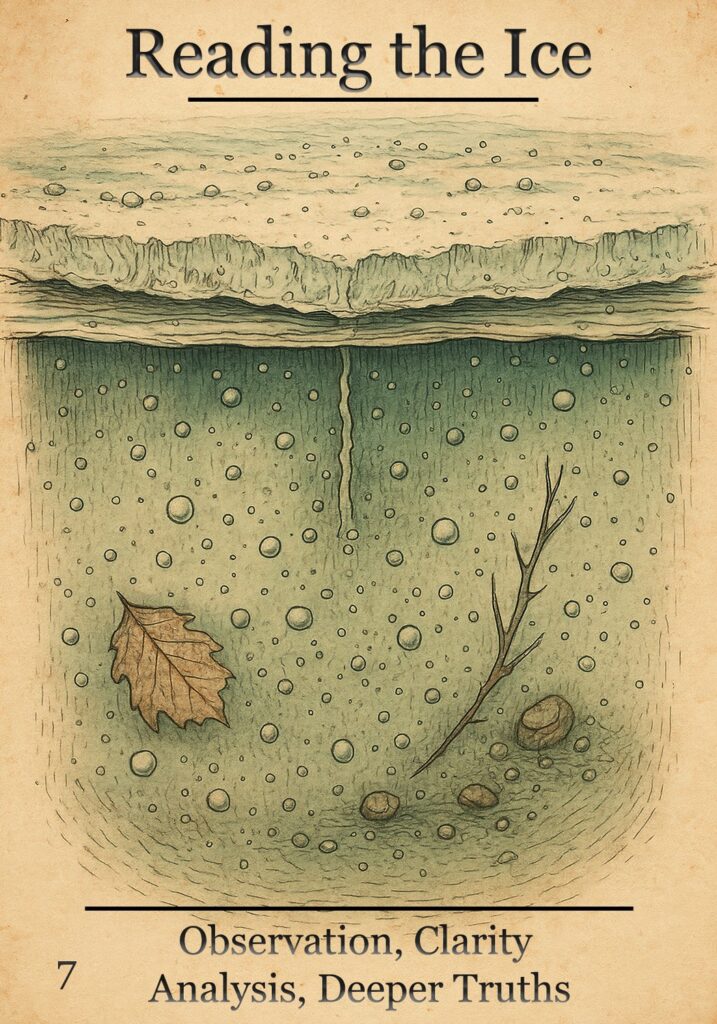
What Reading the Ice means
This card is about looking closely at the details of a situation to understand its deeper truths. Like an explorer examining the patterns and currents frozen in the ice, you are being called to observe, to analyze, and to gain clarity by paying attention to what others might overlook.
Reading the Ice often shows up when a person senses something is off but cannot say what. A colleague has gone quiet, a relationship feels different, the numbers look fine and yet something nags. The card's face shows a slab of ice in cross-section, bubbles and a single leaf held in the clear layer, with darker water below. I read it as an invitation to look at a situation the way a person looks through clear ice: patiently, from an angle, noticing what is suspended inside it. The detail that matters is often small and has been there for a while, frozen in plain sight.
Where it goes wrong is analysis that never ends. The person gathers detail after detail, reads every message twice, tracks every shift in tone, and builds a careful map that never gets used. Observation becomes a hiding place from the decision the observation was meant to inform. A second risk is reading too much into the patterns, seeing intent in an accident or a message in a coincidence. Ice has bubbles because water has air in it, not because it is sending a signal. The card asks for close attention and a fair conclusion, then a willingness to act on what was seen.
I see with a clear mind and an open heart, and I discover the truth in the details.
When Reading the Ice appears in a reading
My first question with Reading the Ice is what the person has noticed that they have not said out loud. There usually is something: a remark that did not fit, a change in a routine, a charge that keeps reappearing on the statement. I ask them to describe it in plain words, without interpretation, the way a witness would. Then I ask what else could explain it. The card is not looking for suspicion. It wants clarity, and clarity usually comes from holding two or three possible explanations at once until the evidence picks one.
My practice with the card is a short observation log. For three days I write down, in one or two lines each evening, what actually happened in the situation that is bothering me. Facts and nothing else: who said what, what changed, what stayed the same. I do not add theories until the third day. When I reread the three entries together, the pattern is usually clearer than it was in my head, and sometimes it is smaller than I feared. If three days is too long to wait, I write down one observation now and one tomorrow, and that is enough to start.
Beside The Frozen Pond, I read the pair as looking closely at a still season instead of assuming it is empty. Beside The Autumn Mist, the card warns that clarity may not be available yet, so watch without forcing a conclusion. Where I keep Reading the Ice distinct from The Sound of the Owl is method. Reading the Ice works by looking at the details. The Owl works by listening in the dark, to intuition, when the details are not visible at all.
One small deliberate act
Write down three plain facts about a situation that has been bothering you, with no interpretation, and read them back before you decide what they mean.
Reading the Ice in the Pond Spread
The Walden Oracle guidebook’s three-card spread is The Pond Spread, for any situation that looks one way from the outside and feels another underneath. The cards are laid in a vertical line like layers of water: the surface, the depths, and the bottom. In each layer this card tends to say:
- The Surface. Reading the Ice shows a situation that seems settled and readable at a glance, nothing worth a second look.
- The Depths. It points at a small detail you noticed and set aside because it did not fit the story you were already telling.
- The Bottom. It says the truth here is visible to anyone patient enough to look at it from another angle.
Journal prompts
- What "small details" have I been ignoring in my life or a specific situation that might hold a larger truth?
- How can I practice more intentional observation in my daily life?