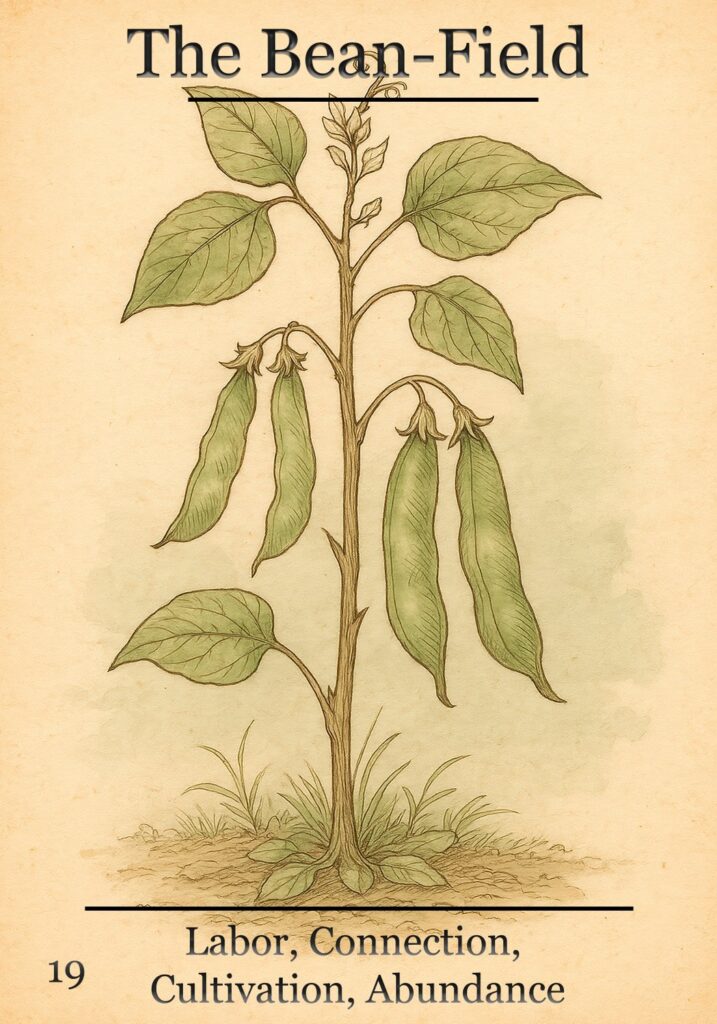
What The Bean-Field means
This card represents honest labor that creates a life of purpose. It reminds you that abundance is cultivated, not given, through consistent effort. Find meaning in your work and see your daily tasks as a form of sacred, creative expression that sustains you.
The Bean-Field tends to turn up in the middle of a long, unglamorous stretch of work: a course finished at night after the day job, a small business in its third year, a garden that has eaten every Saturday since April, a savings account being rebuilt twenty dollars at a time. The person is usually tired and a little embarrassed by how little there is to show. I read the card as a statement about where they are in the season, not a verdict on the work. Rows are in, weeds are down, and not much is visible above the soil yet. Thoreau asked, "What shall I learn of beans or beans of me?" That question sits at the heart of the card for me, because it turns the field around and asks what the work is growing in the person doing it.
Where it goes wrong is treating effort as a down payment that the world now owes interest on. The hours get logged like a grievance, and every week the harvest does not arrive on schedule becomes evidence that the field is cheating. Another version is the person who cannot stop hoeing: the rows are long since clean, but work has become the way they prove they deserve to rest, so they never pick anything or sit down to eat it. Both forget that a field is tended for food. Labor that never reaches a table stops being cultivation and becomes a treadmill with dirt on it.
My consistent effort and hard work are planting the seeds for my greatest successes.
When The Bean-Field appears in a reading
When this card shows up, I ask the person to name the field in a single sentence, and then to tell me what they have actually harvested from it so far, however small. Most of them pause at the second question. They can recite the effort in detail and have never counted the returns, which is how a field starts to feel barren when it is not. I listen for the small yields they skipped over: a skill that is now automatic, a customer who came back, a Saturday morning that felt like theirs. Those quiet yields are usually what the card is pointing at.
My practice with the card is a harvest list, kept on paper near wherever the work happens. At the end of a working session I write one line about what came of it, not what I did: the second chapter finally has an ending, the tax form turned out to be manageable, the seedlings made it through the cold snap. If that feels like too much, I start with one line on Sunday covering the whole week. After a month the list does what memory will not: it shows the field producing at its own pace. This is the part of simple living I trust most, because it costs nothing and changes how the work feels without changing the work.
Beside The Loaf of Bread, I read the pair as labor that needs to reach a table: the work is fine, and the person has forgotten to eat what it makes. Beside The Walden Clock, the pair asks whether the pace is the person's own or one borrowed from someone faster. Where I keep The Bean-Field distinct from The Wood-chopper is the time scale. The Wood-chopper is today's work, warm by tonight. The Bean-Field is the season, planted in one month and picked in another, and its lesson is patience with the gap between effort and return.
One small deliberate act
Pick, use, or hand to someone one small finished thing your long project has already produced, so the work reaches a table today instead of waiting for the full harvest.
The Bean-Field in the Pond Spread
The Walden Oracle guidebook’s three-card spread is The Pond Spread, for any situation that looks one way from the outside and feels another underneath. The cards are laid in a vertical line like layers of water: the surface, the depths, and the bottom. In each layer this card tends to say:
- The Surface. The Bean-Field looks like plain hard work with little to show yet, and the card asks you to describe the field honestly before judging it.
- The Depths. It points at a quiet resentment that the effort has not been repaid on time, and asks whether the deal you are holding the world to was ever offered.
- The Bottom. The card lands on cultivation itself: the steady work is shaping you as much as the crop, and that return has already started.
Journal prompts
- What is the "bean-field" I am tending in my life right now, and what am I cultivating?
- What lessons can I learn about patience and reward from the act of planting and harvesting?