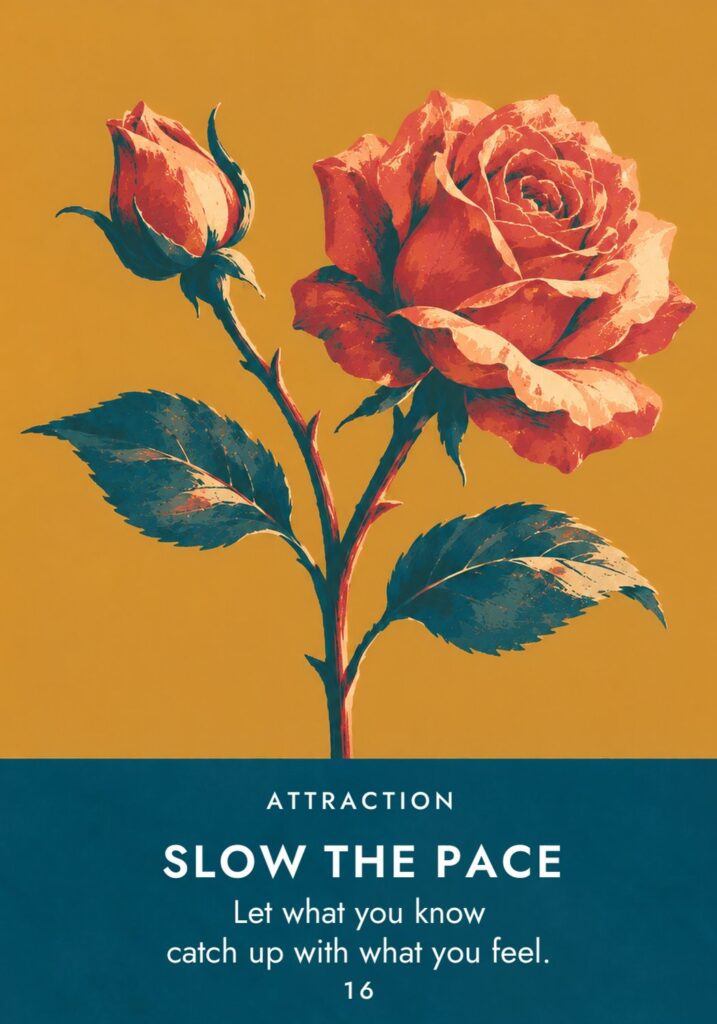
What Slow the Pace means
A powerful attraction creates a strong urge to collapse uncertainty quickly, through constant contact, rapid disclosure, early exclusivity, or a shared future sketched by the second week. Attachment anxiety sharpens that urge, and limerence makes reciprocation feel urgent. Slowing the pace is not playing hard to get. It is letting repeated behavior become visible. Do words and actions line up over time? How do they handle a no, a disappointment, your separate life?
Someone draws Slow the Pace eleven days into knowing a person and is already discussing a lease. Or a trip, or exclusivity, or what the holidays will look like. The feeling is enormous and the information is thin, and the person wants to close the gap by deciding something, because deciding feels like knowing. I read the card as a correction to the method. The gap between what is felt and what is known does not close by committing harder. It closes by time, and time is the one thing the urge cannot stand. The card is not asking the person to feel less. It is asking them to let the knowing take the time it takes, and to notice that the urgency is coming from inside the attraction, not from the facts.
In shadow, this becomes rushing to lock a bond down, or faking scarcity to manufacture pursuit. The rush is sincere and expensive. A label by week two, a key by week six, a shared account before anyone has seen the other one angry, each step chosen to end the uncertainty and each one making the eventual uncertainty more costly. The faked scarcity is the cynical cousin. The person has read that slow is attractive and performs it, leaving messages unanswered on purpose, declining a date they wanted, running a strategy instead of a life. That is not pacing. It is manipulation with better branding, and it tends to attract people who are playing the same game.
Slow is not cold. Slow is clear.
When Slow the Pace appears in a reading
If you draw this card, start by naming the decision you are itching to make. There usually is one. Then ask what you would know in three months that you do not know now, and whether the decision could wait for that. I read Slow the Pace as a card about letting repeated behavior become visible, and repetition needs repeats. One good weekend is a weekend. Four months of weekends, with a bad one in the middle, is a pattern you can read. The decision will still be available later. The information will not be available now, no matter how much you want it.
My practice with the card is to swap one future-shaped question for one present-shaped one. Instead of "where is this going," I ask "how did they handle it when the restaurant lost the reservation." Instead of "should I bring them to the wedding," I ask "what happened the first time I said I was busy." Then I give the present-shaped questions time to be answered by events rather than by conversation. I also stop treating the people around me as obstacles to the romance. If a friend says "that seems fast," I write it down. They are watching from outside the fog, which is a vantage point I do not have.
Beside Chemistry Is Data, I read the pair as a strong signal and an instruction to keep watching. Beside Secure Bond, the pair reads as a reassurance that going slowly is not the same as being guarded. Where I keep Slow the Pace distinct from Ready for Love is that readiness is about my capacity, and pacing is about the rate at which two people can actually learn each other. A person can be entirely ready and still be moving faster than the evidence.
One small honest step
Name the one decision that is running ahead of what you actually know about this person, and set it down until the evidence has caught up with it.
Slow the Pace in the You, Me, Us Spread
The Second Question guidebook’s three-card love reading is You, Me, Us, the classic layout with the positions changed so that none of them asks for mind reading. The first card is what I bring, the second is what their behavior has actually shown so far, and the third is what the dynamic needs for its next honest step. In each position this card tends to say:
- What I Bring. As What I Bring, the card says you have arrived with an urge to settle things quickly, and that urge is going to look like certainty to you and like pressure to the other person.
- What Their Behavior Shows. As What Their Behavior Shows, it asks whether their actions have had time to repeat yet, since a single good stretch is not a pattern, and whether they have shown you how they handle a no, a delay, or your separate life.
- What the Dynamic Needs. As What the Dynamic Needs, it points to time as the missing ingredient, not another conversation about the future, and suggests the next step is an ordinary month lived without a milestone attached.
Journal prompts
- What am I trying to know sooner than experience can honestly tell me?
- What would I learn by letting this unfold at the pace of mutual knowledge?