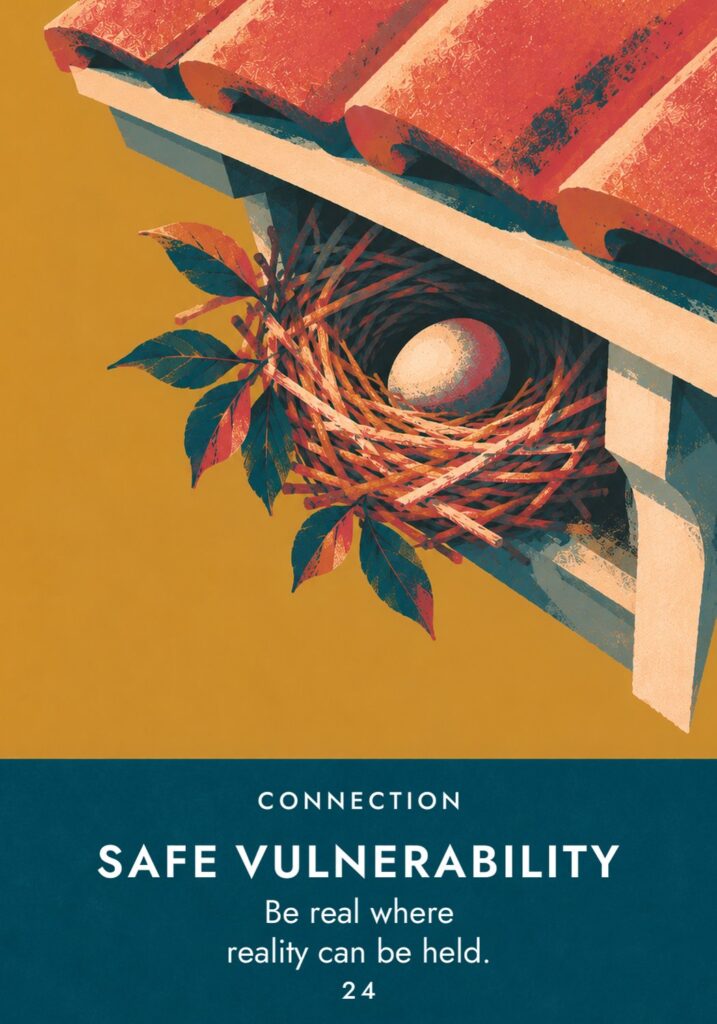
What Safe Vulnerability means
Vulnerability sits close to the center of courage, shame, and connection. In a relationship, it means letting something true be known when the response cannot be controlled. A fear, a request, a disappointment, a show of affection. The crucial word is safe. Vulnerability is not indiscriminate disclosure. Watch what someone does with a small truth before you hand them a large one. When openness is met with ridicule, coercion, or weaponized later, "be more vulnerable" is not good advice.
Safe Vulnerability comes up for two people who think they have opposite problems. One has told a new person everything by the second date, the family history, the last breakup, the thing they are ashamed of, and is now confused about why the closeness feels one-sided. The other has been with someone for years and has never said one true frightening thing, and is confused about why the relationship feels polite. I read the card as a question about proportion and sequence. The size of the truth should match the size of the trust, and trust is built by watching what someone does with a small truth before handing them a large one. Both people skipped that step, in opposite directions.
In shadow, this becomes hiding everything until no one can reach you, or disclosing too much too fast to force closeness. The hiding is the person who has decided that being known is the same as being exposed, and has built a life where nobody could possibly use anything against them because nobody has anything. It is safe and it is lonely and it is hard to tell the difference from inside. The disclosing is the person who uses confession as a shortcut, pouring out a large truth early so the other person feels obligated to match it. That is not openness. It is a bill, presented before the meal, and the other person often pays it and then quietly leaves.
I can let myself be known at the pace trust allows.
When Safe Vulnerability appears in a reading
The person who draws Safe Vulnerability is usually asking whether they should say the thing, and I turn the question around. I ask what this person has done with the smaller things already said. The time you mentioned a bad day. The preference you admitted. The small embarrassment you let slip. Was it held, or was it used, or did it vanish? That record is the reading. If the small truths were handled with care, the larger one has somewhere to land. If they were turned into a joke at a party, the question is not whether to be vulnerable. It is whether this is the place.
My practice with the card is to size the next true sentence to the trust already in the room, and to say that sentence rather than the one I am tempted by. On a third date the sentence might be "I get nervous before these." With a partner of ten years it might be a fear I have been carrying since spring. Either way, one true sentence, offered plainly, and then I watch. Not for a matching confession. For care. Did they slow down, did they ask a question, did they change the subject. I do the watching before I decide what comes next, because the response is information I need before the second sentence.
Beside Secure Bond, I read the pair as cause and effect: care taken with small truths is how the bond becomes the kind that can hold large ones. Beside Keep Their Dignity, the pair reads as a warning in the other direction, about what it means when a vulnerability shows up later as a weapon in an argument. Where I keep Safe Vulnerability distinct from Ask, Don't Assume is that Ask is about requesting information, and this card is about offering it. They are often the same conversation, and the offering tends to go first.
One small honest step
Recall the last small truth you told this person and write down, in one line, what they did with it, because that record is the answer to whether a larger one belongs here.
Safe Vulnerability in the You, Me, Us Spread
The Second Question guidebook’s three-card love reading is You, Me, Us, the classic layout with the positions changed so that none of them asks for mind reading. The first card is what I bring, the second is what their behavior has actually shown so far, and the third is what the dynamic needs for its next honest step. In each position this card tends to say:
- What I Bring. As What I Bring, the card says you have arrived either with everything on the table too soon or with nothing on it at all, and either way the pace of your openness is out of step with the trust that exists so far.
- What Their Behavior Shows. As What Their Behavior Shows, it asks what they have done with the small truths you have already shared, held, used, or forgotten, since that record decides whether a larger truth belongs here yet.
- What the Dynamic Needs. As What the Dynamic Needs, it points to one proportionate disclosure, offered and then watched, as the step that lets trust grow at the speed it can actually grow.
Journal prompts
- What truth wants expression, and what evidence says this is a safe place for it?
- Who has been careful with what I have already shared, and who has not?