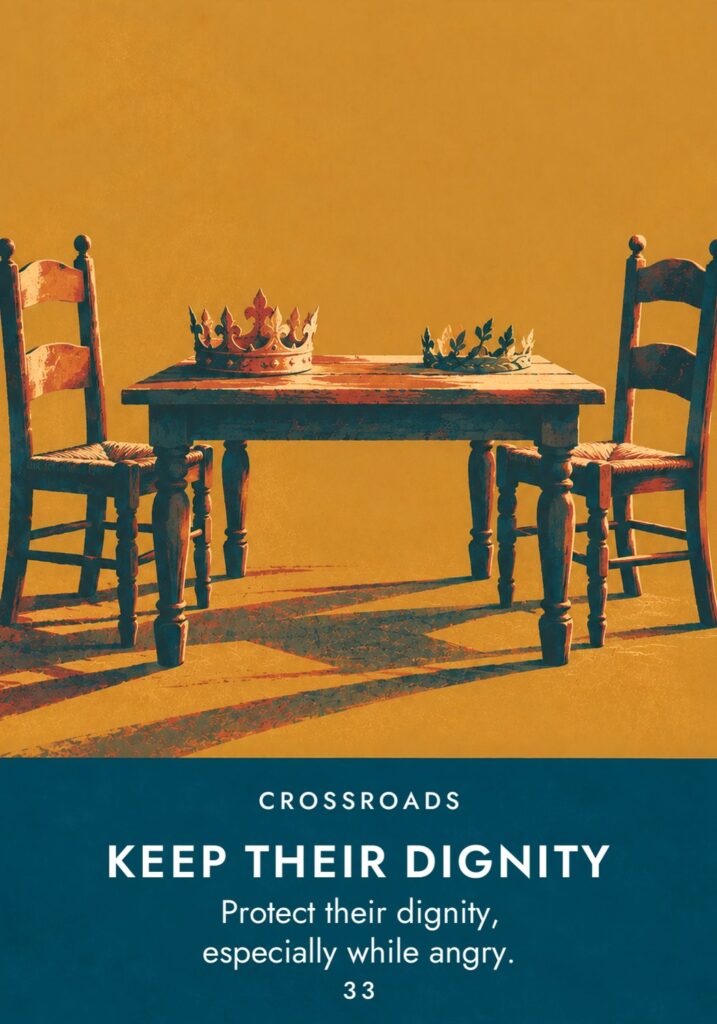
What Keep Their Dignity means
Contempt is disagreement delivered from above, as if the other person were beneath you. Researchers who study couples rank it among the most corrosive conflict patterns. What helps is steady appreciation: noticing what you respect in them and saying it out loud. This card is not here to predict a breakup. It asks whether disagreement can happen here without stripping someone of dignity. Respect does not require agreement, staying, or softening a boundary. It requires refusing to make humiliation the method.
Keep Their Dignity arrives when the person has started to feel superior to the person they are arguing with, and has noticed, and does not like it. The eye-roll. The sigh that means "here we go." The private sentence, "they're pathetic," that has begun to leak into the public ones. Sometimes the person drawing the card is on the receiving end, and the question they bring is whether disagreement in this relationship can happen without being made small. I read the card as a line, not a prediction. The line is between fighting about something and fighting from above it. Plenty of couples argue hard and stay whole. The ones that come apart, in my reading of the card, are the ones where one person has become the judge and the other the defendant.
In shadow, this becomes contempt disguised as honesty, weaponized vulnerabilities, or "respect" demanded as obedience. The disguise is the person who delivers cruelty and calls it candor, "I'm just being honest," as if the honesty excused the elevation. Weaponized vulnerability is the ugliest version: the thing shared in trust, months ago, brought out in a fight because it is the sharpest object in the room. And the demand is the inversion, where "you have to respect me" means "you have to agree with me," and any disagreement is treated as an insult to be punished. All three have the same structure. One person is above and the other is below, and the argument is no longer about anything but the height.
I can disagree without making anyone smaller.
When Keep Their Dignity appears in a reading
The person who draws Keep Their Dignity usually arrives with a long account of what the other person has done, and somewhere in the account there is a tone I listen for. It is the tone of someone describing a lesser being. I do not point at the tone right away. I ask what the person respects about the other one, and I wait, because the wait is the reading. If the answer comes quickly, the contempt is a mood and can be set down. If the person cannot think of anything, the card is asking a larger question than how to argue better.
My own practice with this card is to catch the internal sentence before it becomes an external one, and to replace it with a description. "They're an idiot" becomes "they left the thing on the counter again." "She's so needy" becomes "she asked where I was three times." The description is usually true, and the verdict usually is not, and the difference matters because the description can be discussed and the verdict can just be delivered. I also say one thing I respect about the person out loud, in the middle of an ordinary day, not as a repair, just as maintenance. It keeps the floor level for the next disagreement.
Beside Gentle Beginning, I read the pair as the two ways a hard conversation goes wrong at the start: criticism judges what someone is, contempt looks down on them for it. Where I keep Keep Their Dignity distinct from Safety Before Love is important and I say it plainly in a reading. This card is about disrespect inside a disagreement between two people who are safe with each other. It is not about humiliation used as a method of control. When the account I am hearing includes fear, the reading moves to card 39 and stays there.
One small honest step
Privately name one specific behavior you respect in the person you are most frustrated with, and keep it where you can find it before the next disagreement.
Keep Their Dignity in the You, Me, Us Spread
The Second Question guidebook’s three-card love reading is You, Me, Us, the classic layout with the positions changed so that none of them asks for mind reading. The first card is what I bring, the second is what their behavior has actually shown so far, and the third is what the dynamic needs for its next honest step. In each position this card tends to say:
- What I Bring. As What I Bring, the card says you may be carrying a view from above into this connection, a private verdict on the other person that is starting to show in the public sentences.
- What Their Behavior Shows. As What Their Behavior Shows, it asks whether their actions in a disagreement leave your dignity intact, no mockery, no use of what you shared in trust, no demand for agreement dressed as respect, and whether yours do the same for them.
- What the Dynamic Needs. As What the Dynamic Needs, it points to appreciation said out loud and contempt caught before it is spoken as the step that would let disagreement happen here without anyone being made smaller.
Journal prompts
- Where has my frustration turned into a story that I am simply better than them?
- What appreciation have I withheld because I am angry?