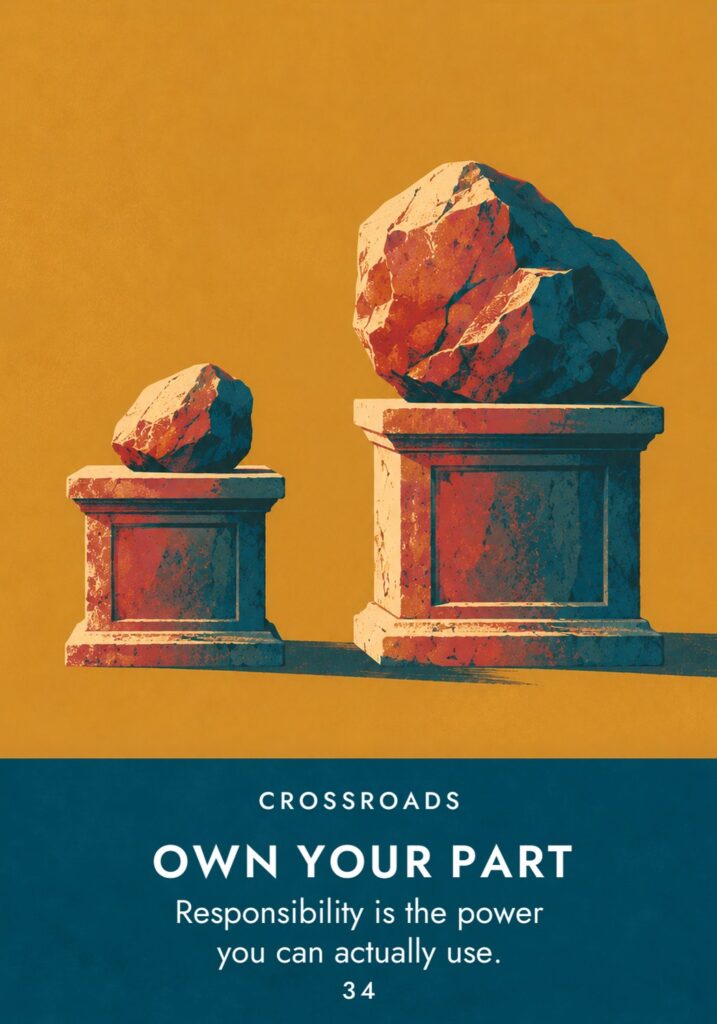
What Own Your Part means
Defensiveness is a reflex. Attacked, people explain, counterattack, or prove innocence. What helps is owning some of it, even a small piece. Not every conflict is fifty-fifty. The question is what portion is yours. Owning five percent is more useful than claiming fifty. A clean acknowledgment sounds like "you are right that I said I would call and did not. I see why that hurt trust." Your behavior is the one part you can change.
Own Your Part comes up in the middle of a defense. The person has been accused of something, and the accusation was partly unfair, and they have spent the last two days building a case that it was entirely unfair, because partly is harder to hold. The card is interested in the useful fraction. There is nearly every time some piece of a conflict that is mine, and it is rarely half. It might be ten percent. The card is not asking the person to take the blame. It is pointing out that the ten percent is the one piece of the situation they can actually change, and that defending the other ninety has been keeping them from touching it.
In shadow, this becomes total blame-shifting, or apologizing for having needs, being hurt, or reacting to harm you did not cause. The blame-shifting is the person for whom ownership is a loss, so every conflict becomes a tribunal in which they must be found innocent, and the relationship becomes a series of acquittals with nobody any closer. The over-apologizing is the quieter failure and it tends to belong to the person who was raised to keep the peace. They own everything. They apologize for being upset, for asking, for having been hurt by something that was in fact hurtful. That is not accountability. It is a way of making the conflict end by disappearing from it.
I can own my part without owning all of it.
When Own Your Part appears in a reading
Where I keep Own Your Part distinct from a confession is the arithmetic. In a reading, I ask the person what percentage of the situation is theirs, and I take whatever number they say and then ask them to describe just that part, in behavior. Not "I was difficult." What they did. "I said I'd call and I didn't." "I brought up the thing from last year." Then I ask what is not theirs, and I want that in behavior too, because the second list matters as much as the first. A person who cannot make the second list is not owning their part. They are owning the whole thing to make it stop.
My own practice with this card is two sentences that have to be written together or not at all. The first begins "My part was" and names an action of mine. The second begins "What I'm not taking on is" and names an action of theirs. I write both before I say anything, and I say the first one out loud to the other person, cleanly, without the word "but" anywhere near it. The second one I usually keep, unless it needs saying. The point is that owning my piece is not the same as agreeing the whole fight was my fault, and writing the two sentences side by side keeps me honest in both directions.
Beside Repair Early, I read the pair as the content and the clock: this card finds the piece, that card says to offer it before the silence hardens. Beside Self Compassion, the pair reads as a note about sequence, because owning a part at midnight with a fresh hurt in the room tends to turn into owning everything. Where I keep Own Your Part distinct from Keep Their Dignity is that dignity is about how I treat the other person's standing in an argument. This card is about my own conduct, the one piece of the record that was mine to write.
One small honest step
Tell the other person one specific thing you did in the last disagreement that was yours, in a single sentence with no "but" in it, and let the sentence stand on its own.
Own Your Part in the You, Me, Us Spread
The Second Question guidebook’s three-card love reading is You, Me, Us, the classic layout with the positions changed so that none of them asks for mind reading. The first card is what I bring, the second is what their behavior has actually shown so far, and the third is what the dynamic needs for its next honest step. In each position this card tends to say:
- What I Bring. As What I Bring, the card says you are arriving with a defense already built, or with an apology for everything, and either one is keeping you from the small piece that was actually yours to change.
- What Their Behavior Shows. As What Their Behavior Shows, it asks whether their actions include any ownership at all, a named piece of their own conduct, or whether every conflict ends with you holding the whole thing, because that pattern is information about the dynamic and not about your worth.
- What the Dynamic Needs. As What the Dynamic Needs, it points to one clean acknowledgment of your own part, sized honestly and stated without a counterclaim attached, as the step that would change the shape of the next conversation.
Journal prompts
- What is mine here, specifically, and what is not?
- What am I defending that I could simply acknowledge?