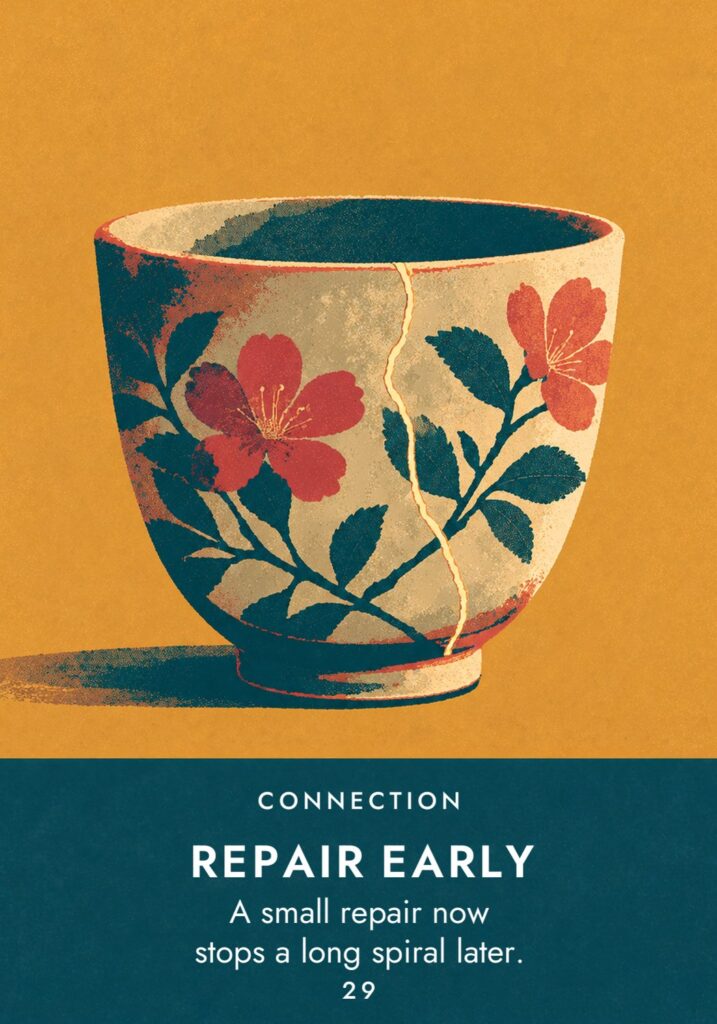
What Repair Early means
A repair can be a word, a joke, or a gesture that lets two people step back from a fight before it runs away with them. "I said that badly." "Can we start again?" "I need twenty minutes and I will come back." Timing is the lesson. A small acknowledgment early in a spiral is easier than repairing hours of injury. Repair is not magic. The other person may not be ready, and serious breaches need more than a clever phrase.
"That came out badly." Four words, said at breakfast, are what Repair Early is about, and the person who draws it is usually the morning after. The fight ran late, both people said more than they meant, and the person drawing the card is now deciding whether to say something or let it blow over, and leaning toward blowing over because the fight already took enough out of them. What the card measures is cost and timing. A small acknowledgment now is cheap. "That came out badly" costs about four words. The same repair tomorrow costs more, because by then there will be a second layer, the silence, and by the weekend a third. The card does not say the person was wrong. It says the price of the fix is going up every hour, and the fix is available at the current price right now.
In shadow, this becomes repeated apology with no changed behavior, or demanding instant forgiveness because the apology was offered. The first is the repair that has become a ritual. "I'm sorry, I'll do better" is said with real feeling every few weeks, and nothing is different the next time, and the words slowly lose their purchasing power until they are just a thing that gets said after a fight. The second is the apology with an invoice attached. The person says sorry and then waits, visibly, for the other person to be fine, and gets hurt when they are not fine yet. A repair is an offer. It does not come with a deadline for the other person's response.
I can turn back before the damage compounds.
When Repair Early appears in a reading
The person who draws Repair Early usually tells me about the fight and leaves out the hours after it. I ask about the hours. What happened at breakfast? Who spoke first, or did nobody? I listen for the moment a small repair was available and not taken, because there nearly every time was one, a pause in the kitchen, a glance, a text that could have been sent. The person often says they were waiting for the other one to go first, and I point out that the other one was probably waiting too, and that two people waiting is how a bad night becomes a bad week.
My own practice with this card is a rule about size and ownership. The repair has to be about my own behavior, specifically, and it has to be small enough to say in one breath. "When I went quiet last night, that wasn't fair to you." Not a speech, not an explanation of why I went quiet, not a mention of what they did first. Then I stop talking. The stopping is the hardest part, because the urge is to fill the silence with context, and context turns a repair back into an argument. I let the other person do whatever they do with it. The repair was mine to make. The response is theirs.
Beside Own Your Part, I read the pair as the content and the timing: that card finds the piece that was mine, and this one says to offer it before the price goes up. Where I keep Repair Early distinct from Repair Is a Practice is scale. This card is one move, early, inside one spiral. That card is the longer work of changing the pattern that produces the spirals. A person can be excellent at early repair and still be having the same fight every month, and that is the reading for the other card.
One small honest step
Send or say one four-word repair today for something small and recent of yours, "that came out wrong" or "I was short earlier," and leave it there without an explanation attached.
Repair Early in the You, Me, Us Spread
The Second Question guidebook’s three-card love reading is You, Me, Us, the classic layout with the positions changed so that none of them asks for mind reading. The first card is what I bring, the second is what their behavior has actually shown so far, and the third is what the dynamic needs for its next honest step. In each position this card tends to say:
- What I Bring. As What I Bring, the card says you may be arriving with a habit of waiting for the other person to go first after a hard moment, and the waiting is costing more than the first word would.
- What Their Behavior Shows. As What Their Behavior Shows, it asks you to look at what they do in the hours after a fight, whether they make small turns back toward you and whether they receive yours, because that record matters more than how the fight itself went.
- What the Dynamic Needs. As What the Dynamic Needs, it points to one early, specific acknowledgment as the next step, offered without a demand for forgiveness attached, before the silence gets a second layer.
Journal prompts
- What could I repair now, before pride makes it harder?
- Which of their attempts to repair have I been refusing to receive?