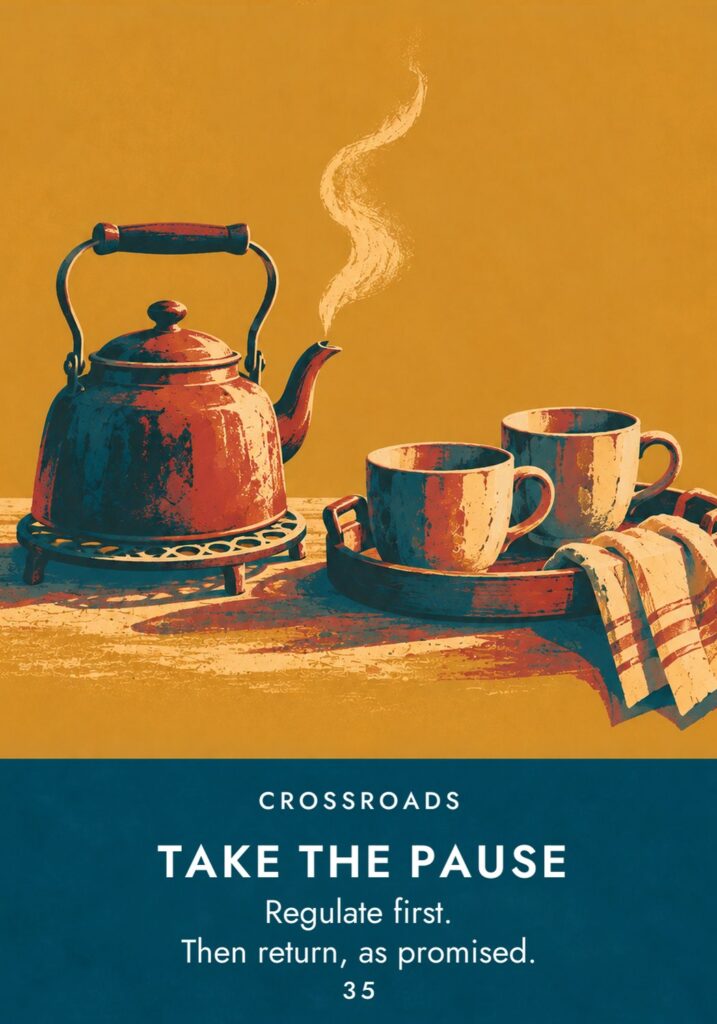
What Take the Pause means
Shutting down often happens when a person is overwhelmed. Past a certain point, a body in alarm cannot hold a constructive conversation, and forcing resolution then makes things worse. The alternative is a communicated pause with a return. "I am too activated to do this well. I need a break, and I will come back at seven." That is not silent punishment. It protects the conversation. The same card speaks to anyone about to send the tenth message.
Someone draws Take the Pause having just said something they will be apologizing for tomorrow, and knows it, and is still in the room. The conversation went past the point where anything useful was being said twenty minutes ago, and both people kept going because stopping felt like losing. Sometimes it comes up for the person on the other side, who has been left mid-sentence by a partner who walked out and did not say when, or whether, they would be back. I read the card as a distinction between two things that look alike from outside. One is leaving. The other is a pause with a return time attached, and the return time is the whole difference. The first ends the conversation. The second protects it.
In shadow, this becomes disappearing, withholding contact to punish, or "I need space" used indefinitely to avoid accountability. The disappearing is the walkout with no return, the door that closes and the silence that follows it for a day, and the other person learns that any hard conversation might end with them being alone in a room. The punishment version is colder: the pause is not for settling, it is for making the other person feel the cost of having raised something. And the indefinite space is the pause that never ends, "I just need time," said at every attempt to return to the subject, until the subject is simply gone. A pause has a clock on it. Without the clock, it is something else.
I can step away and still come back.
When Take the Pause appears in a reading
If you draw this card, start by remembering the last conversation that went past its useful point, and the moment you knew it had. There was one. A sentence you heard yourself say, a change in your breathing, the other person's face going flat. I read Take the Pause as a card about that moment and the ten words that could have been said in it: "I'm too wound up to do this well, back at eight." The card is not telling you to leave the room less. It is telling you to leave it on purpose, with the return already promised, so that leaving is a move inside the conversation rather than the end of it.
My practice with the card has two halves and the second half is the one people skip. The first half is the leaving: I say the time I will be back, and I go do something that uses my body and not my mind, a walk, the dishes, anything with motion in it, and I do not rehearse the argument while I do it. The second half is the return. At the time I said, I come back, whether or not I feel ready, and I say one thing that needs saying rather than everything I thought of while I was gone. Coming back on time is what makes the leaving trustworthy. Without that, the other person has no reason to let me go next time.
Beside Chase and Retreat, I read the pair as the withdrawing partner's way out of the loop: a retreat with a stated return does not read as abandonment, so it does not trigger the chase. Where I keep Take the Pause distinct from No Contact is scale and purpose. No Contact is a long boundary with a reason behind it that does not involve the other person's response. This card is twenty minutes, inside a relationship that is continuing, with a time on it.
One small honest step
Decide now, before any argument, what your pause sentence will be and how long your pause will last, and tell the other person on a calm day so it is not a surprise when you use it.
Take the Pause in the You, Me, Us Spread
The Second Question guidebook’s three-card love reading is You, Me, Us, the classic layout with the positions changed so that none of them asks for mind reading. The first card is what I bring, the second is what their behavior has actually shown so far, and the third is what the dynamic needs for its next honest step. In each position this card tends to say:
- What I Bring. As What I Bring, the card says you are entering this connection with a habit under pressure, either staying past the useful point or leaving without a return time, and the other person has probably learned to brace for it.
- What Their Behavior Shows. As What Their Behavior Shows, it asks whether their pauses come with a return, a stated time, an actual coming back, or whether space has been used to end conversations rather than protect them, because the difference is visible in behavior.
- What the Dynamic Needs. As What the Dynamic Needs, it points to an agreed pause, with a clock on it that both of you honor, as the step that would let hard conversations survive their worst moment.
Journal prompts
- What would become clearer if I acted after I settled rather than during the surge?
- When I take space, do I return, and do I say when?