How to Journal With an Oracle Deck
There’s a version of oracle-card reading that ends the second you flip the card: a glance, a small nod, a vague good feeling, and on with the day. That’s fine. But the cards have more to give the moment you pick up a pen.
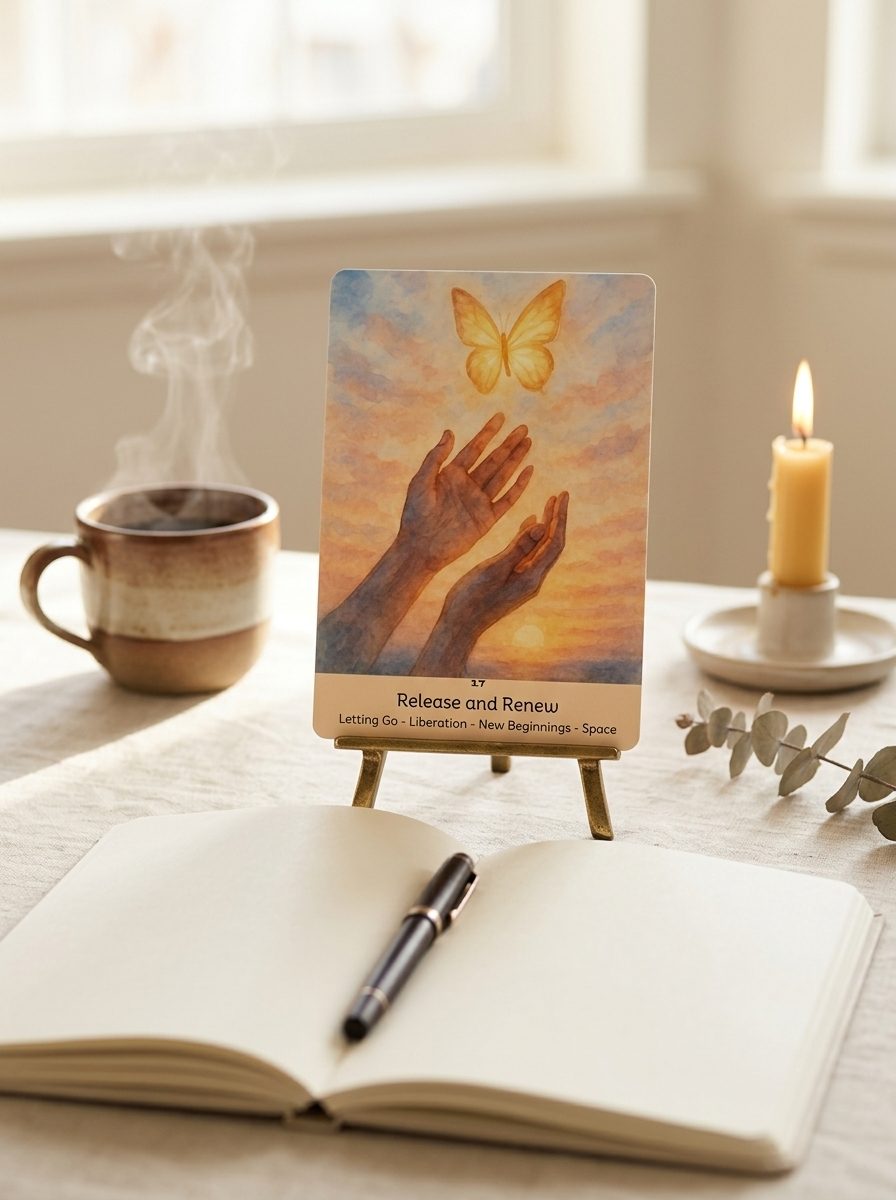
Journaling turns a pretty picture into a conversation. The deck asks, you answer, and somewhere in the writing you find out what you actually think. You don’t need a special notebook or the perfect words. You need a card, a page, and the willingness to be honest before the coffee kicks in.
Why write it down at all
A card you only look at fades by lunchtime. A card you write about stays.
Something happens between reading an image and putting words to it. Your mind reaches for the part of your life the card fits, and that reach is the practice. Say the answer out loud and it drifts off. Write it down and you can read it back next week.
Next week is usually where the insight lives. That’s when you notice you’ve drawn the same theme three days running, or that a card you didn’t understand on Monday makes perfect sense by Friday. The journal becomes the long memory your intuition doesn’t always have on its own.
What you actually need
Less than you’d think.
Any oracle deck you’re drawn to. A journal you’re not afraid to write badly in. Ten quiet minutes, or five. That’s the whole kit.
The one thing worth being a little choosy about is the journal itself. Not because plain paper won’t work, but because a notebook you like the feel of is a notebook you’ll actually open. A few I’d keep on my own desk are at the end of this post.
The practice: getting started with journaling
Instead of trying to journal advanced card spreads, to start, keep it simple enough that you’ll do it tomorrow, too.
Draw one card. One. A single card gives you somewhere to put your attention. A ten-card spread gives you somewhere to hide. Shuffle until a card asks to be turned over, then turn it over.
Look before you write. Spend thirty seconds with the image before you reach for meaning. What does your eye go to first? What is the weather of the card: heavy, open, tender, sharp? First impressions are data. Note them before the guidebook talks you out of them.
Write the first honest line. Not the wisest line. The honest one. “This card annoys me.” “I don’t want to hear this today.” “This is exactly the thing I’ve been avoiding.” Start where you actually are and the page opens.
Ask it a question back. Turn the card into a prompt. There are five below to borrow. Then answer in your own voice, not the deck’s. The card’s job was to start you; the rest is yours.
Close the loop at night. If you can, glance back before bed. Did the card show up in your day? A single line is enough: “It was right about the phone call.” This is the step most people skip, and it is the one that teaches you the deck is worth trusting.
Five prompts to borrow
When you’re staring at a card with nothing to say, one of these will usually pry the door open. Copy them into the front of your journal:
- What is this card asking me to look at today?
- Where in my life is this already true?
- What in this image am I resisting, and why?
- If this card were advice from someone who loves me, what would it be saying?
- What is one small thing this makes me want to do before tonight?
You don’t need all five. Pick the one that makes you slightly uncomfortable. That’s usually the one with something in it.
When nothing comes
Some mornings the card just sits there, mute. That is not a failed reading. It is information, too.
Two things help. First, write “I’ve got nothing,” then describe the card on the page as if you were explaining it to someone who can’t see it. The describing almost always loosens something.
Second, don’t force meaning onto a blank morning. Write the date, the card’s name, and one plain sentence about how you feel. Then close the book.
A practice you keep lightly is one you keep. A practice you grade yourself on is one you quit.
A rhythm, not a rule
Daily is lovely if you can. But “every morning” is how most journals die of guilt in a drawer.
Three mornings a week that actually happen will teach you more than a perfect streak you abandon by February. Let the deck be a standing invitation, not another thing you’re behind on. As you become familiar with recording your thoughts, try your hand at small card spreads and then larger spreads as you gain confidence and experience.
A few journals worth opening
Any notebook works. But if you’d like one that makes the writing feel like it matters, because it does, here are four I’d happily keep on my own desk, all from independent Etsy shops. Match the journal to the writer you actually are, not the one you think you should be.
01
The pretty daily driver: a celestial lined hardcover
If you write in full sentences and want the book to match the mood of the practice, this is a lovely place to start: look for suns, crescent moons, and botanicals in warm gold and cream, wrapped around lined A5 pages. Choose one if a beautiful cover is the thing that gets you to open it.
02
The heirloom: a personalized leather journal
If you want the journal to outlast the season, full-grain leather earns its keep. It softens over time, takes on a patina, lies flat at 180 degrees, and gives you 256 pages in lined, dotted, blank, or grid paper. Add a name or date to the cover if you want a quiet way of telling yourself this practice is worth keeping.
03
The ritual one: a Tree of Life grimoire
For readers who want the notebook itself to feel like part of the magic: genuine leather, a vintage clasp lock, and deckle-edge cotton pages that can hold fountain pen, brush, or a light watercolor wash without bleeding through. It is sold as a “book of shadows,” but it is just as happy holding a daily pull and the thoughts it shakes loose.
04
The maker’s book: a burlap junk journal
Some readers don’t only write. They press a flower between the pages, glue down the day’s card, or sketch what they saw. A burlap junk journal is built for that: a raw burlap cover, thick blank kraft pages, and folds you can tear into pockets for keepsakes. It is more collage base than lined diary, and right for you if the practice tends to spill past words.
Don’t wait for the perfect notebook to begin. Pull a card tomorrow morning, open whatever paper is nearest, and write one honest line about what you see. The practice starts there. Everything else is just finding the journal that makes you want to come back.
Zara