Shadow Work for Beginners: How to Start With an Oracle Deck
One card, ten minutes, and a reaction you cannot quite explain. A gentle way into work that most guides make sound like a demolition.
My first try at shadow work was a printed list of a hundred questions. I answered four, felt worse, and put the list in a drawer for a year. What I needed was not more questions. It was a smaller door.
This is that smaller door: shadow work for beginners, built around one oracle card and about ten minutes. No workbook, no all-night excavation.
You can start shadow work by noticing one strong reaction, drawing one card, and writing about what the card brings up.
What the shadow is, in plain words
Carl Jung used the word shadow for the parts of a person the conscious personality rejects, disowns, or does not recognize. Some of it is unflattering: the envy, the pettiness, the coldness you would rather nobody saw.
The Jungian writer Robert A. Johnson also wrote about the good things people put into the shadow: ambition, appetite, accurate anger, a sharp mind dimmed to stay likable. He called it the gold in the shadow. The guidebook for The Gold in the Dark puts it this way: “the shadow is not a landfill. It is a lost and found.”
How to start shadow work: notice the charge
The easiest doorway is a reaction bigger than the moment that caused it. The remark that stayed with you all afternoon. The coworker you cannot stand for reasons you cannot name. The compliment you brushed off a little too fast.
That gap between the event and your reaction can be where the work is. You do not need a crisis. You need one small, honest charge.
Why an oracle card makes it easier
Sometimes looking straight at yourself does not get very far; the mind is too good at explaining itself. A card gives you something outside you to react to, and the reaction does the talking. Three are worth watching for:
- “That is nothing like me.” A fast, firm no is often worth a second look.
- “That is exactly them.” If a card instantly calls up someone who drives you up the wall, ask whether some version of that trait shows up in you. Not all of it. Maybe only a trace.
- A quiet pull of wanting. If a card of authority or appetite makes you wish you were like that, you may be looking at something of yours you set down. That is the gold.
How to do shadow work with one card
- Settle first. A few slow breaths, feet on the floor, eyes on three ordinary things in the room. You are arriving, not meditating.
- Give it edges. Pick an end time. Light a candle when you begin and put it out when you are done.
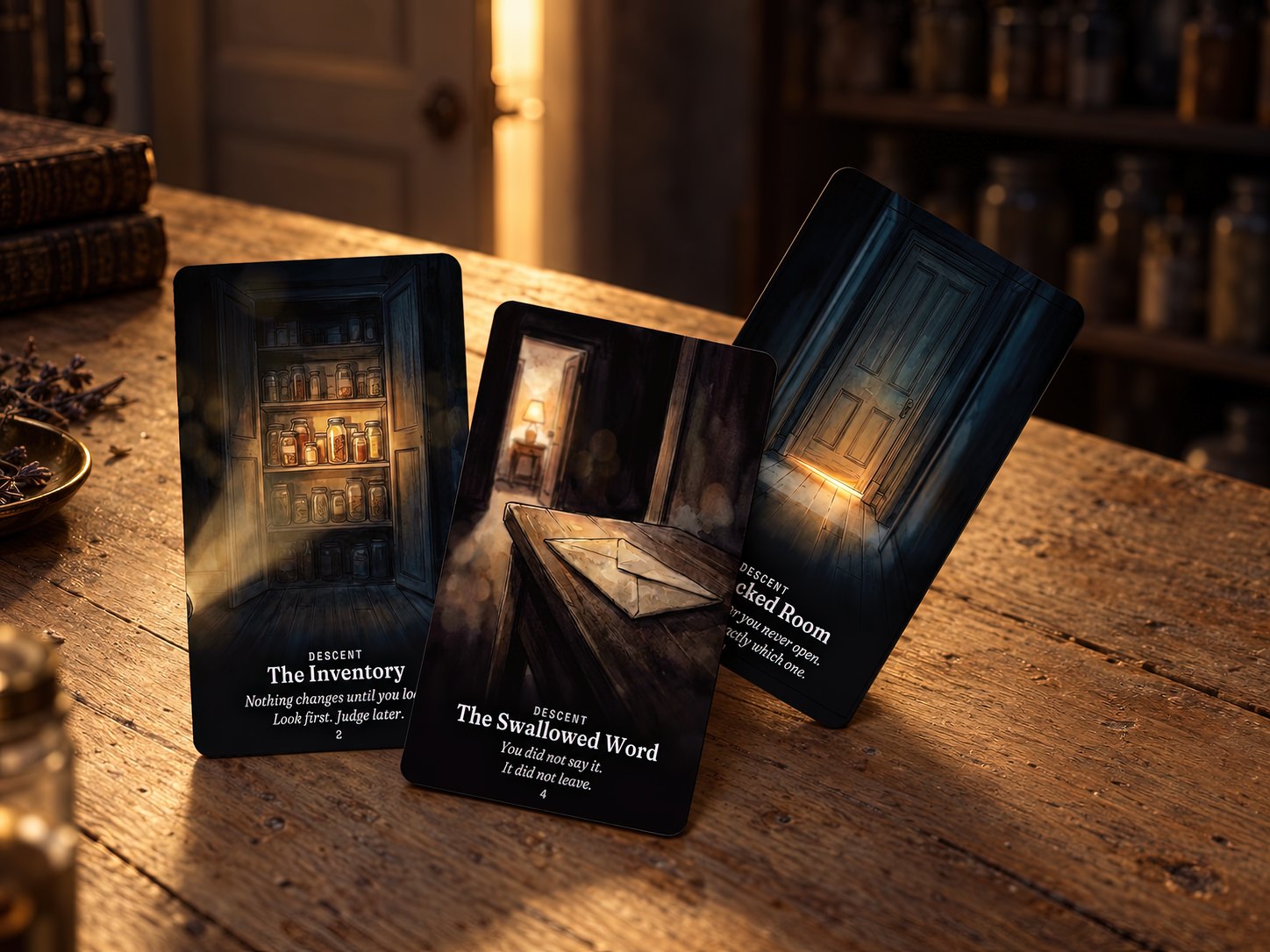
- Describe the card like a camera. Before any meaning, say what is literally there: a door, a guard dog, the floor of a well. Then read the Insight and the Essence.
- Turn it around. Take what you see in the card and ask where it lives in your own life. Then ask the deck’s one question: what part of this is mine? Not all of it. The extra part is the part you can work.
- Take one step. Each card in The Gold in the Dark ends with a Practice, ten minutes or less. Do it, or decide plainly that today is not the day and set the card down. Both are honest.
Two ways shadow work goes sideways
The first is redrawing. You pull a hard card, decide it must mean something kinder, and keep drawing until the deck agrees with you. That is another way of keeping the door shut.
The second runs the other way: using dark, dramatic language to explain away something you should simply apologize for. The guidebook is blunt about this one: “That is not shadow work. That is decoration.”
When to stop for the day
This work goes looking for material, and material does not always arrive in a manageable size. If the ground does not feel steady, or you cannot find your way back to ordinary after you put the cards down, stop and do something ordinary with your hands, ideally with another person nearby. If what comes up keeps following you after the cards are put away, consider talking with a therapist. A deck is a reflective tool, not a substitute for professional care.
Where to go after your first card
Once one card feels manageable, try three. The Shadow Spread asks what you hide, what it protects, and what it wants. On nights you would rather write than draw, these 40 shadow work journal prompts give you one question for every card in the deck.
You can also pull three cards from The Gold in the Dark free before bringing the deck home.
Tonight, think of one moment that stung more than it should have. Draw one card for it and write one honest sentence.
Start small. The shadow is not going anywhere, and neither is the gold.
Zara