The Yule Cat, Krampus and 11 Other Midwinter Beasts at the Threshold
Before the holidays were gentle, they had teeth. Thirteen old visitors from European folklore, and the one question each of them still asks.
The year I finally knitted the wool socks I had been promising my sister, I finished them on the twenty-third, and I remember thinking, for no reason I could name, that I was safe now. Later I learned where that thought came from. In Iceland the Yule Cat circles the houses on Christmas Eve and takes anyone who received no new clothes. I had never heard the story. Some part of me already knew it.
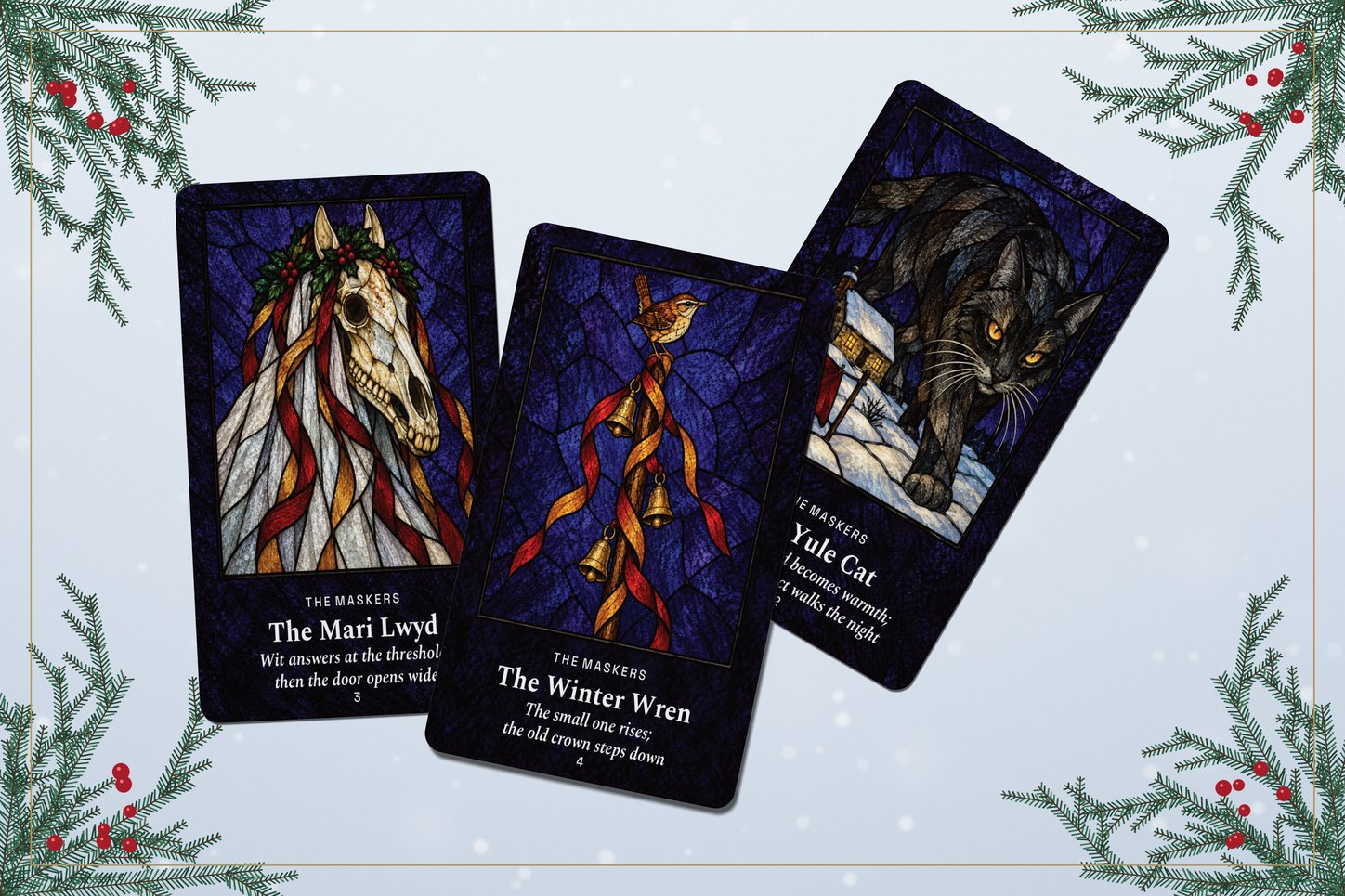
That is what the old midwinter beasts do. They wait at the edge of the season, and when you meet one, it turns out you have been expecting it. When I built The Yule Beasts Oracle, I gave thirteen of them their own suit, the Maskers, because every one of them comes to the door and asks something. Here they are, with the question each card puts to you.
Why midwinter folklore is full of beasts at the door
The guidebook introduces the suit this way: “These are the beasts who come to the door. In villages across Europe, midwinter belonged to them: neighbors in straw and sheepskin, horse skulls on poles, horned things that died on the kitchen floor and had to be sung back to life. When a Masker appears in your reading, something stands at your threshold and asks to be answered.”
I use “Masker” a little broadly in the deck. Not every one of these figures literally went house to house; some crossed the sky, haunted the road or waited in the wood. What they share is the threshold: each interrupts ordinary life and demands a response.
A surprising number of European winter traditions involve exactly this kind of encounter: masks at the door, animals in the house, noise in the street, demands for food, bargains, blessings and threats. Most are documented, several are Yule traditions still practiced, and a few are younger than they look. I say so where it matters. None of these cards predicts anything. They are mirrors with horns on, and the questions below are the ones the deck asks when the card turns up.
The thirteen Maskers, from the Yule Cat to the Koliada Goat
1. The Yule Goat
In Sweden the julbock was a frightening visitor who later turned gift-bringer; in Finland the nuuttipukki went house to house in straw and horn, demanding food and drink. “This card says the life force in you is not gone. It is at the door, loud and a little rude, asking to be let in.”
Ask yourself: What part of my aliveness went dormant this year, and what would welcoming it back look like?
2. The Yule Cat
Icelandic folklore, first written down in the 1860s, tells of a monstrous cat that takes anyone who received no new clothes for Christmas. The usual explanation, a spur to finish the autumn’s wool work, is younger than the tale. “This card is about diligence as a form of love. What you tend faithfully becomes warmth for someone.”
Ask yourself: What unfinished task is quietly costing me warmth?
3. The Mari Lwyd
In South Wales a horse’s skull draped in white and ribboned bright is carried to the door, and the household and the mare trade verses, insult and wit, until one side falters and the door opens to food and beer. “This card brings a challenge that wants engagement, not avoidance.”
Ask yourself: What challenge am I refusing to answer because I might lose the exchange?
4. The Winter Wren
On St. Stephen’s Day in Ireland, wren boys carried a wren on a decorated branch from door to door, singing for coin. The bird is called the king of all birds; in the fable it won its crown by riding hidden on the eagle’s back. “This card marks a turning of power. Something small rises. Something crowned steps down.”
Ask yourself: What am I the outgoing king of?
5. Gullinbursti
In Norse myth the dwarfs forged Freyr a golden boar whose bristles lit the darkest night, and a separate strand of the sagas has Yule vows sworn with hands laid on a boar’s bristles. “This card is about the light a commitment makes.”
Ask yourself: What is the one commitment that would light the next three months?
6. The White Stag
In Arthurian romance and the Breton lays the white stag appears again and again as an extraordinary quarry, drawing hunters away from the ordinary world and into a quest. “The point was never the capture.”
Ask yourself: What have I been chasing, and who have I become while chasing it?
7. The Wild Hunt Hounds
Across northern Europe, stories told of spectral hunts crossing the night sky, hounds baying ahead of them. Wales has its own: the Cŵn Annwn, white with blood-red ears, their cries said to grow quieter as the hounds draw near. “This card marks a storm passing through your life that is not yours to fight.”
Ask yourself: Whose storms do I keep riding out of habit or loyalty?
8. The Turoń
In Poland caroling groups still lead the Turoń from house to house through the Christmas season and, in some regions, into Carnival: black, shaggy, horned, with a snapping wooden jaw. It charges, it leaps, and then it drops dead on the floor, and the company has to revive it with song, cakes and a drink poured down its throat. “This card says a collapse near you is not an ending. It is waiting for generosity.”
Ask yourself: What in my life has collapsed and is waiting to be sung back?
9. The Habergeiß
In the Austrian Alps a Habergeiß stalks the winter nights, three-legged in some valleys, part goat and part bird, long-necked or stranger in others. The form shifts from village to village. The job does not. “It exists to unsettle.”
Ask yourself: What keeps unsettling me, and what might it be trying to say?
10. The Schnabelpercht
On the eve of Epiphany in Austria’s Rauris Valley, tall hooded figures with long wooden beaks move quietly from house to house, carrying brooms and enormous scissors, and inspect the corners. “This card calls for a cleansing that is thorough rather than cosmetic. Sweep the corners you have been decorating around.”
Ask yourself: What corner of my life would I least like inspected, and why?
11. Krampus
In much of the Eastern Alps, Saint Nicholas did not walk alone. Beside him came the horned one, soot-black and belled, carrying birch switches for those who had spent the year earning them. Krampus is not as old as he looks, and his job was never cruelty for its own sake. “He is the consequence that walks beside the gift.”
Ask yourself: Where do I confuse punishing myself with changing?
12. The Kurent
In Slovenia, at Carnival rather than at Yule, the Kurenti come: massive figures in sheepskin, five great cowbells at the belt, running the lanes of Ptuj in a thunder of sound to drive winter out. “This card says stagnation in your life will not leave politely. Make noise.”
Ask yourself: What heaviness has overstayed, and what sound would move it?
13. The Koliada Goat
In Ukraine the Koza is a Christmas-cycle folk play: a young man in an inside-out sheepskin and a goat mask dances into the house while the carolers sing. Where the goat goes, the rye grows. “This card says give first. The field answers the seed.”
Ask yourself: What do I want growing by spring, and what have I actually fed it?
How to let the Maskers in this winter
You do not need the whole deck in play to use them. Set the thirteen Maskers aside as their own small pack and pull one on the nights the dark half of the year gives you: Krampus Night on December 5, the solstice, St. Stephen’s Day, the eve of Epiphany. Read the card’s own meaning, then answer its question in one honest sentence. That is the whole practice.
If you want to bring the rest of the deck into the practice, pull three cards from The Yule Beasts here, free, and see which of the beasts turns up unasked. For the rest of the season’s table, candles and greenery, the Yule correspondences cheat sheet is where I keep all of that.
The old stories did not treat every beast the same. Some were welcomed, some fed, some bargained with, some endured, and some driven away. None could simply be ignored. That is the part worth keeping. Pick one tonight, and see what it asks.
Zara