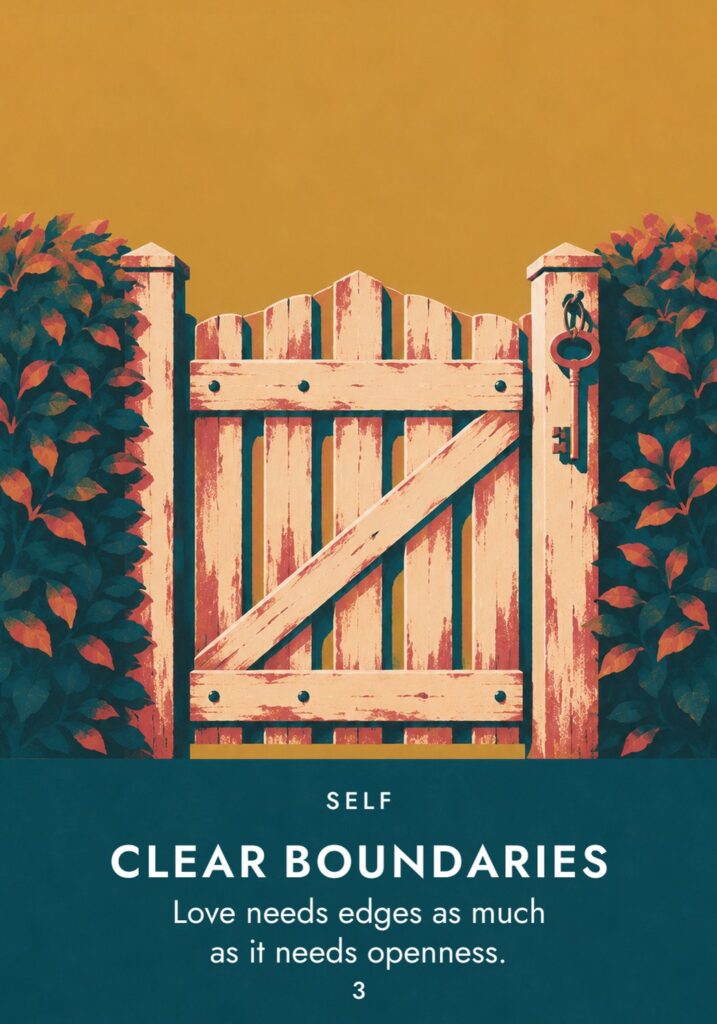
What Clear Boundaries means
A boundary describes what you will participate in, disclose, tolerate, or do. It is not a rule for another adult. "If the yelling starts, I will pause this and return when we can speak respectfully" is a boundary. "You are not allowed to disagree with me" is control in a boundary's clothes. Ask where your yes has gone automatic, where your no has become frightening, and where resentment says you never consented.
Clear Boundaries usually turns up for someone who is tired in a specific way. Not tired from a fight, but from the long ache of going along. They have said yes to a weekend they did not want, laughed at the comment that landed wrong, let the subject drop again. Sometimes the person is on the other side of it, with a partner who has started announcing rules and calling them limits. I read the card as a question about ownership. A boundary is a sentence about my own next move, and the person drawing this card has usually lost track of which sentences are theirs. They have been writing rules for someone else, or letting someone else write rules for them, and neither one is a boundary.
In shadow, this becomes walls so rigid nobody gets in, or limits so porous you keep vanishing. The rigid version is easy to admire from a distance: the person who has read about boundaries and now has one for every occasion, a fence around every subject, a policy where a conversation used to be. Nobody crosses them, and nobody gets close either. The porous version is harder to spot because it looks like generosity. The limit is stated, then quietly waived, then stated again a little louder, and each waiver teaches everyone, including the person who set it, that the words do not mean much. The disappearing happens in small increments and gets noticed late.
My limits are information, not an apology.
When Clear Boundaries appears in a reading
My first question with Clear Boundaries is where the resentment lives. Resentment is useful here, because it points at a place where consent was assumed and never given. I ask the person to name the thing they keep doing with their teeth slightly clenched. Then I ask whether anyone ever actually asked them to do it, or whether they volunteered, early, and have been held to the volunteering ever since. That is often where the first boundary belongs, not at the dramatic edge of the relationship but at a small, routine yes that went automatic years ago.
The way I work this card for myself is to test one boundary for grammar before I say it out loud. If the sentence has "you" as the subject, it is not mine yet. "You need to stop calling after ten" becomes "I don't answer the phone after ten, and I'll call back in the morning." The second version needs nobody's agreement to be true. Then I keep it small for the first round. One boundary, one situation, one week of actually doing the thing I said. If I cannot hold a small one, I am not ready to announce a large one.
Beside Keep Their Dignity, I read the pair as a reminder that a limit can be firm and still be delivered without contempt, and that the two often get confused in a heated room. Where I keep Clear Boundaries distinct from No Contact is scale. No Contact is a single large boundary with a purpose attached. This card is about the dozens of small ones underneath it, the ones that, if they had been held, might have meant the large one was never needed.
One small honest step
Decline one small thing today that you would normally absorb, using a sentence that describes your own action and nothing about theirs.
Clear Boundaries in the You, Me, Us Spread
The Second Question guidebook’s three-card love reading is You, Me, Us, the classic layout with the positions changed so that none of them asks for mind reading. The first card is what I bring, the second is what their behavior has actually shown so far, and the third is what the dynamic needs for its next honest step. In each position this card tends to say:
- What I Bring. As What I Bring, the card says you have been entering this connection with your edges undefined, agreeing by default, and the other person may not even know where your limits are because you have not been told either.
- What Their Behavior Shows. As What Their Behavior Shows, it asks how they have responded to the small no you have managed so far, with respect, with pressure, or with a rule of their own, because that response is better information than any promise.
- What the Dynamic Needs. As What the Dynamic Needs, it points to one plainly stated limit, held through one test, as the thing that would let the connection stand on something firmer than your endurance.
Journal prompts
- Which boundary would make my next yes more honest?
- What have I been tolerating that I never actually agreed to?