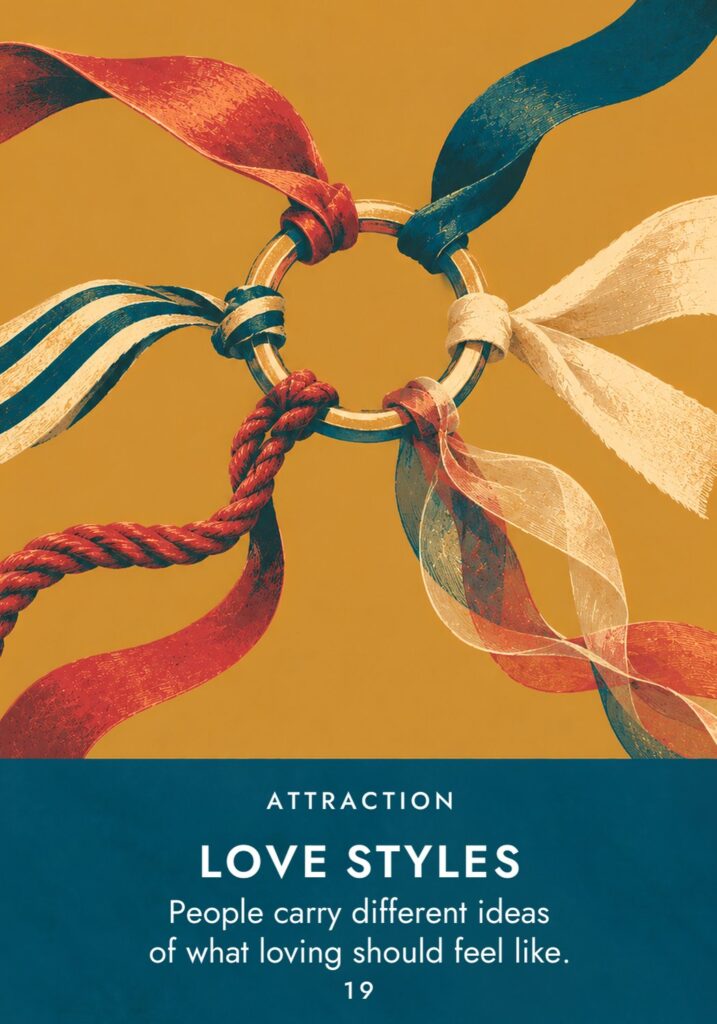
What Love Styles means
One well-studied map describes six attitudes toward love, and research supports them as attitudes, not types. Nobody is just one of them. But everyone carries a belief about what loving is supposed to feel like, and that belief decides whom you recognize as romantic and which warning signs you forgive. Passionate? Playful? Built on friendship? Practical? Consuming? Self-sacrificing? What did you inherit?
Love Styles usually comes up in an argument that has no resolution because the two people are not disagreeing about facts. One of them thinks love is supposed to be a fever, and the relationship has cooled into something steady and kind, which feels to them like the end. The other thinks love is what you build on a Tuesday, and the fever was the unreliable part. Each one is sure the other is doing it wrong. I read the card as a translation between dialects. Neither person is wrong about what love is. They are each describing the version they were handed, early, by a house or a film or a first heartbreak, and they have never once held it up to the light to see where it came from.
In shadow, this becomes one philosophy of love treated as the only legitimate one, and obsession mistaken for depth. The first is the quiet tyranny of the person who knows what love looks like and grades every partner against it: too calm, too practical, not passionate enough, not devoted enough. The partners fail, one after another, and the person concludes that real love is rare. The second is the more dangerous shape. The consuming style, the all-or-nothing, the person who cannot eat or sleep, gets read as the deepest kind of love because it is the loudest. It is not deeper. It is louder. Depth tends to be quiet and inconvenient, and keeps showing up.
I can question what I was taught love should feel like.
When Love Styles appears in a reading
Where I keep Love Styles distinct from a personality quiz is that nobody is one thing. In a reading, I ask the person to describe the first love they ever watched closely, not their own, someone else's, a parent, a grandparent, a couple in a film they saw at twelve. I listen for the adjectives. Passionate, steady, sacrificing, practical, playful, consuming. Then I ask which of those they have been rewarding in partners and which they have been quietly punishing. The pattern usually matches the first love they watched. Nobody chose it. It was inherited like a chair.
My own practice with the card is to write a definition of love in verbs, because adjectives lie and verbs do not. Not "passionate" but "calls when they said they would, argues without leaving, remembers the thing I said in March." Then I read the verbs and ask whether they describe the person I am with, and separately, whether they describe the way I love. Those are two different questions and the second one is usually the surprise. I keep the list and reread it when I catch myself grading someone against a feeling instead of against a behavior.
Beside Passion and Choice, I read the pair as the whole argument laid out: this card names the inherited belief about what love should feel like, and that one separates the feeling from the deciding. Where I keep Love Styles distinct from Many Ways to Care is scale. Many Ways to Care is about how affection is delivered day to day. This card is about the larger philosophy underneath, the one that decides whether a quiet, reliable Tuesday counts as love at all.
One small honest step
Think of the first couple you ever watched closely, and name one thing about how they loved that you have been expecting from everyone since.
Love Styles in the You, Me, Us Spread
The Second Question guidebook’s three-card love reading is You, Me, Us, the classic layout with the positions changed so that none of them asks for mind reading. The first card is what I bring, the second is what their behavior has actually shown so far, and the third is what the dynamic needs for its next honest step. In each position this card tends to say:
- What I Bring. As What I Bring, the card says you are carrying an inherited idea of what love is supposed to feel like, and you may be grading this connection against it without ever having examined where the grade sheet came from.
- What Their Behavior Shows. As What Their Behavior Shows, it asks you to notice how this person loves in practice, what they do, keep, and offer, and whether you have been dismissing a real form of care because it arrived in an unfamiliar dialect.
- What the Dynamic Needs. As What the Dynamic Needs, it suggests the next honest step is a conversation about definitions, what each of you means by the word, before either of you decides the other one is doing it wrong.
Journal prompts
- Which definition of love did I inherit without ever examining it?
- Whose way of loving have I dismissed because it did not look like mine?