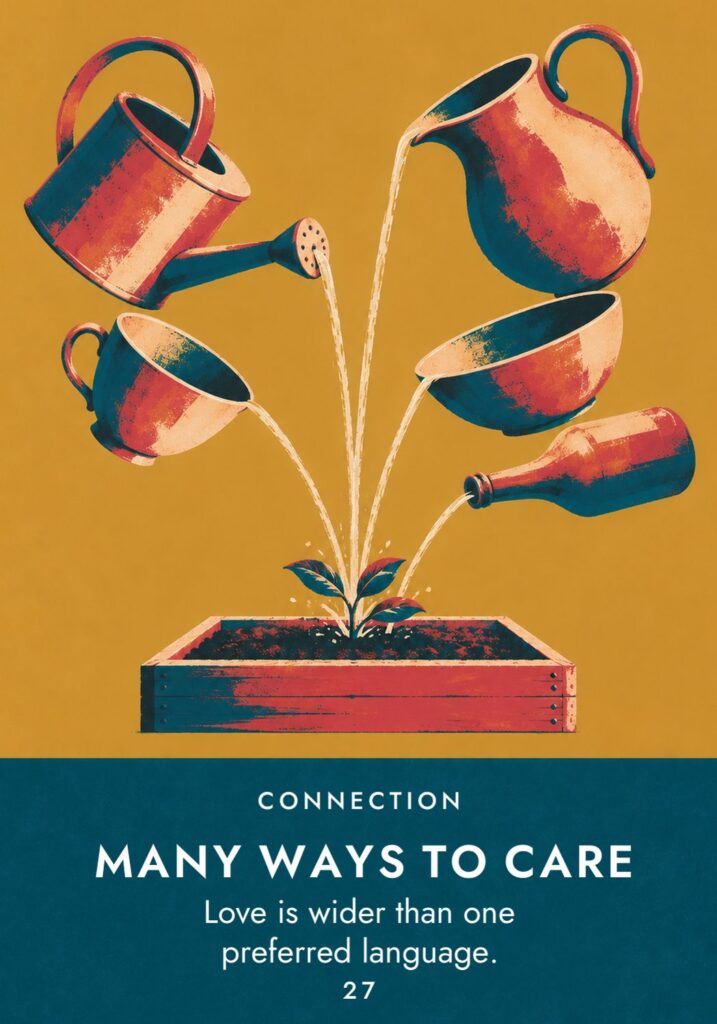
What Many Ways to Care means
The love languages idea is popular because it gives people a vocabulary for how care is expressed. The stronger claims do not hold up. Recent research found little support for one language per person, exactly five of them, or a matching effect that drives satisfaction. The better lesson is abundance. Care arrives through attention, touch, words, help, generosity, reliability, humor, protected time, and curiosity. Ask what care is meaningful now.
The person who draws Many Ways to Care feels unloved, and the partner, as far as anyone can see, fixes the thing, pays the bill, shows up at the airport, remembers the allergy. The person is waiting for the words, or the touch, or the gift, and reports that nothing is arriving. Sometimes care is arriving in forms the person has stopped noticing. Sometimes it is arriving and a need is still unmet. The card asks the reader to tell those two apart. Sometimes it is the other way, and the person is giving in the way they know and bewildered that it is not landing. I read the card as a widening of the lens. The person has a short list of what counts as care, learned early and never revised, and some of what is being delivered may be landing outside the list and getting filed as nothing.
In shadow, this becomes keeping score, using a "language" to demand one specific behavior, or dismissing love that arrives in an unfamiliar form. The scorekeeping turns affection into an accounting problem. The demand turns a useful vocabulary into a rule: "my language is words, so you have to say it," as if care that comes in any other shape does not count against the ledger. The dismissal is the quietest and most expensive failure. The person is being cared for every day, in a dialect they never learned, and because it does not sound like love they conclude that it is not love. The partner, meanwhile, is giving everything they have and watching it land as nothing.
I can receive care in forms I did not expect.
When Many Ways to Care appears in a reading
In a reading, Many Ways to Care asks me to find the care the person has stopped counting. I ask them to list everything the other person has done for them in the last week, however small, and to include the things that felt like logistics. The coffee made. The errand run without being asked. The text at lunch. Then I ask which of those they experienced as love in the moment, and the honest answer is usually "none of them, I was waiting for something else." That is the reading. The waiting has been so loud that the arriving went unheard.
My own practice with this card is to give in a shape that is not mine for a few days, and to receive in a shape I usually overlook. The giving part means doing the thing that feels awkward: if I am a doer, I say the words out loud; if I am a talker, I fix the thing without commentary. The receiving part means noticing one form of care each day that I would normally file as ordinary, and saying thank you for it specifically. "Thanks for handling the car" is a different sentence from "thanks," and it changes what the other person understands about what they are giving. Neither part takes long. Both are uncomfortable in a useful way.
Beside Turn Toward, I read the pair as a reminder that the small reach I am stepping over might be care in a form I did not recognize. Where I keep Many Ways to Care distinct from Name Your Needs is that this card is about how affection is delivered, and that one is about what is actually required. A person can be receiving plenty of care in forms they have not counted and still have an unmet need. The two cards together sort out which is which, and the sorting matters, because the fix is different.
One small honest step
Thank the person closest to you for one specific thing they did in the last few days that you would normally file as ordinary, naming the thing and not just saying thanks.
Many Ways to Care in the You, Me, Us Spread
The Second Question guidebook’s three-card love reading is You, Me, Us, the classic layout with the positions changed so that none of them asks for mind reading. The first card is what I bring, the second is what their behavior has actually shown so far, and the third is what the dynamic needs for its next honest step. In each position this card tends to say:
- What I Bring. As What I Bring, the card says you have arrived with a short definition of what care looks like, and a good deal of what is being offered may be falling outside it unnoticed.
- What Their Behavior Shows. As What Their Behavior Shows, it asks you to list what they have actually done for you lately, including the things that looked like logistics, and to consider that the list may be the love you have been waiting to hear in a different form.
- What the Dynamic Needs. As What the Dynamic Needs, it points to a plain conversation about what care means to each of you, followed by one attempt to give in the other person's dialect, as the next honest step.
Journal prompts
- Which forms of care nourish me, and which have I been overlooking?
- What care am I offering that may not be landing, and have I asked?