Use this spread when
I lay this one when a friend asks a simple question and I hear myself answering at length. That is usually the tell. This spread assumes the information is already in the room and the work is admission rather than discovery, so it is shorter and more uncomfortable than the others here.
How to lay it
- Hold the question loosely. "What do I already know here?" works better than "What should I do?"
- Write the story you have been telling, in one sentence, before you shuffle.
- Lay three cards face down, left to right.
- Turn one and two. Read them against the sentence you wrote and note where the two disagree.
- Turn three. Read all three together, then say the second card's line out loud once before you close the journal.
What each position means
- 1The PretenseThe version of the story you have been telling, including to yourself.
The official story. Not a lie exactly, which is what makes it durable. Usually a true thing emphasized hard enough to cover a truer one. I try to write this card's line in the words I have actually been using out loud.
- 2What I Already KnowThe thing underneath, said plainly.
The known fact the pretense is built over. This card rarely surprises me, and it is not supposed to. Its job is to make me write the sentence down where I can see it, which is different from knowing it.
- 3The MoveWhat admitting it makes possible.
The action that becomes available once the story is set down. Often smaller than expected, and often a conversation rather than a decision. If the card points somewhere large, I take the first honest sentence of it.
A worked example with Trickster
Here is how the spread reads with three cards from the Trickster Oracle. Suppose I am asking about a working arrangement I keep describing as fine, and the three cards are The Double Mask, The Obsidian Mirror, and The Unmasked King.
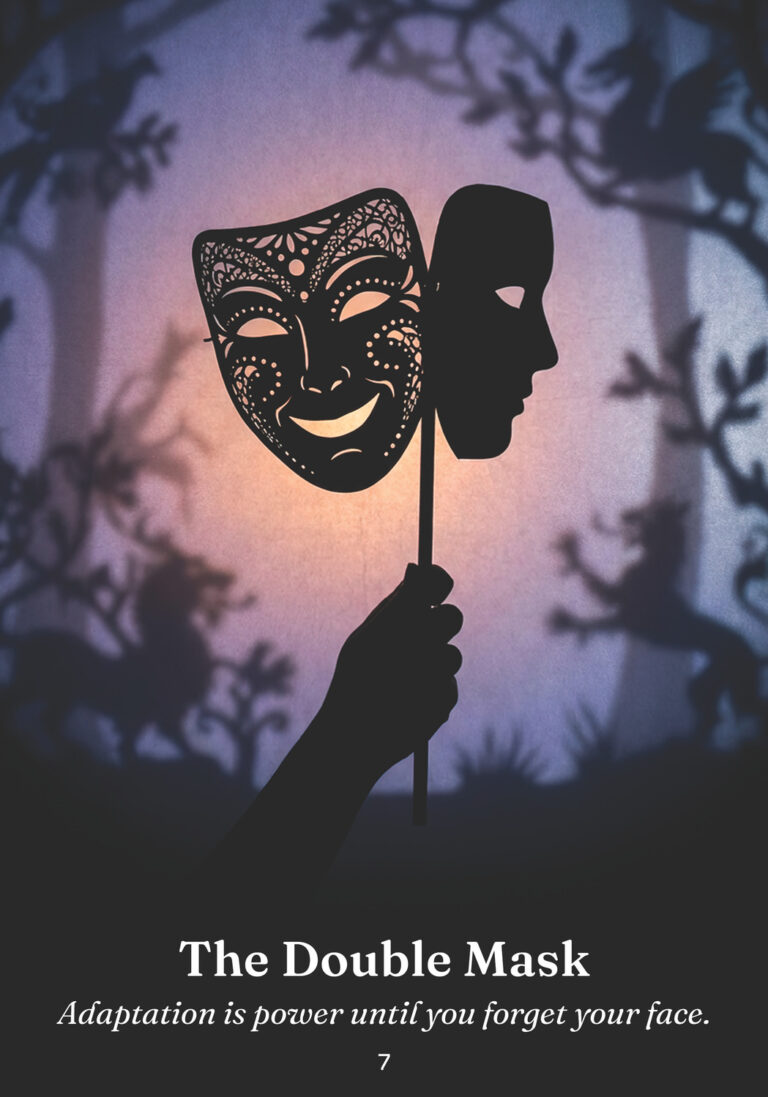
1 · The Pretense
Adaptation is power until you forget your face.
Two masks joined back to back, one smiling and one unreadable. The pretense is the smiling one, worn so consistently in this arrangement that it has stopped being a choice. The card is fair about it. Wearing the face a room requires is real power. The shadow is a different face for every audience and none for myself, which is where this has landed.
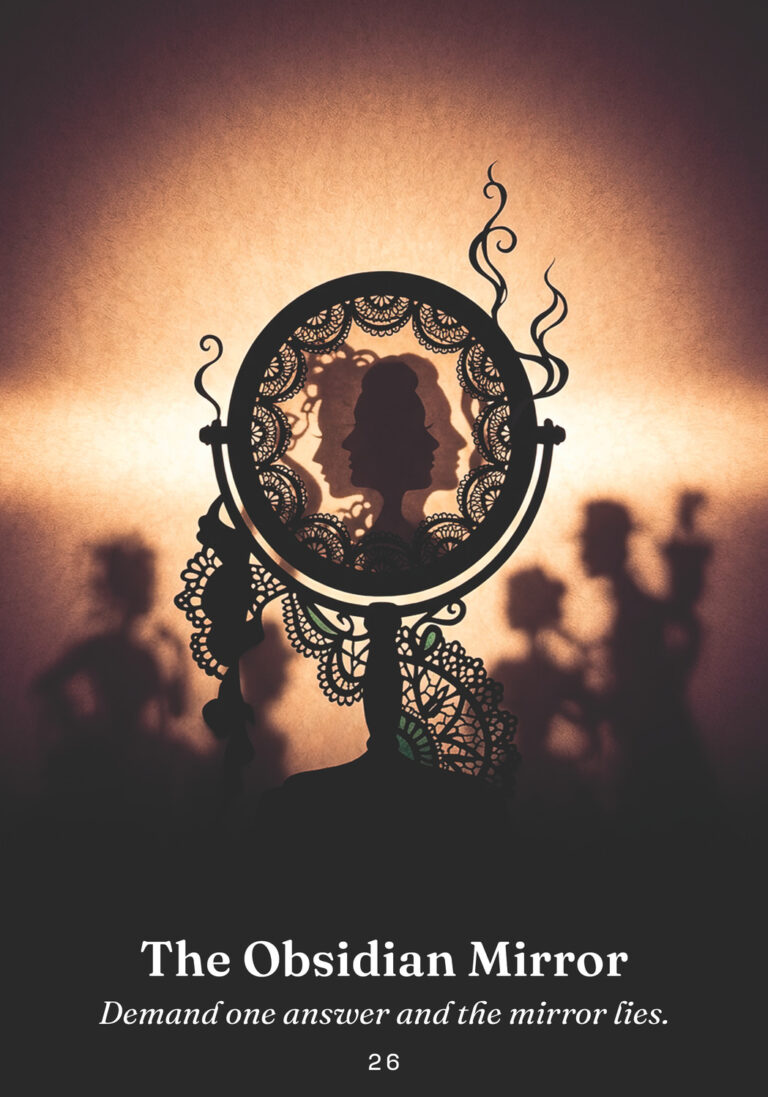
2 · What I Already Know
Demand one answer and the mirror lies.
What I already know is that the arrangement is not fine, even if I cannot reduce why to one clean verdict. Tezcatlipoca's mirror shows the world darkly and never quite still, and what I know will not resolve into a single verdict, and the card says that is the nature of the glass rather than a failure of looking. It becomes an enemy only when I insist it show one answer, which is precisely the demand I have been making so I can go on not deciding.
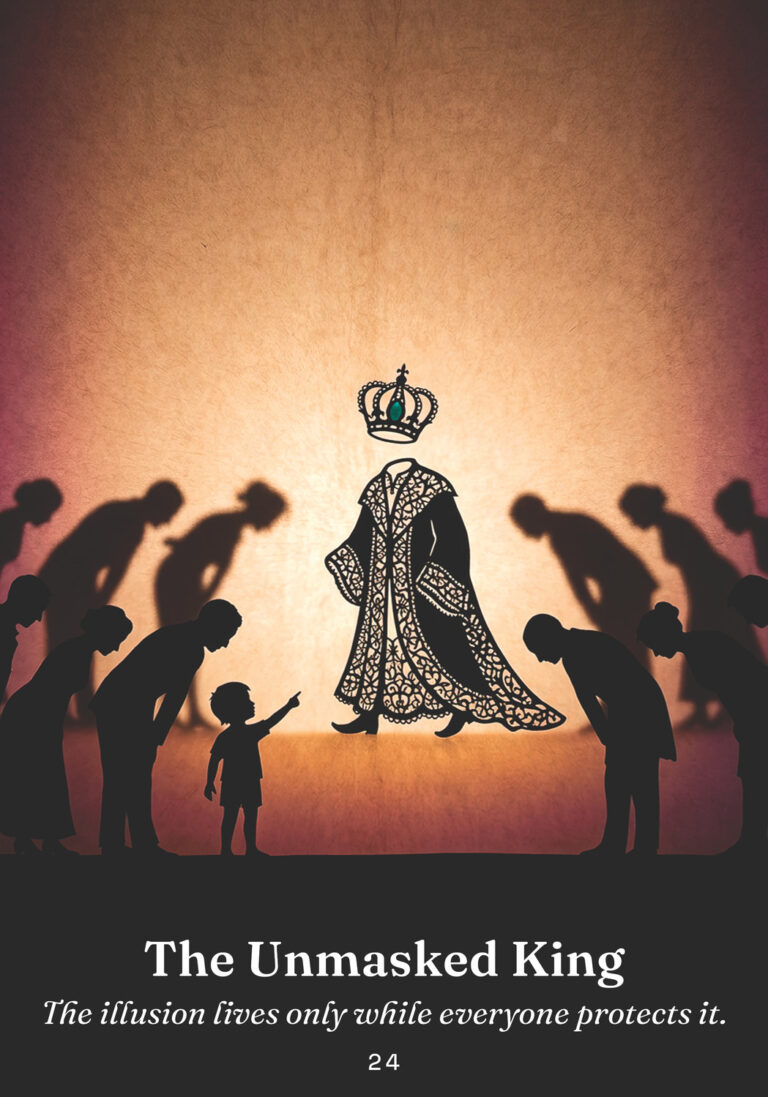
3 · The Move
The illusion lives only while everyone protects it.
A whole city admires the invisible robe until a child says otherwise. The move is a sentence, said plainly, in a room where everyone has agreed not to. The card refuses to assign me a part: I may be the child, I may be the crowd, and finding out is the work. Its shadow is weaponizing the embarrassment, which is not what this is for.
Read together
The arrangement is not fine, and calling it fine has been a skill rather than a mistake. What I know does not resolve into one verdict, and I have been using that as permission to say nothing. The move is one plain sentence in a room where nobody has said one. Not an ultimatum. A sentence, offered without needing to be the only person who says it.
If you have known something for a while, lay the three cards now. The reading tool below lays these same three positions with The Trickster Oracle.